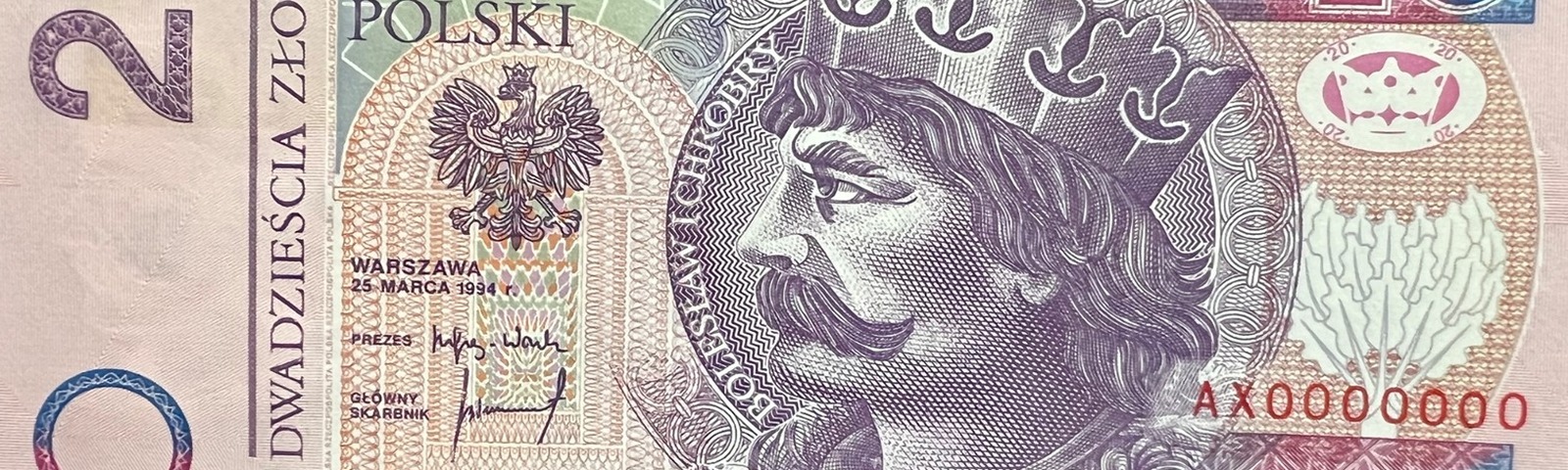
Polish Banknotes 1994 – Specimen Series and Unrecorded Types
When Poland introduced its modern złoty on March 25, 1994, the headlines focused on stability and a fresh national design. Yet behind that launch was a quieter story — one involving specimens, test printings, and approval notes that were never meant to circulate. Some slipped into collections, others remained in printer archives, and a few have only surfaced in recent years.
The examples presented here extend beyond what appears in Czesław Miłczak’s catalog, the Standard Catalog of World Paper Money (Pick), or even PMG population data. These notes were always out there — hiding in plain sight — but went unrecognized until now.
This site brings that hidden layer of the 1994 issue into full view. Notes once dismissed as rumors or “white crows” — a Polish expression for something almost impossibly rare — are documented here with clear evidence and high-resolution study images. Some trace directly to confirmed PWPW and Thomas De La Rue production work, while others appear to be one-off anomalies that never reached official records. Together they reveal how Poland’s first modern currency was conceived, tested, and refined. Explore the research here.
A New Era for Poland’s Currency
In 1995, following redenomination, the National Bank of Poland released a new series dated March 25, 1994 — the first issue of the modern złoty (PLN) replacing the old PLZ. Designed by Andrzej Heidrich, the series unified artistry, history, and security into one visual identity. The result was a family of notes that symbolized national renewal and set new standards for Polish banknote design.
Denominations and Designs
- 10 PLN – Mieszko I
- 20 PLN – Bolesław I the Brave
- 50 PLN – Casimir III the Great
- 100 PLN – Władysław II Jagiełło
- 200 PLN – Sigismund I the Old
- (500 PLN – John III Sobieski, added later, outside the 1994 issue)
Each note features a portrait of a Polish ruler on the front, paired with architecture, heraldry, or symbolic scenes from their reign on the back.
Security Features of the 1994 Issue
- Watermark – a secondary portrait image embedded in the paper, visible when held to the light.
- See-through register – a recto-verso crown printed on both sides of the note that aligns perfectly when viewed against the light.
- Security thread – a clear embedded thread within the paper, containing repeating microprinted inscriptions, visible when held to the light.
- Raised intaglio printing – tactile printing used for portraits, denominations, and key inscriptions, allowing the design to be felt by touch.
- Complex guilloché patterns – dense, overlapping geometric line structures forming the background and borders, designed to resist scanning and photocopying.
- Latent image (angle effect) – the denomination numeral becomes visible when the banknote is tilted at a specific angle.
- UV elements – fluorescent fibers and inks visible under ultraviolet light.
What is a Specimen?
A Specimen (pattern or reference note) is a banknote produced within the banknote manufacturing process for purposes of approval, control, reference distribution, or archival documentation – never intended for circulation. Specimens do not exist in a single uniform form, but appear in several distinct configurations corresponding to different control and documentation stages.
In practice, Polish banknote specimens can be identified by the following characteristics and execution types:
- a characteristic serial number “0000000”, most commonly with the AA prefix, and more rarely with other prefixes used at the testing and reference stages,
- in the case of PWPW control markings – a red “WZÓR” overprint on the obverse and a red “SPECIMEN” overprint on the reverse,
-
in the case of Thomas De La Rue (London) control markings – a set of
characteristic features, including:
- red “SPECIMEN” overprints on both obverse and reverse,
- a red oval stamp “SPECIMEN OF NO VALUE / DE LA RUE”,
- two round punch holes piercing the banknote.
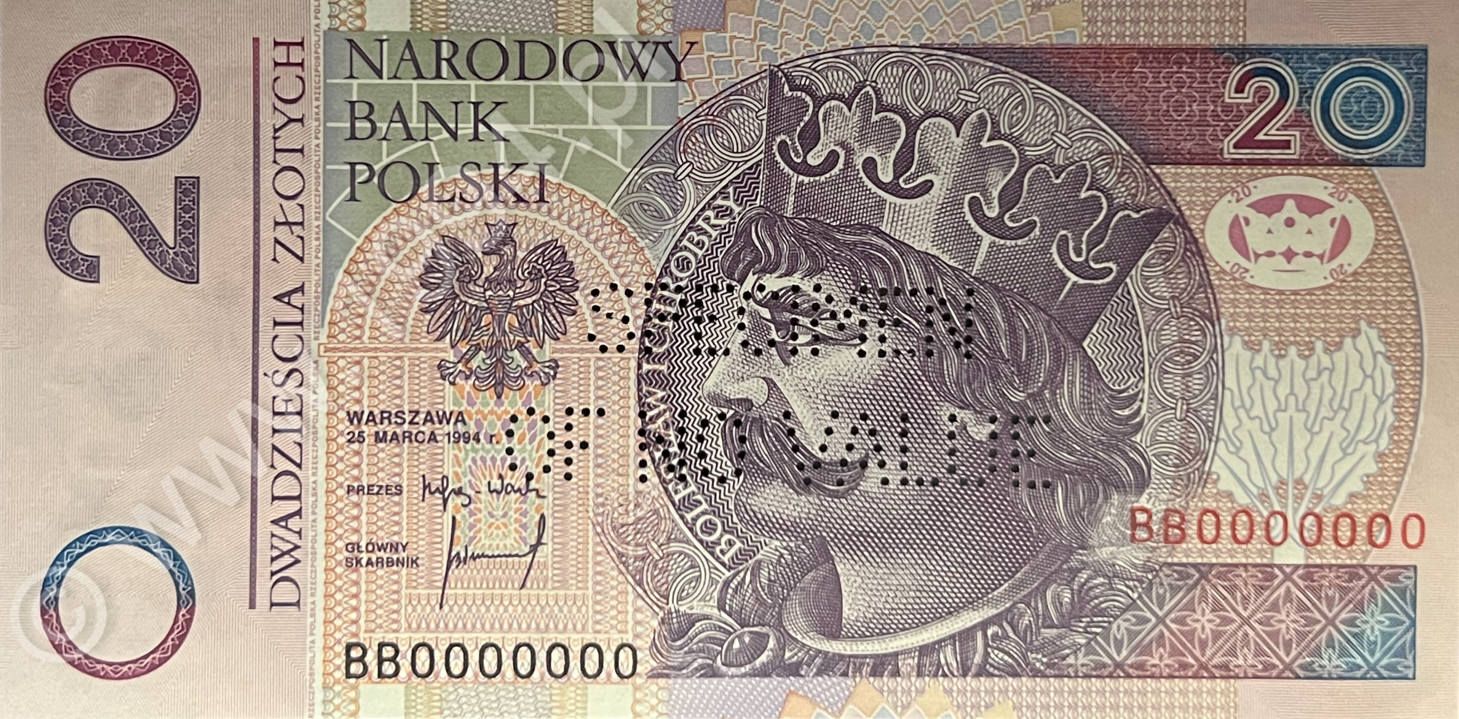
- the existence of perforated specimens bearing the inscription “SPECIMEN OF NO VALUE”, representing the final archival form of specimen invalidation,
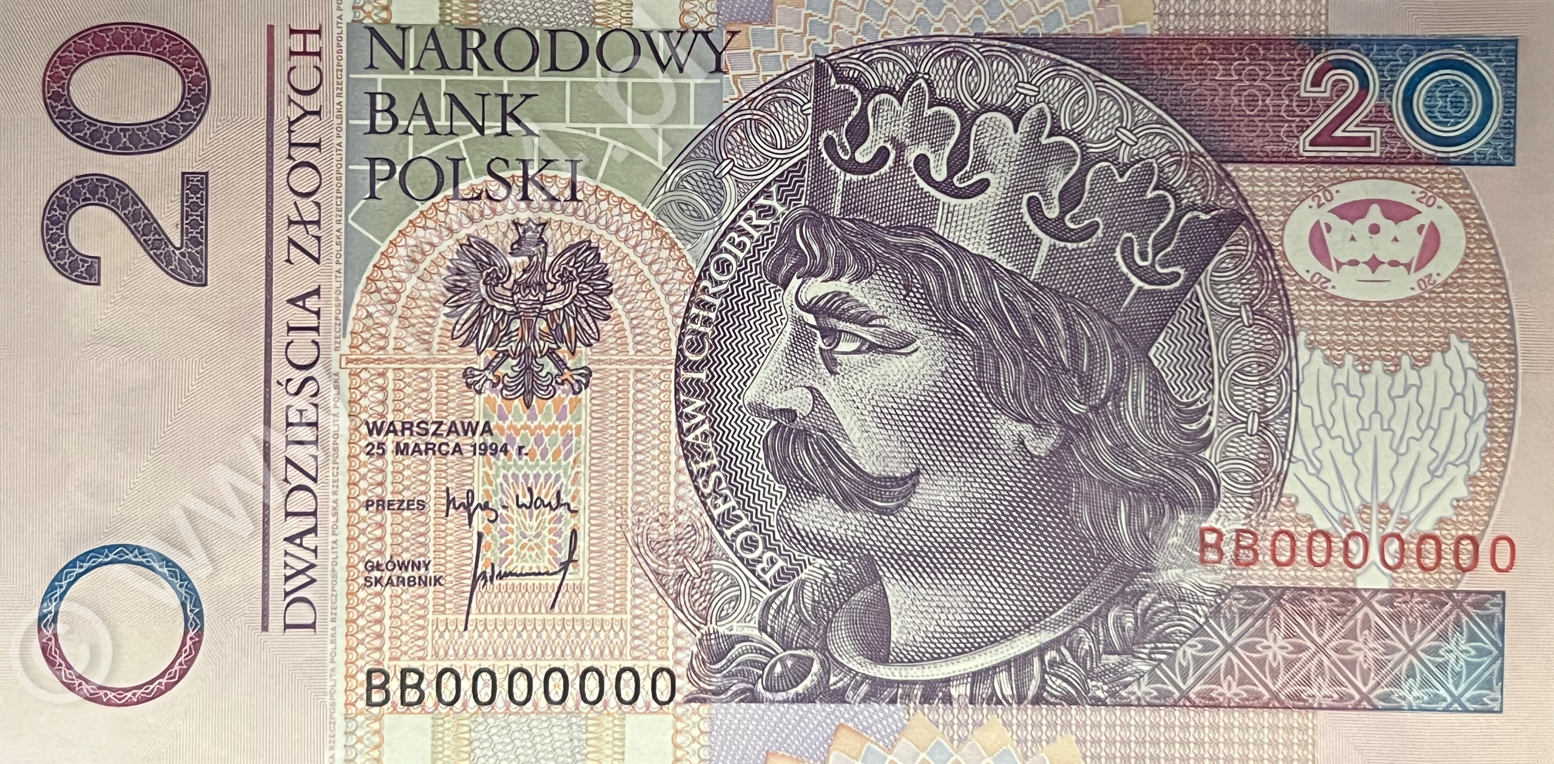
- the existence of approval specimens without any overprints or perforations, preserving the full appearance of a circulation note while serving as formal approval of the design and security layout,
- an additional identifier in the form of a specimen number, applied by the printer for registration and control purposes – appearing on PWPW-controlled examples as WZÓR Nr and on TDLR-controlled examples as SPECIMEN Nº,
- print quality, paper, and security features identical to those of regular circulation notes, confirming their production within the same technological process.
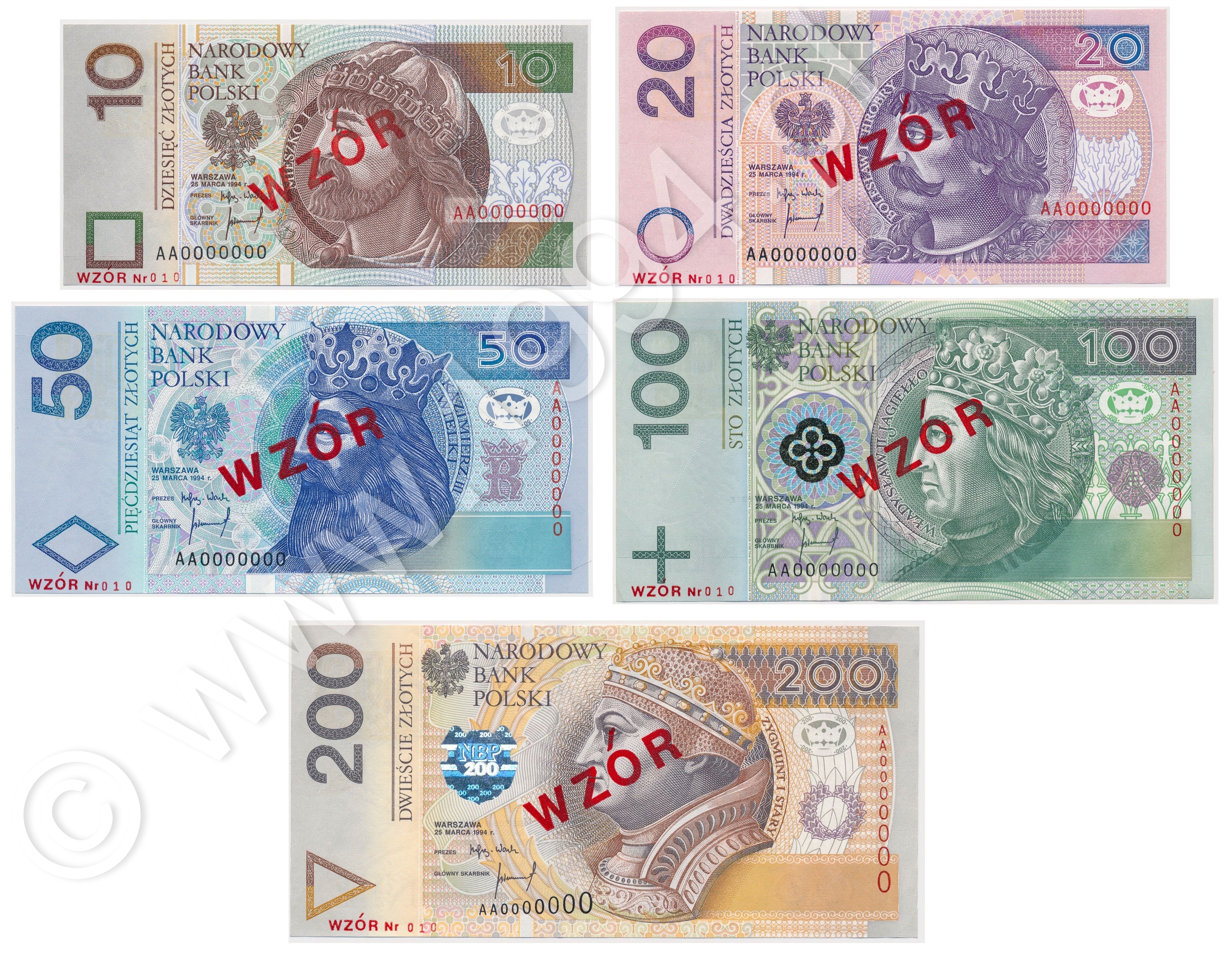
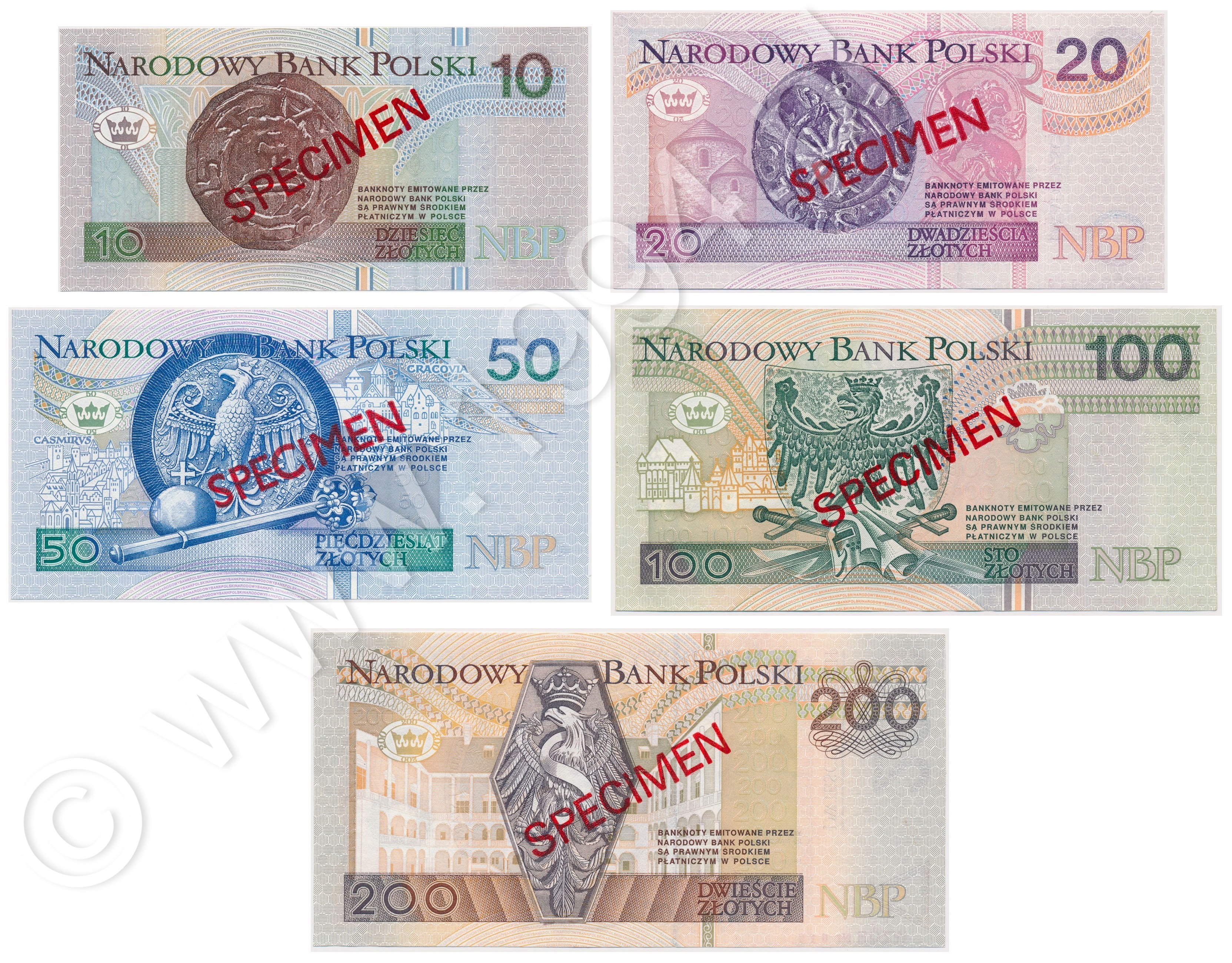
Specimens from the 1994 issue are rare; they were distributed mainly to central banks, museums, and select institutions. On the collectors’ market they are highly sought after, especially in uncirculated (UNC) condition.
Behind the print run: The 1994 notes were designed in Poland, but the first sheets rolled off the presses in London. De La Rue underbid the Warsaw mint by more than 30%, and the National Bank quickly accepted. Time was short — redenomination was only approved in July 1994, but the new złoty had to enter circulation the following year. PWPW couldn’t meet the deadline alone, so Thomas De La Rue took on the job. They printed the entire A–B prefix runs and even part of the C series for the 50-złoty note. Back in Warsaw, production always restarted with DA, which is why the elusive “C” series is absent in most denominations — and in the case of the 50s, the run was cut off midstream.
Context and Collector Questions
Why do banknotes from the 1994 issue matter to collectors?
The 1994 series marks the completion of Poland’s post-denomination monetary reform and represents the first fully unified, modern banknote system of the Third Republic.
Beyond availability or condition, these notes are valued for their documentary role: they record how the new currency was designed, approved, and formally introduced into use.
Are 1994 banknotes still legal tender?
Yes, all denominations from the 1994 issue remain legal tender in Poland.
From a numismatic perspective, however, collector focus is directed toward non-circulating material—specimens and approval notes—which were never intended for everyday use and retain an archival, rather than transactional, character.
Is a specimen without overprints a distinct type?
Yes. The absence of overprints, stamps, or perforations does not indicate an incomplete note, but a separate approval stage.
Such examples document the moment at which a design, layout, and security structure were formally accepted for production and are identified in serious collections as approval specimens, treated as a distinct category.
What role does grading play for reference and specimen notes?
Grading does not alter the documentary nature of a specimen or transform it into a circulation issue.
Instead, it provides authentication, consistency, and a shared point of reference, allowing examples to be compared objectively and positioned accurately within private and institutional collections.
How should archival and specimen banknotes be stored?
Proper storage requires chemically neutral holders or grading capsules, stable humidity and temperature, and protection from ultraviolet light and mechanical pressure.
These measures preserve the paper structure and ensure long-term archival stability.
The long-term importance of the 1994 issue is defined not by its role as spendable money or face value in circulation, but by its historical context, production function, and documentary integrity.
Prefix Distribution and Replacement Series
The table below shows the prefix distribution for all denominations of the 1994 Polish banknote series, divided between printing by TDLR (London) and PWPW (Warsaw). For every denomination, domestic Polish printing began with the prefix D, regardless of where the London print runs ended.
| Denomination | TDLR Prefixes (London) | PWPW Prefixes (Warsaw) | Notes |
|---|---|---|---|
| 10 zł | AA – BZ | DA – KI | C prefix not used |
| 20 zł | AA – BF | DA – GY | C prefix not used |
| 50 zł | AA – CJ | DA – HI | The only denomination with a partial C prefix used by TDLR; not continued in Poland |
| 100 zł | AA – BQ | DA – JR | C prefix not used |
| 200 zł | AA – AR | DA – DY | Very short print run; multiple replacement series issued |
In summary: for every denomination, PWPW began printing with prefix D. The C prefix does not appear in regular production (with the sole exception of a partial TDLR run for the 50 zł note).
Replacement Series
Replacement series (commonly known as star notes) were special print runs produced to replace sheets damaged or rejected during production. Instead of reusing identical serial numbers, printers employed separate prefixes to clearly distinguish these replacements from regular issues.
For the 1994 series, TDLR consistently used a single replacement prefix: ZA, across all denominations. In contrast, PWPW introduced its own sequence of replacement prefixes, beginning with YA and continuing alphabetically (YB, YC, YD, and so on).
This system allows collectors to identify replacement notes immediately. In practice, replacement series are significantly scarcer and more desirable, as their print quantities were many times smaller than those of regular production.
The table below summarizes the replacement prefixes used for each denomination, shown separately for TDLR and PWPW printing.
| Denomination | TDLR (London) | PWPW (Warsaw) |
|---|---|---|
| 10 zł | ZA | YB, YC, YD, YE, YF, YG |
| 20 zł | ZA | YB, YC, YD, YE, YF |
| 50 zł | ZA | YA, YB, YC, YD |
| 100 zł | ZA | YA, YB, YC, YD, YE, YF, YG, YH, YI, YJ, YK, YL, YM, YN |
| 200 zł | ZA | YA, YB, YC |
In short: TDLR relied on a single universal replacement prefix (ZA), while PWPW implemented its own expanding replacement system (YA, YB, YC…), reflecting a different internal approach to print control.
Printing in London (TDLR) and in Poland (PWPW)
The banknote series dated 25 March 1994 was produced at two locations: in London by Thomas De La Rue & Company, Limited (TDLR), and domestically in Poland by the Polish Security Printing Works (PWPW). Below is a practical comparison of the characteristics most relevant to collectors.
| Feature | TDLR – London | PWPW – Poland |
|---|---|---|
| Printing location | Thomas De La Rue, London | Polish Security Printing Works |
| Print character | Sharper contours and more saturated guilloche colours | Slightly softer tones with finer line structure |
| Paper | Smoother surface and more uniform texture | Slightly rougher paper feel |
| Market availability | Extremely rare; only a handful of examples have appeared on the collectors’ market over the last three decades | Also scarce; PWPW WZÓR / SPECIMEN notes appear sporadically, mostly in lower denominations, while higher denominations are virtually unobtainable |
Example of All Known 10 zł Variants (1994 Issue)
| Series | Type / Variation | Pick# | CM# | Prefix Range | Printer |
|---|---|---|---|---|---|
| 1st Series (TDLR) | Issued | 173a | 196a | AA–BZ | TDLR |
| 1st Series (TDLR) | Replacement | 173a* | 196c | ZA | TDLR |
| 2nd Series (PWPW SA) | Issued | 173a | 196b | DA–KI | PWPW SA |
| 2nd Series (PWPW SA) | Replacement | 173a* | 196d | YB, YC, YD, YE, YF, YG | PWPW SA |
| Specimens (Prefix AA) | “WZÓR” overprint | 173s | 196Wa | AA | TDLR |
| Specimens (Prefix AA) | “SPECIMEN” overprint & oval stamps | 173as | 196Wb | AA | TDLR |
| Specimens (Prefix AA) | Approval specimen w/out overprint | Unlisted | 196Wc | AA | TDLR |
| Specimens (Prefix AA) | Perforated “SPECIMEN OF NO VALUE” | Unlisted | Unlisted | AA | TDLR |
| Specimens (Other prefixes) | “SPECIMEN” overprint & oval stamps | Unlisted | Unlisted | BB, BK, BQ... | TDLR |
| Specimens (Other prefixes) | Approval specimen w/out overprint | Unlisted | Unlisted | BB, BK, BQ... | TDLR |
| Specimens (Other prefixes) | Perforated “SPECIMEN OF NO VALUE” | Unlisted | Unlisted | BB, BK, BQ... | TDLR |
Documented & Unrecorded Types — Polish Banknotes, 1994 Issue
A type describes any banknote that differs in a meaningful, production-level way from the regular circulation issue. Such differences may include the serial prefix, printing location, method of cancellation, the presence of overprints or perforations, or the deliberate absence of any markings at all. In the 1994 Polish series, unmarked approval notes are just as significant as those carrying stamps or perforations.
The examples shown below use the 20-złoty denomination to illustrate the full range of known specimen and approval states. The long-established AA prefix is contrasted with the BB prefix, a configuration only recently documented and previously unknown in the literature. Together, they demonstrate how different production paths generated distinct, collectible types.
To examine the complete structure in detail, see the fully illustrated 20-złoty reference sequence , which presents all currently documented types — including circulation issues, replacement notes, specimen variants, and unmarked approval forms.
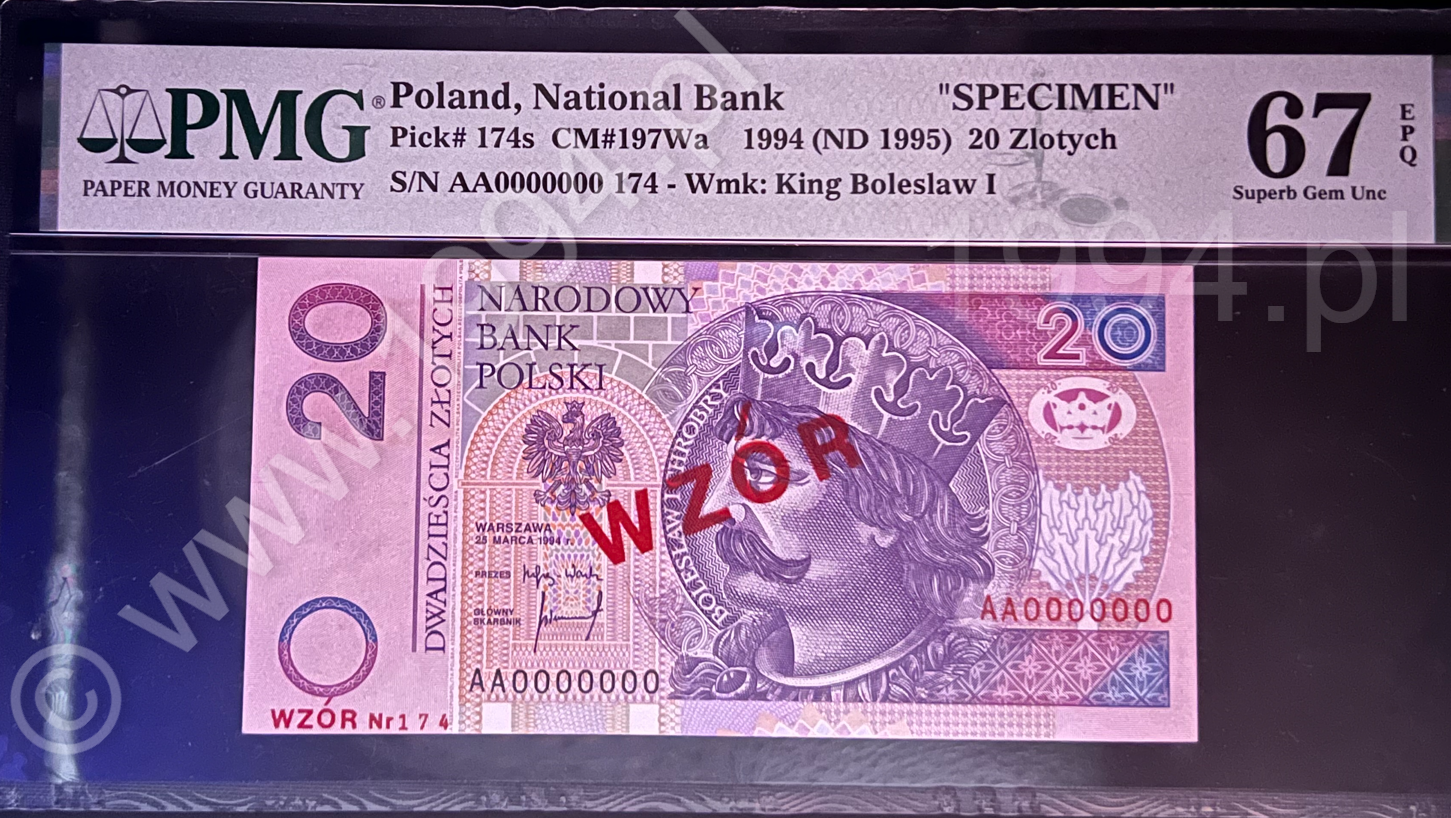
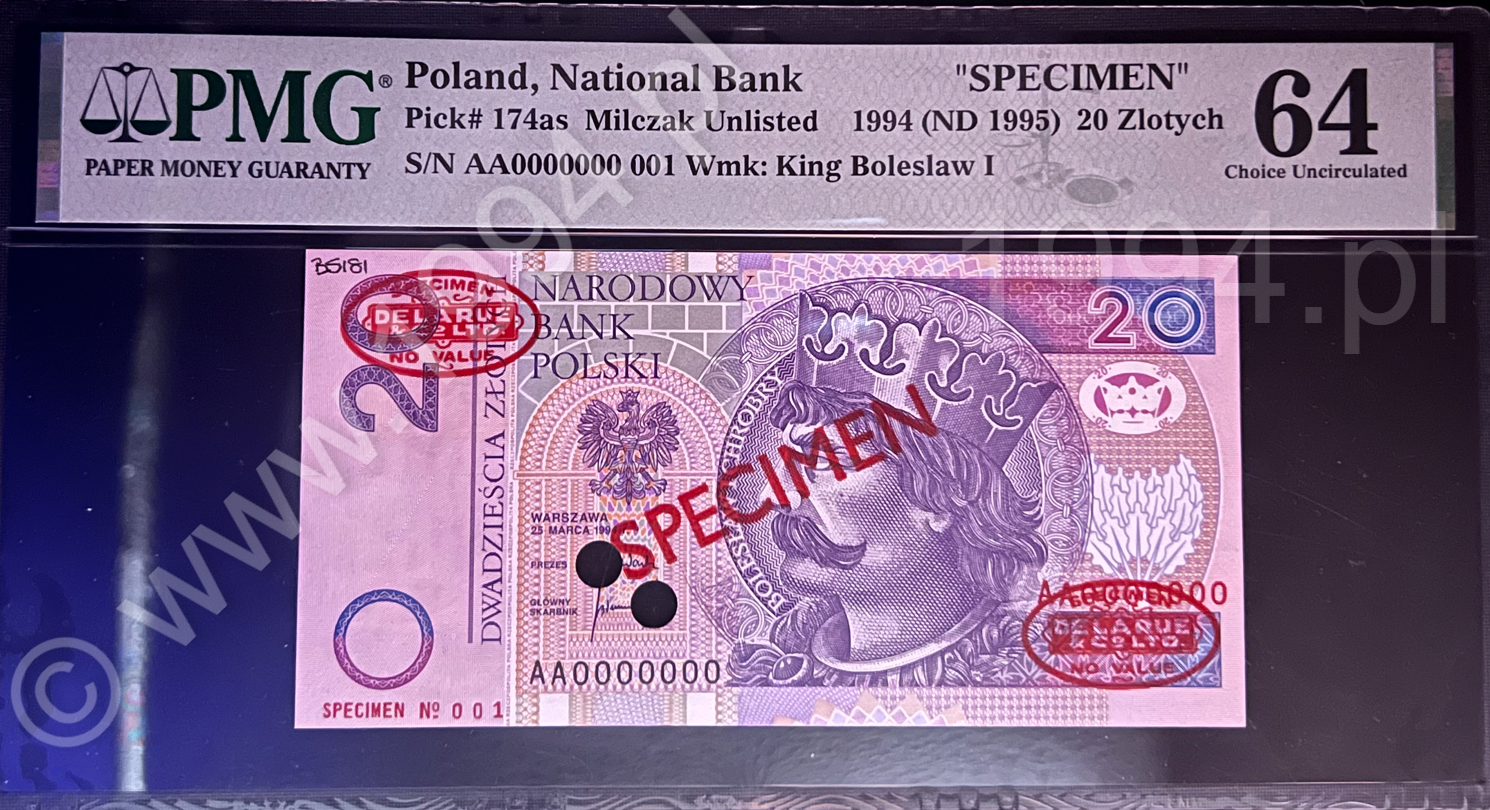

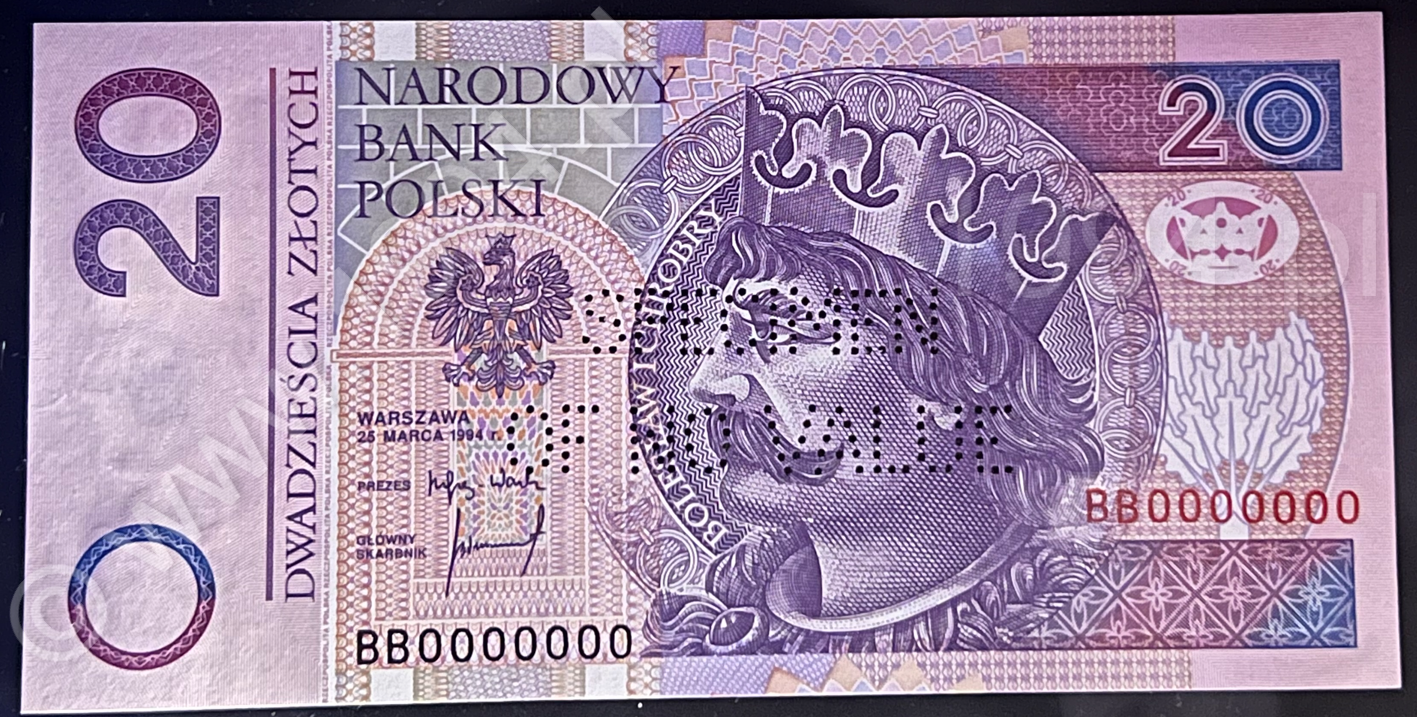

Complete Overview of Variants — Illustrated by the 1994 20 Złoty Note
According to the classification used by Czesław Miłczak, the letters a, b, c, d designate circulation and replacement issues, while Wa, Wb, Wc refer to specimen / WZÓR types. The variant Wd (perforated specimen) is not listed in Miłczak’s catalog; the designation Wd is an author-introduced term used here to logically extend the established sequence and clearly distinguish this form.
Below is the complete set of eight known variants of the 20 zł banknote from the 1994 issue:
| Czesław Miłczak catalog | Variant description | Pick catalog |
|---|---|---|
| 197a | Circulation issue (printed by De La Rue) | 174a |
| 197b | Circulation issue (printed by PWPW) | 174a |
| 197c | Replacement issue (printed by De La Rue) | 174a* |
| 197d | Replacement issue (printed by PWPW) | 174a* |
| 197Wa | PWPW specimen with red “WZÓR” overprint | 174s |
| 197Wb | TDLR specimen with red “SPECIMEN” overprint and oval De La Rue stamp; Miłczak records this variant only with prefix AA | 174as |
| 197Wc | Approval specimen without overprints; Miłczak records this variant only with prefix AA | Pick unlisted (174bs) |
| 197Wd | Specimen with perforation “SPECIMEN OF NO VALUE”; not recorded by Miłczak (Wd is an author’s classification) | Pick unlisted (174cs) |
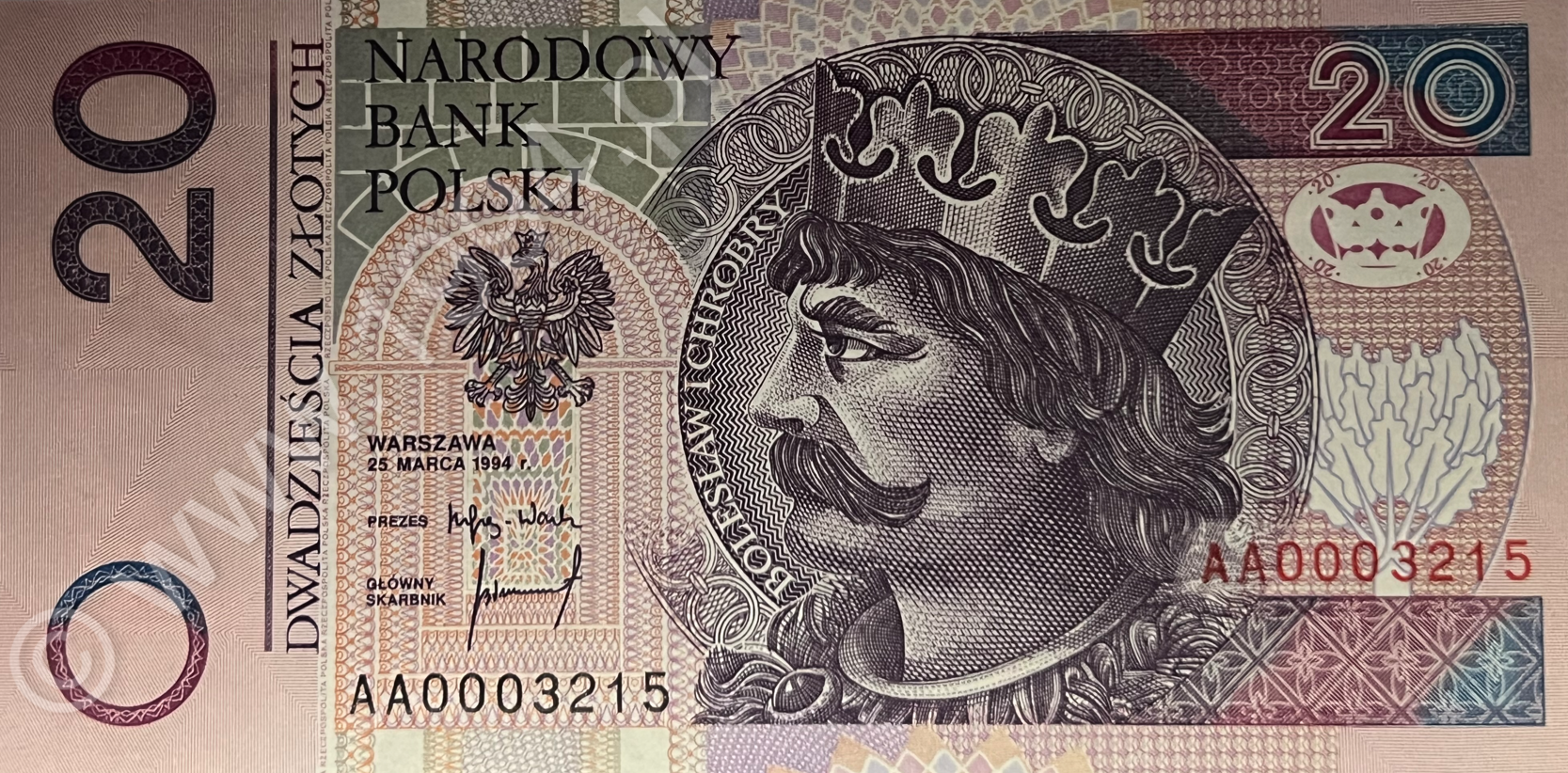
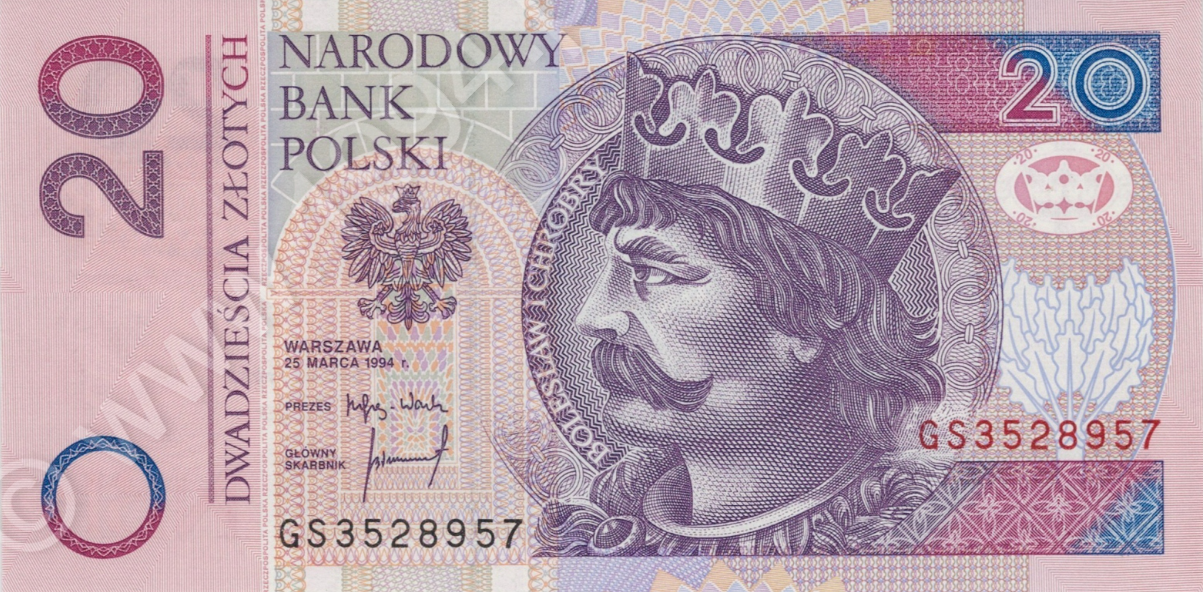
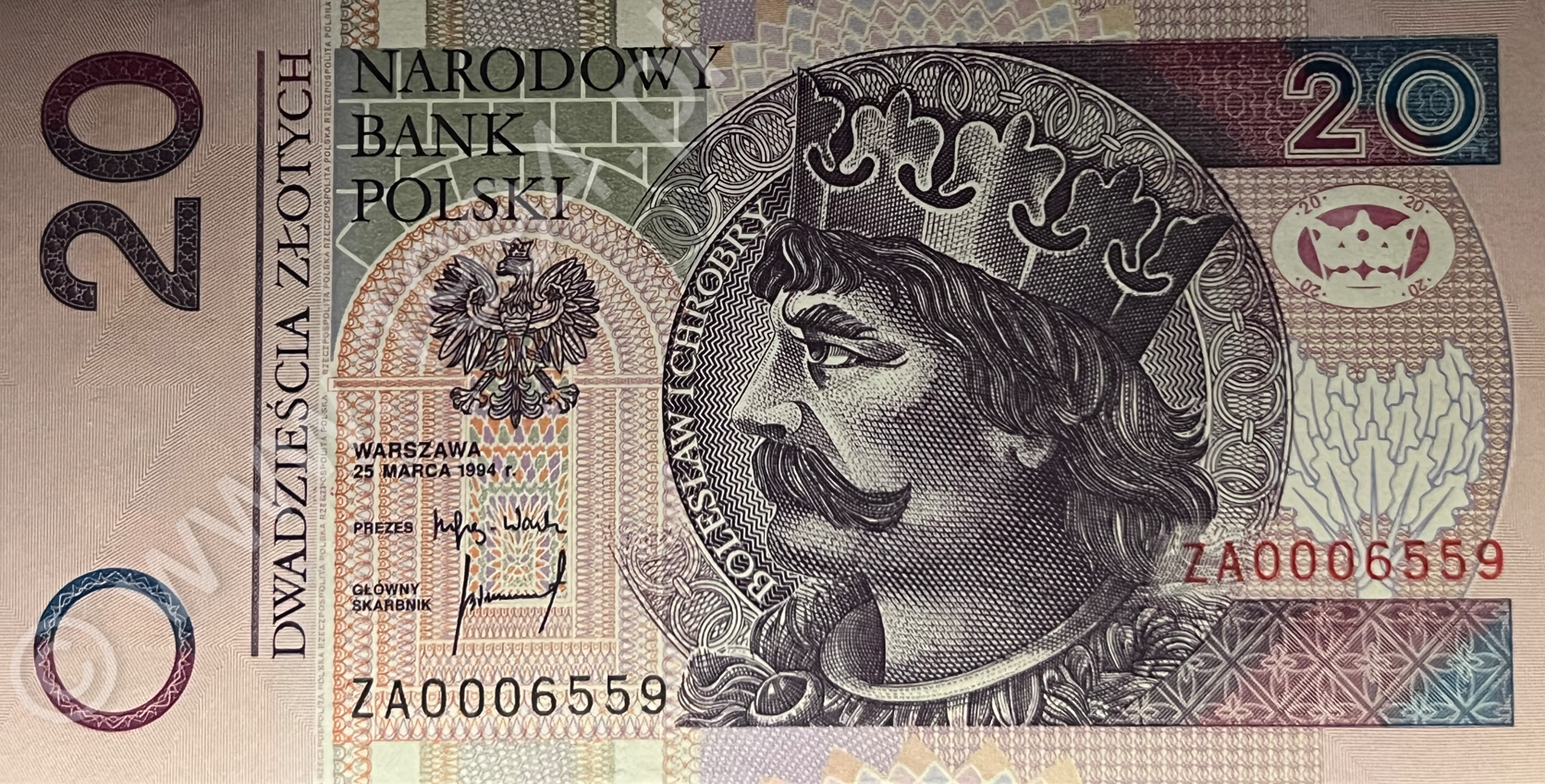
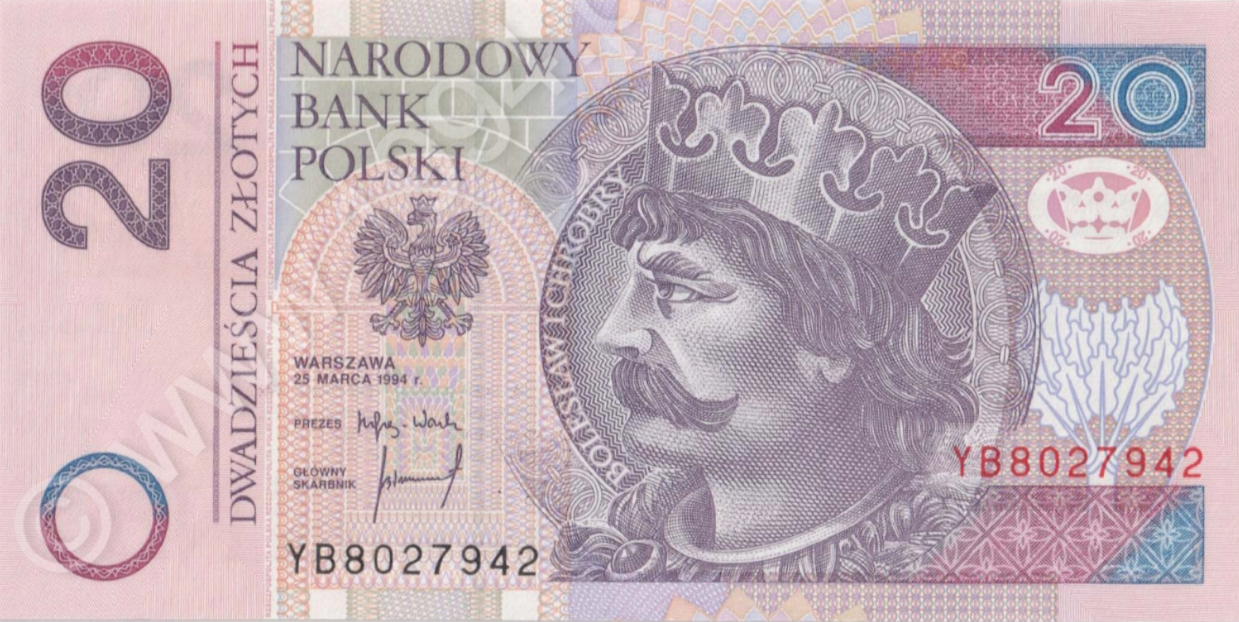
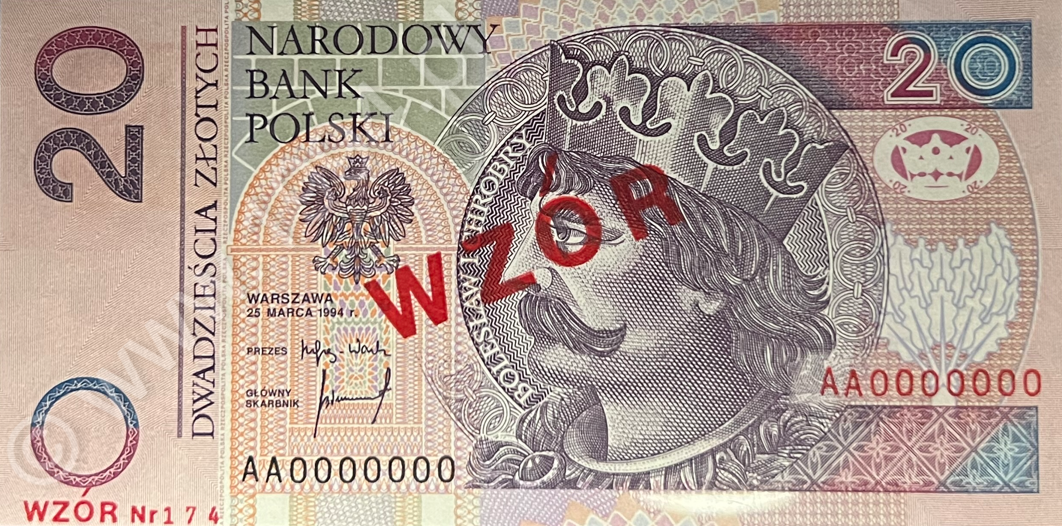
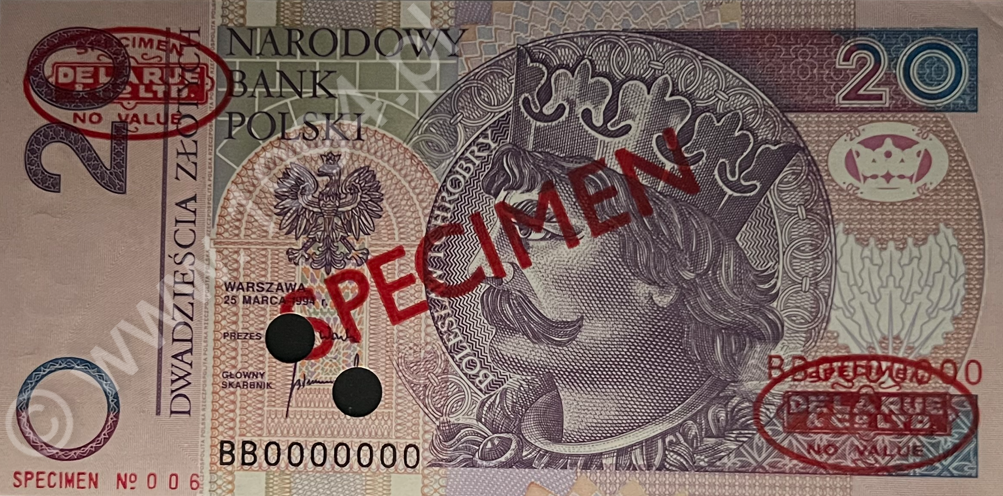
Contact
Questions, contributions, or additional images and variants to add? Write to: info@1994.pl
Bibliography & sources
- Czesław Miłczak, Katalog banknotów polskich
- Standard Catalog of World Paper Money (Pick)
- NBP articles and materials
- Archival auctions: OneBid, Heritage, and others
- PMG publications ( Paper Money Guaranty )
This section is being expanded on an ongoing basis. Links to external sources will be added later.