Description and research notes
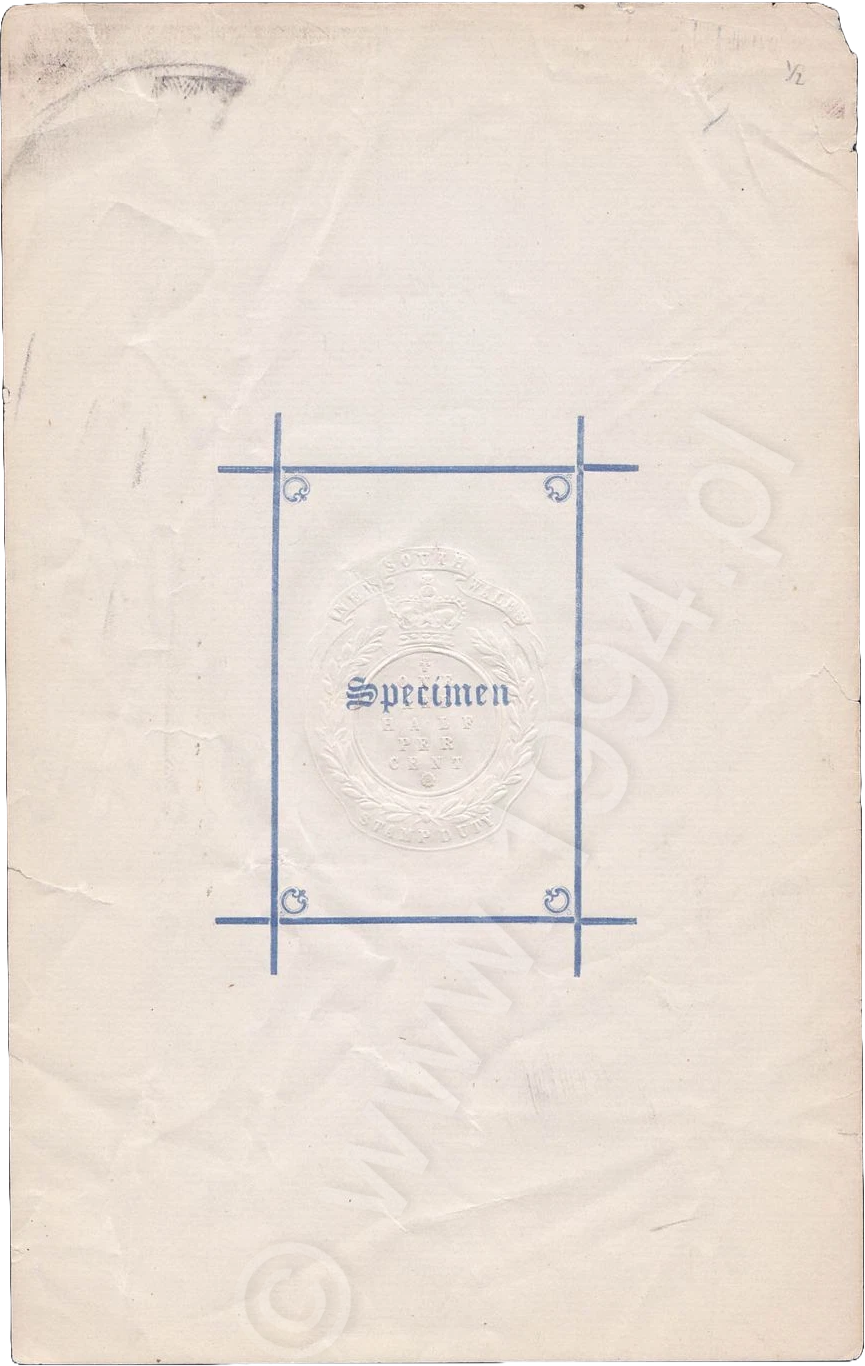
This archival embossed proof was prepared for the Treasury of the Colony of New South Wales in 1865 as part of the design approval process for official stamp duty revenue paper. The piece displays the crowned colonial arms surrounded by a laurel wreath with the inscription 'ONE HALF PERCENT', executed in colourless embossing and framed by printer’s blue layout guide lines with a printed 'Specimen' designation.
Unlike adhesive revenue stamps, this form of fiscal authentication was produced as embossed security paper intended to validate legal and financial documents. The inscription 'ONE HALF PERCENT' represents an ad valorem duty rate applied to instruments such as bonds, contracts, and high-value agreements where the tax was calculated as a percentage of the transaction value rather than as a fixed denomination.
The proof is printed on watermarked paper manufactured by Cowan & Sons, one of the principal British suppliers of high-grade security paper during the nineteenth century. Such paper stocks were widely used for government revenue instruments and later for colonial banknotes. The presence of Cowan paper reflects the integration of New South Wales fiscal printing into the broader British security printing industry.
The embossing itself was almost certainly executed by Thomas De La Rue & Company in London, which served as a primary supplier of colonial revenue dies and printing services during this period. Embossed die proofs such as this were created so that government officials could inspect the quality of the engraving and confirm the alignment of the die before authorizing full production of the fiscal paper.
Because these proofs were working approval materials rather than issued fiscal documents, most examples were destroyed after printing commenced. Surviving sheets that retain the printer’s blue framing guides and 'Specimen' designation provide rare documentation of the early stages of colonial security printing. As such, this piece represents a direct witness to the administrative and technical foundations of fiscal printing in nineteenth-century Australia.