Description and research notes
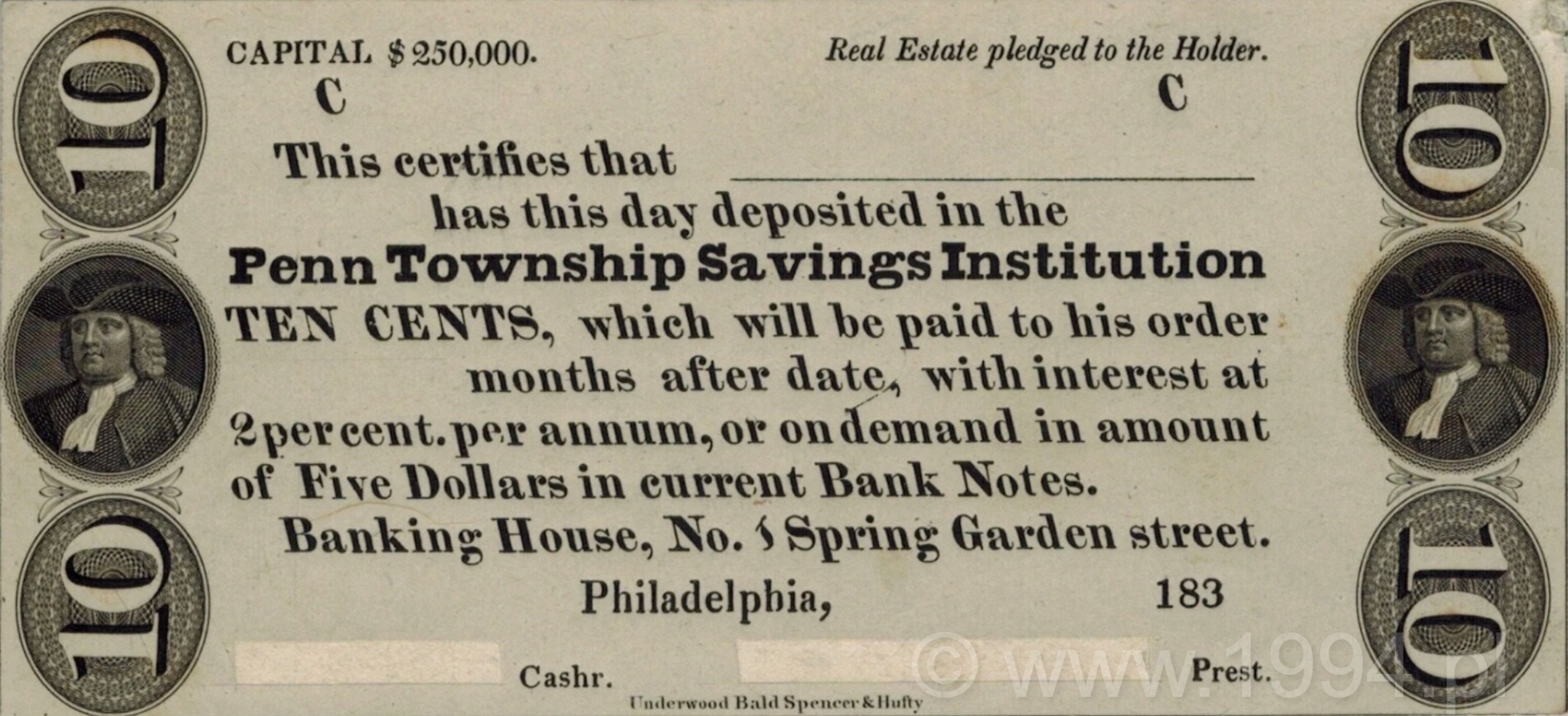
This engraved proof note was prepared for the Penn Township Savings Institution of Philadelphia, Pennsylvania, during the early 1830s. Rather than serving as circulating currency, the document represents a fractional savings deposit certificate issued by one of the many mutual savings institutions that emerged in American cities during the early nineteenth century.
The text of the instrument reveals its purpose: a depositor places ten cents with the institution, which promises repayment with interest at two percent per annum, or redemption on demand once the accumulated balance reaches five dollars in current bank notes. Such certificates allowed working-class depositors to save in extremely small increments, effectively functioning as an early micro-savings system decades before formal savings accounts became widespread.
The design prominently features paired engraved portraits of William Penn, founder of the Pennsylvania colony, reinforcing the civic identity and trustworthiness of the institution. Large denomination counters reading '10' appear at the margins, while the central obligation text certifies the deposit with the Penn Township Savings Institution located at the Banking House on Spring Garden Street in Philadelphia.
An important line printed across the top reads 'Real Estate pledged to the Holder,' indicating that deposits were secured by mortgage-backed assets. This was typical of early American savings banks, which invested depositor funds in real estate loans and advertised that collateral publicly to reassure small savers of the institution’s solvency.
The engraving was executed by the Philadelphia firm Underwood, Bald, Spencer & Hufty, one of the prominent American security printers active before the later consolidation of major banknote engravers into the American Bank Note Company. Their work here demonstrates the refined steel engraving style characteristic of pre-Civil War American security printing, combining strong typographic layout with finely executed portrait vignettes.
Proof impressions such as this were produced for internal approval and archival reference prior to printing the circulating certificates. Most were discarded after the design was finalized, making surviving proofs from small Philadelphia savings institutions extremely rare.
As a historical artifact, the piece documents the intersection of early American banking, working-class savings culture, and the development of security printing in the decades before the Civil War.