Description and research notes
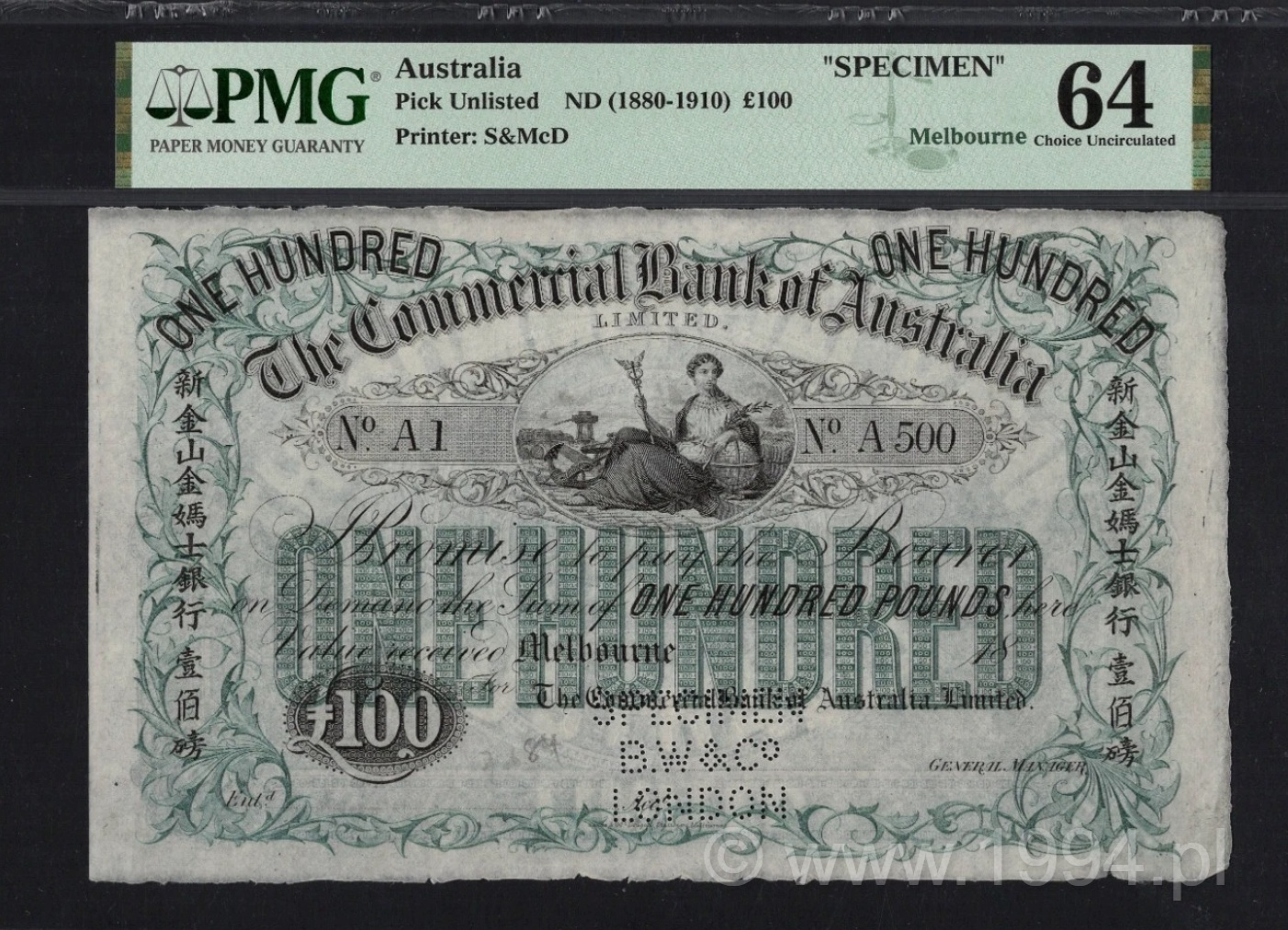
A monumental survivor from Australia’s private banking era, this £100 specimen ranks among the most important colonial-era notes known. Printed circa 1880–1910 for the Commercial Bank of Australia Limited, it represents the uppermost denomination produced under the private-issue system that existed before the Commonwealth took full control of note issuance in 1910. No issued examples of this £100 are believed to have survived, making specimens the only remaining documentation of the type.
Engraved by Bradbury, Wilkinson & Co. in London and printed locally by Sands & McDougall in Melbourne, the note embodies the cooperative evolution of Australian banknote production. Bradbury, Wilkinson supplied the master plates, security devices, and engraving framework, while Sands & McDougall executed local printing to supply the bank's circulation demands across Victoria and the wider Australian colonies. The imprint 'Bradbury, Wilkinson & Co., Engravers, London' confirms its master-plate origin, while the local printer’s marks establish the dual-track production typical of the late colonial banking era.
The central vignette features an allegorical figure of Commerce, holding a caduceus and globe, framed by intricate lathe-work and industrial motifs representing trade, manufacturing, and the expansion of colonial wealth. The vertical inscriptions in both Chinese and English remain one of the most unusual design choices of any 19th-century Australian note. The Chinese inscription reads '新金山金媽士銀行', literally identifying the institution as the 'New Goldfields' or 'New Gold Mountain Commercial Bank', with '金媽士' functioning as a Cantonese phonetic rendering of 'commercial'. The opening characters '新金山', New Gold Mountain, were a Chinese name associated with Victoria and Australia during the gold-rush era, distinguishing the Australian goldfields from the earlier 'Gold Mountain' of California.
The Chinese text was not an incidental decorative feature added to a later issue. It formed part of the Commercial Bank of Australia’s note design from the bank’s establishment in 1866. The winning note design announced in June 1866 specifically incorporated the bank’s name and the denomination in Chinese characters into the border. This was a deliberate commercial distinction aimed at Chinese customers at a time when Chinese merchants, miners, laborers, trading houses, and investors formed an important part of the Victorian economy. Contemporary reporting explicitly connected the Chinese inscriptions with the bank’s desire to attract Chinese depositors, making the notes an early and unusually direct example of financial-product localization and customer acquisition embedded in the currency itself.
That commercial strategy was reinforced at the institutional level. Prominent Chinese-Australian businessmen Lowe Kong Meng and Louis Ah Mouy were involved with the Commercial Bank of Australia from its foundation in 1866 and were among its important early shareholders, with both serving on the provisional committee. Kong Meng was one of colonial Victoria’s wealthiest merchants and Ah Mouy a leading businessman and Chinese community figure. Historical research directly links their involvement, and the bank’s Chinese inscriptions, with the desire to attract Chinese depositors and Chinese commercial business. The Commercial Bank therefore did more than acknowledge Victoria’s Chinese population: it incorporated Chinese recognition into the financial instrument itself as a competitive point of difference.
Very few banknotes from anywhere in the British Empire incorporated bilingual Chinese text in this way, making the type a highly significant survivor in both Australian and global numismatics. The note documents not only colonial banking and printing practice, but also the commercial integration of Chinese Australians into the economic life of 19th-century Victoria and one of the earliest documented examples of deliberate market localization expressed directly through a banknote.
This specimen carries prefix A1, placing it within the earliest control sequence (A1–A500). Evidence indicates that issued £100 notes were fully redeemed and destroyed, as high-denomination colonial notes typically had short life spans, strict redemption procedures, and low survival rates due to institutional consolidation. The perforated 'BW & Co LONDON' cancellation and printer annotations confirm that this example was withdrawn from production and preserved exclusively for archival or approval purposes.
The historical context of this note is equally important. Before the 1910 Australian Notes Act, each major commercial bank operated as both a private deposit institution and a note-issuing authority, backed by gold reserves and subject to varying degrees of colonial regulation. The Commercial Bank of Australia was among the most prominent issuers, and its large denominations were used for interbank settlement, bullion transactions, and wholesale commercial payments. These notes circulated in an economy that was rapidly industrialising and integrating into global commodity markets through wool, gold, minerals, and agricultural exports.
When the Commonwealth centralized currency authority in 1910 and later established the Australian Notes Branch (and eventually the Reserve Bank), nearly all private banknote issues were recalled and destroyed. As a result, only specimen or printer’s archival material survived for many denominations. For the £100 type, the absence of issued survivors underscores the near-total eradication of high-value private currency from the record.
Pick Unlisted and absent from major catalogues, this note represents the intersection of rarity, artistry, cultural history, and financial significance. As a design artifact, a Chinese-Australian commercial document, a surviving record of deliberate 19th-century financial localization, and a financial relic from the end of Australia’s private-banknote era, this piece is an educational cornerstone for advanced Commonwealth collections and a critical reference in the study of pre-federation monetary history.