Description and research notes
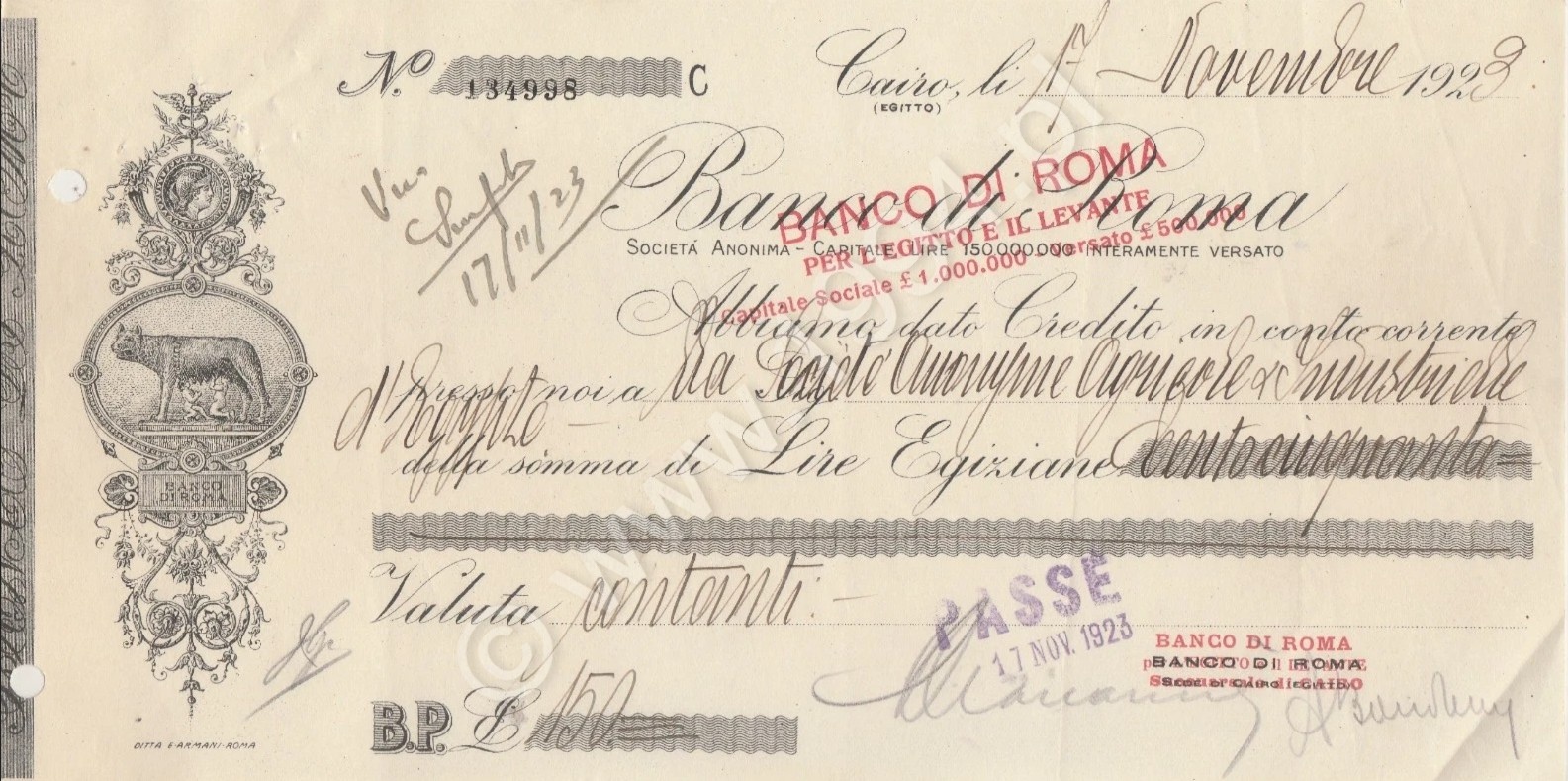
Original cheque issued by the Cairo branch of Banque Belge pour l'Étranger on 2 September 1918, produced during the final phase of the First World War. The form is printed on light cream security stock with a richly engraved Art Nouveau header. Along the left margin runs a vertical ornamental cartouche enclosing the bank’s interlocking monogram and the legend BANQUE BELGE POUR L'ÉTRANGER – LE CAIRE, framed by a list of the bank’s principal branches in BRUXELLES, LONDRES, ROTTERDAM, LE CAIRE, ALEXANDRIE, SHANGHAI, PEKIN and TIENTSIN. The wide geographical spread reflects the institution’s pre-war ambition to operate as a global correspondent house linking European capital with Asian and Middle Eastern commercial centers.
The cheque is completed in dark brown fountain-pen script with the date 'Le Caire, le 2 Septembre 1918' at top. The sum-cinquante neuf livres sterling, six shillings et onze pence-is written across a pink micro-lithographed security band designed to prevent alteration. The amount in sterling underscores the dominance of the British pound in wartime Egypt, where local institutions and foreign banks conducted high-value transactions in pounds due to currency stability and British political presence.
A large oval violet cachet of the Banque Foncière et Industrielle d'Égypte overlaps the left portion of the cheque, confirming the payee’s receipt of funds. Additional purple overprints reference the London correspondent office at 2 Bishopsgate, revealing how the cheque moved within the broader Anglo-Belgian clearing network. The lower section carries the Banque Belge Cairo branch signatures executed in heavy sweeping strokes, intersecting the printed title and validating the instrument with formal dual authorization.
The guilloche work-consisting of wave-patterned borders, fine line engraving, and micro-text-matches the high-security printing standards used by Belgian and French engravers during the 1910s. Such designs were produced not only to prevent forgery but also to visually convey the bank’s reputation and financial solidity during a period of global instability. Even in wartime, foreign banks in Egypt adhered to European-style aesthetic and technical requirements for their negotiable instruments.
Banque Belge pour l'Étranger played a discreet but significant role in Egypt’s wartime financial system. The bank provided sterling exchange, trade financing, documentary clearing, and short-term advances to commercial houses engaged in shipping, cotton brokerage, and military supply contracts. During World War I, Cairo functioned as a logistical and administrative hub for British forces in the Eastern Mediterranean, and foreign banks-Belgian, French, British, Italian, Greek-facilitated the movement of hard currency, letters of credit, and payment instructions across the region.
Surviving WWI-period cheques drawn by Banque Belge in Egypt are extremely scarce. Most were destroyed in interbank reconciliations, lost in postwar archival reductions, or discarded during institutional mergers. Complete examples retaining engraved borders, correspondent office overprints, payee cachets, and full manuscript entries are exceptionally rare. This 1918 specimen stands as a high-tier artifact of Belgian overseas banking operations in Egypt during the Great War and provides a primary-source window into the financial infrastructure that underpinned Egypt’s wartime commercial and administrative economy.