Description and research notes
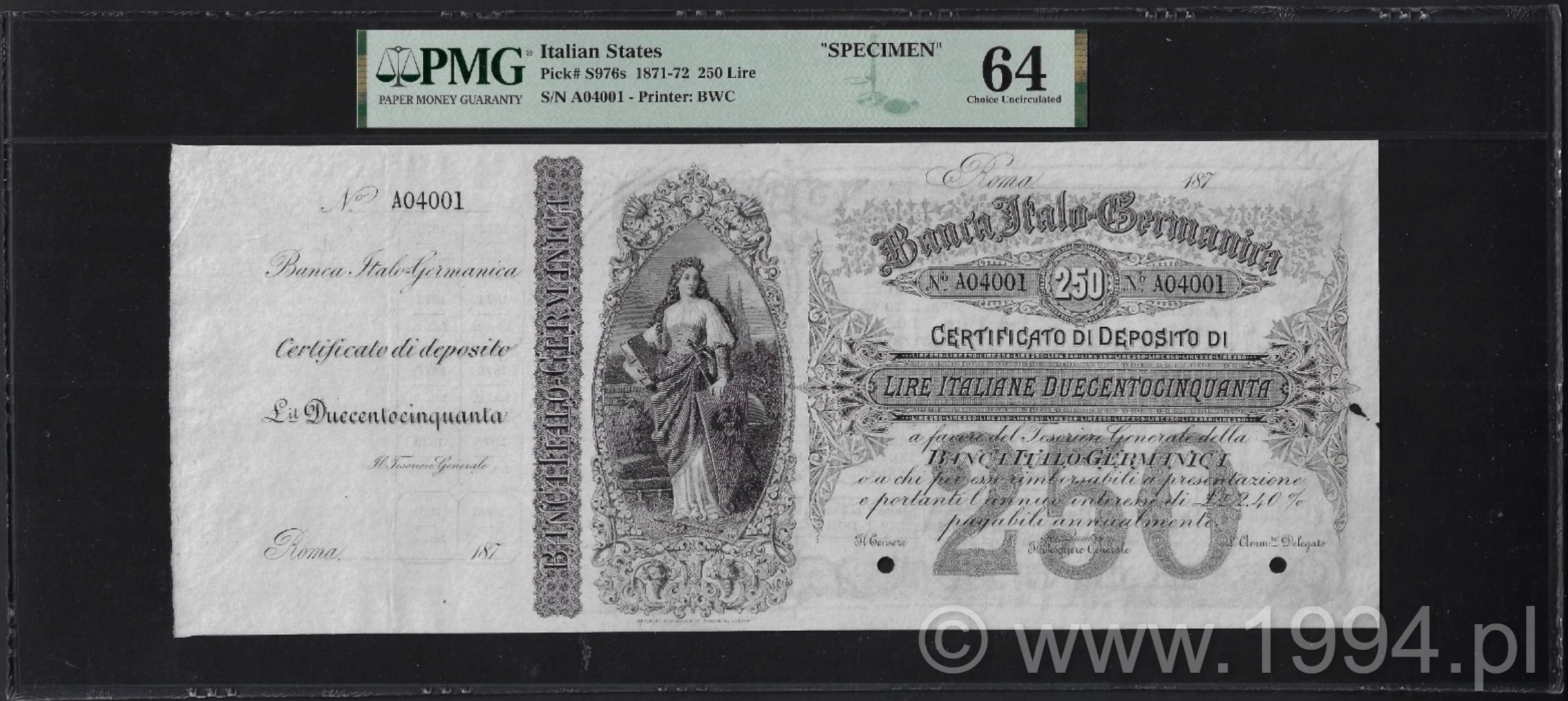
An exceptional and academically important survival from the experimental phase of Italy’s early post-unification banking era, this 250 Lire specimen from the short-lived Banca Italo-Germanica, cataloged as Pick S976s, represents one of the rarest and most ambitious private note-issuing projects attempted in Rome during the 1870s. No issued examples of this type are known to exist, and all scholarship indicates that the bank’s banknote program collapsed before any notes entered circulation, leaving only a microscopic number of presentation pulls, proofs, or internal printer’s archive sheets. This PMG 64 Choice Uncirculated example is the sole graded specimen in the PMG census, making it both Top Pop and Only Pop.
Produced by Bradbury, Wilkinson & Co. in London during the early stages of their European expansion, the engraving reflects a transitional moment in BWC’s development from commercial engravers into one of the world’s premier security printers. The deeply cut guilloches, vast empty margins, and sculptural allegory of Standing Italia exhibit a sophistication rarely seen on private Italian issues of the period. BWC’s design language of the 1870s-ornate, aspirational, and technically ambitious-foreshadows the company’s later dominance in colonial and European banknote engraving. As an artifact of design history alone, this note marks one of the earliest intersections between British engraving expertise and the newly unified Italian state.
The Banca Italo-Germanica was founded amid the financial turbulence that followed Italy’s political unification (1861) and the annexation of Rome (1870). The new nation lacked a centralized note-issuing authority, and private, regional, and foreign-funded institutions vied for influence in a chaotic and rapidly shifting monetary landscape. German capital poured into Rome hoping to shape the financial future of the new kingdom, and several ventures attempted to position themselves as potential proto-central banks. The Banca Italo-Germanica was one such institution, backed by foreign investors and driven by optimism about Italy’s industrial and political ascent.
However, reality diverged quickly from ambition. Regulatory barriers, political infighting, and a series of financial scandals undermined the feasibility of private note-issuing schemes. The Banca Italo-Germanica’s plans appear to have stalled almost immediately, with scarce evidence that more than a handful of specimen or proof notes were ever produced. There is no surviving archival footprint indicating any issued circulation, and researchers today rely almost entirely on these few surviving specimens to reconstruct the history of the bank’s brief existence.
The survival of this particular note is itself remarkable. Oversized, fragile, and produced on early BWC security paper, such pieces were highly vulnerable to destruction. Most unadopted private note designs were discarded by banks, burned during liquidation, or lost during institutional mergers. Specimens from failed Italian banknote issuers of the 1870s are almost nonexistent, and the Banca Italo-Germanica ranks among the most elusive of them all.
The note’s allegorical figure-Italia armed with shield and lance-embodies the nationalist mythmaking of the period, projecting unity, legitimacy, and sovereign stability at a time when the country’s financial systems were anything but stable. Its presence on a private banknote is historically significant: it illustrates how commercial institutions attempted to appropriate national symbols to bolster their credibility in a fragmented monetary ecosystem that lacked central authority. In this sense, the note functions both as a financial instrument and a cultural-political statement.
Rarity research places this specimen in the highest tier of European banknote scarcity. PMG lists exactly one graded example-this note-and no additional pieces have surfaced in major auctions, museum digitizations, or literature beyond isolated mentions in nineteenth-century trade records. In the absence of any documented issued notes and with no other certified specimens known, Pick S976s firmly qualifies within the R9 tier of extreme rarity.
As a museum-grade artifact of Italian financial history, a key reference piece for early Bradbury Wilkinson engraving, and one of the finest surviving private-banknote specimens from post-unification Italy, this 250 Lire note stands as a cornerstone in the study of failed monetary experiments and the evolution of modern Italian banking.


