Description and research notes
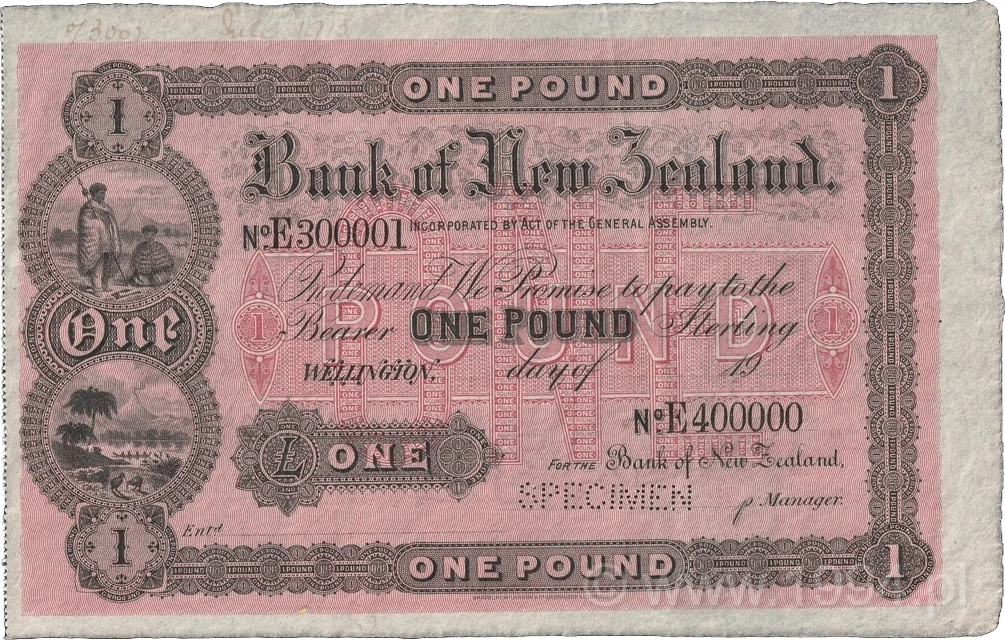
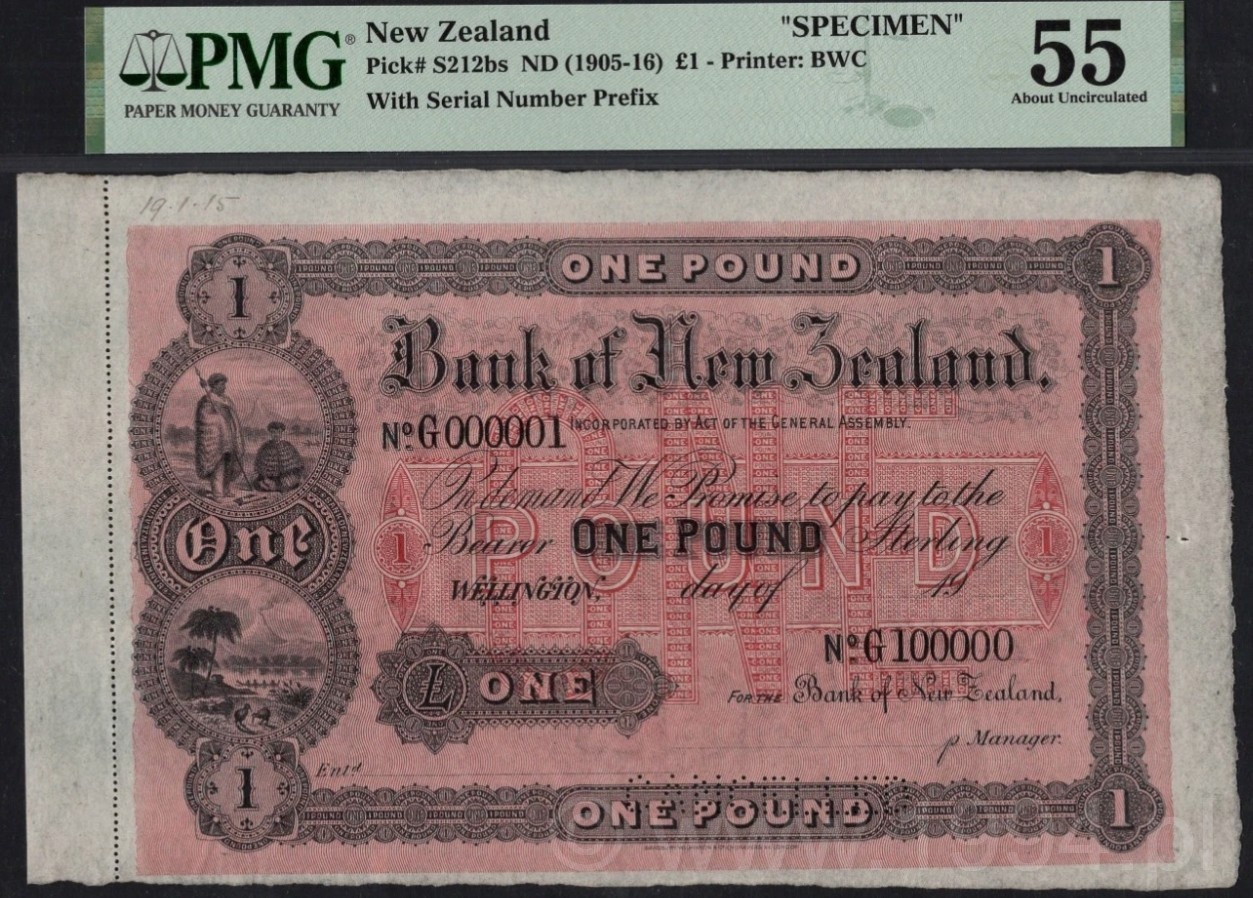
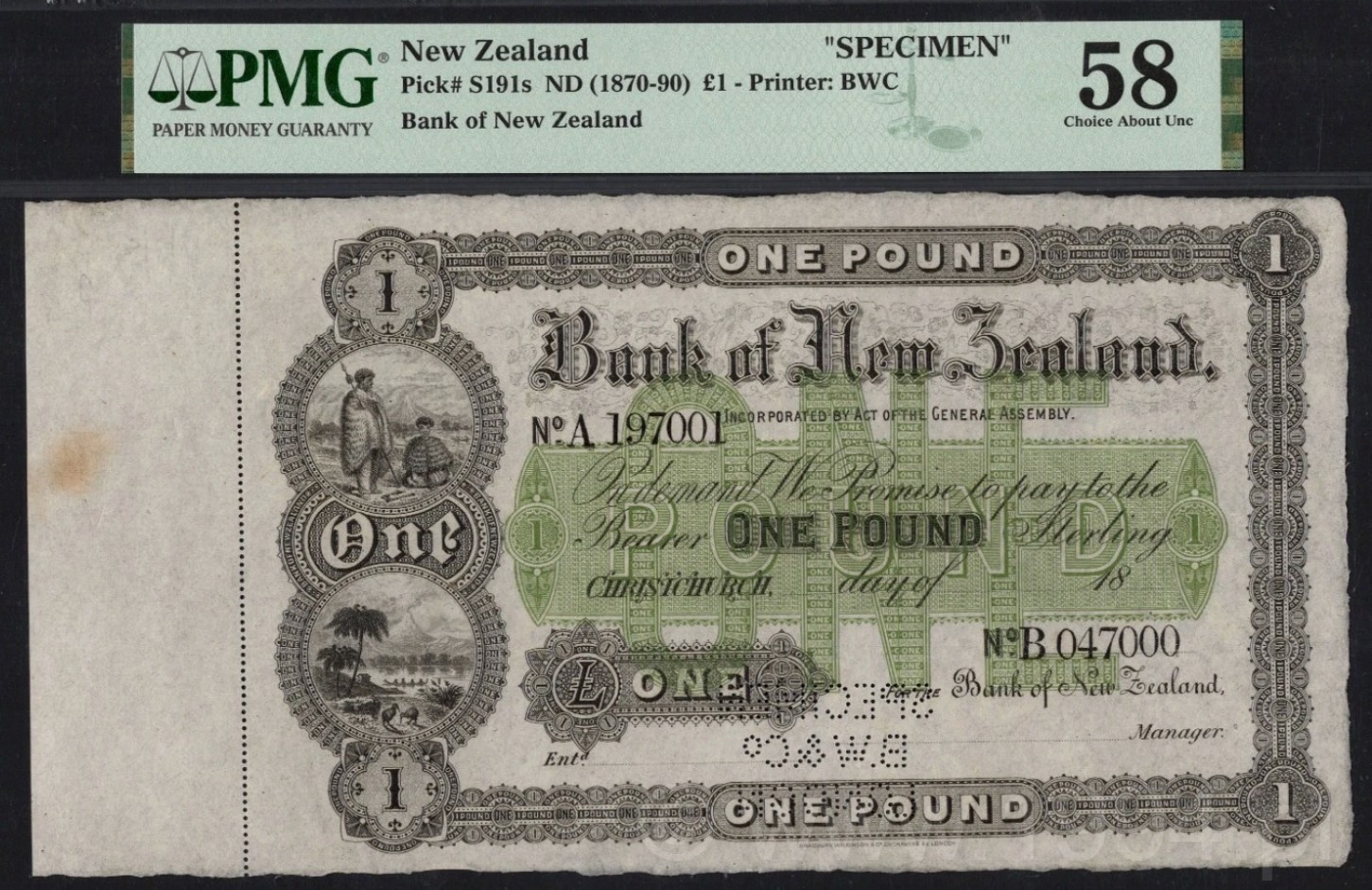
The first Bank of New Zealand specimen and the foundation of the country’s pre-Reserve Bank note lineage. Engraved and printed by Bradbury, Wilkinson & Company, Limited, London, this one pound green specimen (Pick S191s) established the visual architecture reused throughout all later BNZ issues: paired Māori figures at left, an engraved coastal vignette below, and an ornate duty-tint panel framing the ONE POUND denomination. This design became the structural and visual origin of the Bank of New Zealand color lineage that defined New Zealand’s early commercial-bank currency.
This specimen carries a dual-prefix serial system, with A197001 at left and B047000 at right. These are not circulation serials but internal control numbers applied by Bradbury Wilkinson to track production stages, plate alignment, and archival referencing. The use of two independent serial blocks reflects early control methodology, allowing cross-verification between printing batches and ledger records. This dual-format numbering is a defining feature of early BNZ specimens and distinguishes them from later standardized serial practices.
The note was produced as an internal printer’s specimen for archival retention and audit purposes. A perforation reading 'SPECIMEN B.W & Co LONDON' is applied across the lower central area, executed through pin-perforation rather than ink overprint, serving as the primary method of specimen invalidation and identification. At far left, a wide vertical audit margin remains intact, a characteristic feature of printer’s file copies retained for inspection, documentation, and internal reference within Bradbury Wilkinson’s production system.
This £1 Green specimen marks a pivotal stage in New Zealand’s monetary development. During the late nineteenth century, the Bank of New Zealand operated within a privately issued currency system, where commercial banks produced their own notes backed by reserves and governed under colonial legislation. Bradbury Wilkinson introduced high-security engraving standards to this system, embedding British technical precision into a developing colonial economy.
The visual composition reflects both identity and function. The paired Māori figures at left represent one of the earliest sustained uses of indigenous portraiture on British Empire currency, while the coastal vignette beneath-depicting maritime activity-anchors the note within New Zealand’s trade-dependent economy. Dense guilloche work, layered engraving, and ornamental borders provided both aesthetic complexity and anti-counterfeiting security.
The one pound green sits at the foundation of the Bank of New Zealand’s chromatic denomination system, later expanded by the five pounds orange (Pick S192s) and ten pounds brown (Pick S193s). This structured denomination-color mapping became the defining framework of the BNZ color lineage, later influencing early Reserve Bank design logic following centralization in 1934.
As a specimen combining dual control serials, Bradbury Wilkinson specimen perforation, retained audit margin, and full original design structure, this example represents a complete and highly informative record of Bradbury Wilkinson’s early production and verification methodology. It is not merely a denomination note but a working document of the printing process itself, preserving multiple layers of operational and historical evidence.
Surviving specimens of the S191s type are extremely scarce. Most were removed during archival reductions or lost during the transition from private-bank to centralized currency issuance. As the earliest and foundational specimen of New Zealand’s engraved banknote history, this one pound green stands as the origin point of the BNZ color lineage and a cornerstone reference within the broader narrative of colonial-era currency development.