Description and research notes
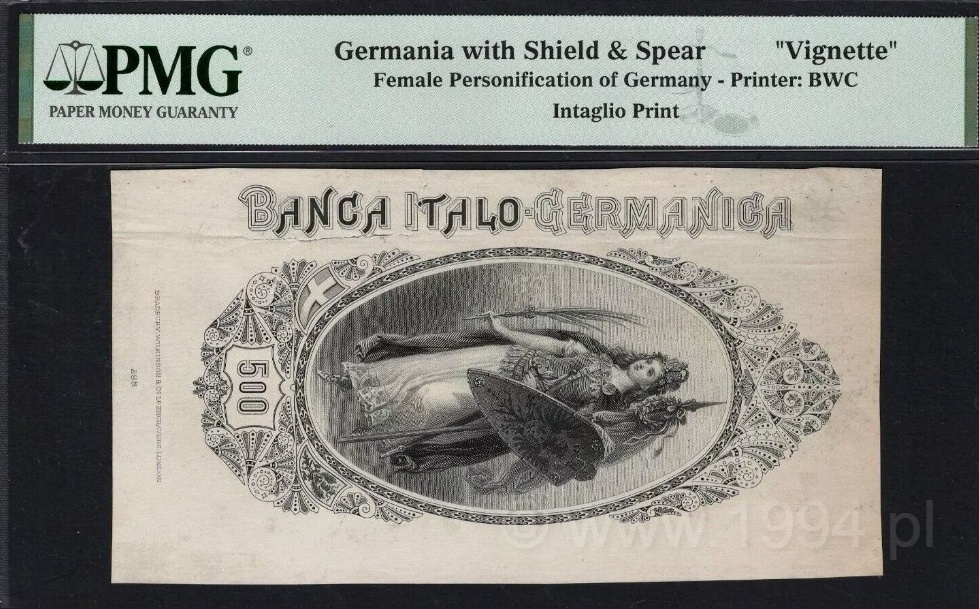
This engraved vignette proof depicting 'Germania with Shield and Spear' was produced by Bradbury, Wilkinson & Co. in London for the Banca Italo-Germanica during the early 1870s. The impression preserves the complete ornamental vignette prepared for the proposed 500 Lire banknote design, including the decorative frame and denomination tablet engraved for integration into the final banknote layout.
The allegorical figure represents Germania, the female national personification of Germany. Crowned with laurel and armed with spear and shield bearing the imperial eagle, she embodies the newly unified German Empire proclaimed in 1871 following the Franco-Prussian War. The appearance of Germania on a banknote prepared for an Italian banking institution reflects the transnational character of the Banca Italo-Germanica, a financial enterprise intended to facilitate commercial and industrial cooperation between Italy and the newly unified Germany during the rapid economic expansion of the period.
Vignette proofs such as this were printed directly from the engraved steel die during the approval phase of banknote production. At this stage the printer and issuing bank evaluated the engraving quality, tonal balance, and compositional stability of the central image before transferring the design to working printing plates. Because the proof is taken directly from the die, it preserves the engraving in its pure form, without color layers, guilloche backgrounds, or additional plate elements that would appear in the completed banknote.
Bradbury Wilkinson’s engraving demonstrates the firm’s distinctive nineteenth-century intaglio technique. The figure is modeled through tightly controlled parallel linework and cross-hatching, creating sculptural depth while maintaining the clarity necessary for secure banknote reproduction. The surrounding ornamental frame combines classical scrollwork and architectural symmetry typical of Bradbury Wilkinson vignette design, providing a stable visual structure into which the denomination tablet and bank title were integrated.
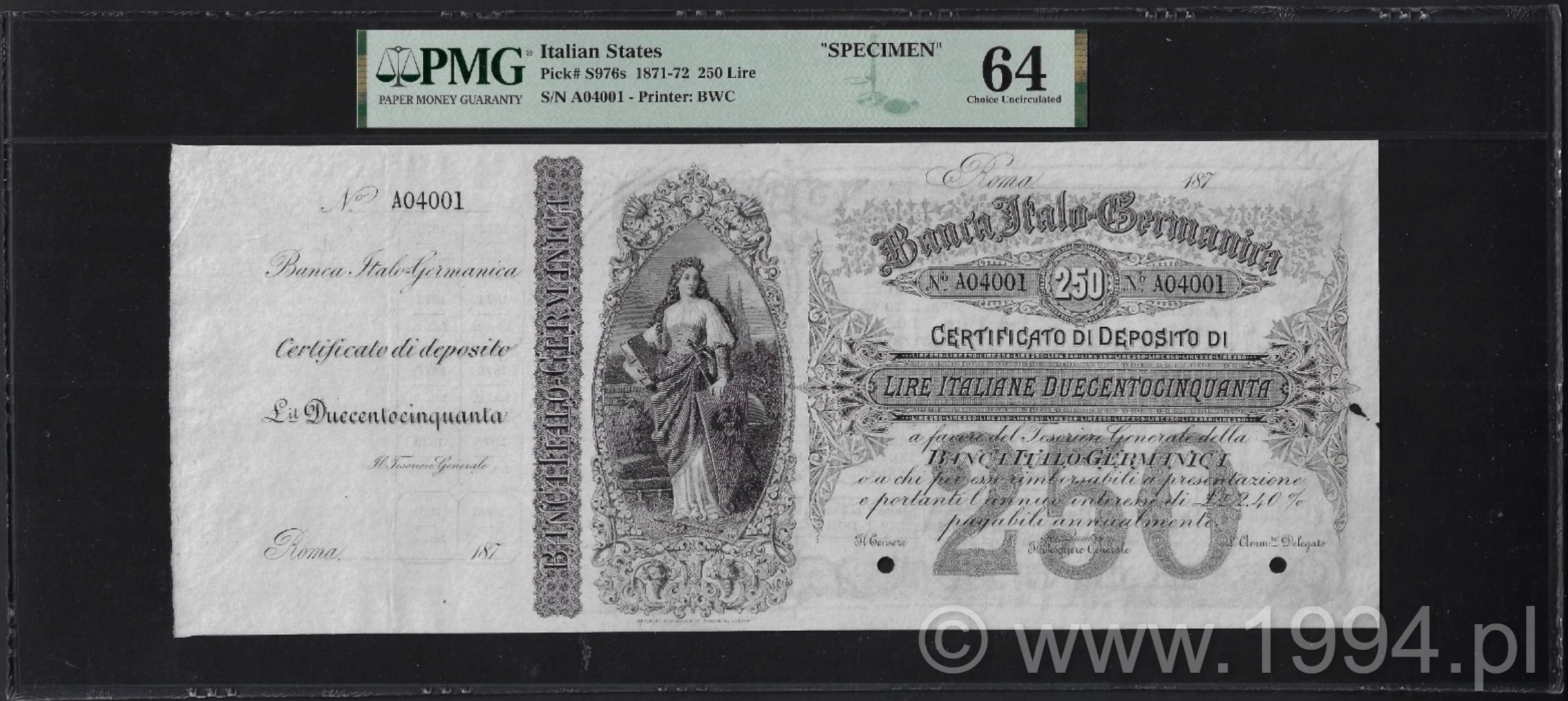
The proof reference PS977 identifies the design’s later appearance in the 500 Lire proof prepared for the Banca Italo-Germanica. Within the banknote production chain, such vignette impressions represent one of the earliest surviving stages of the design process, preceding plate assembly, color separation, and final printing.
Very few impressions of these working proofs survive because they were produced solely for internal approval and archival reference within the printer’s workshop. Once the engraving was accepted and transferred to production plates, most proof pulls were discarded. This surviving example therefore preserves both the technical precision of Bradbury Wilkinson’s engraving and the allegorical program chosen to represent an ambitious cross-European banking institution at the moment of Germany’s political unification.