Description and research notes
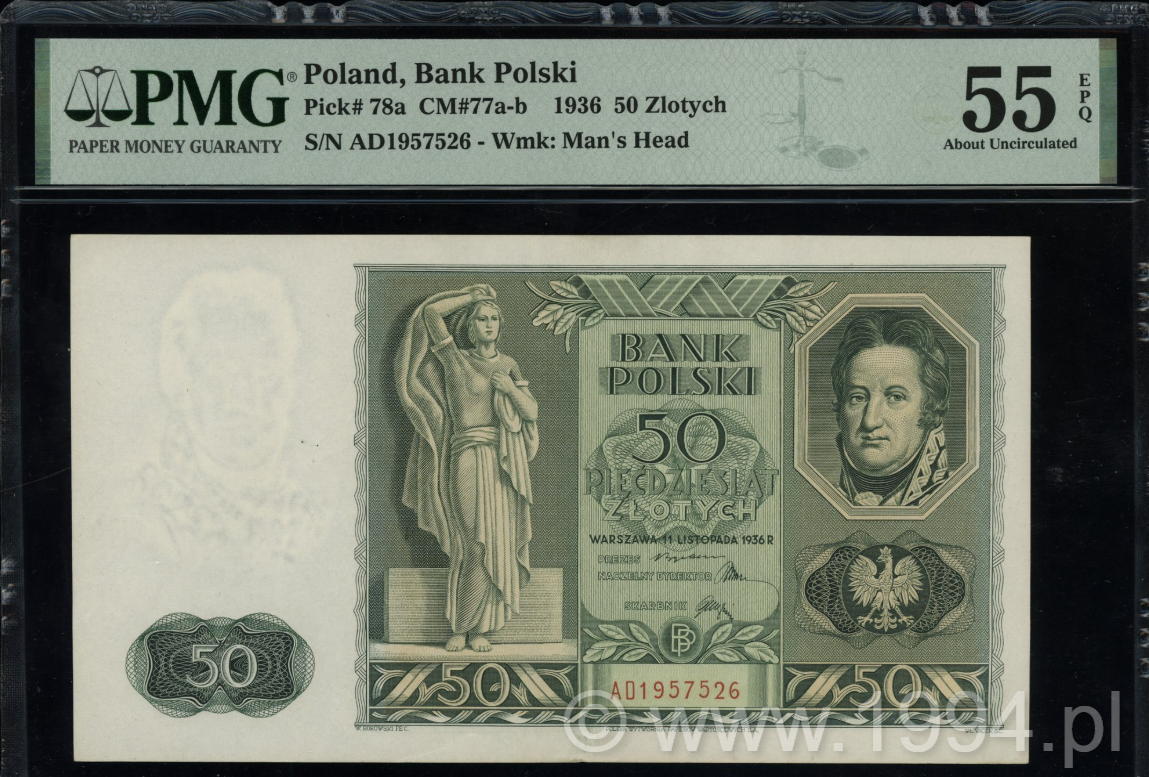
The 1936 50 Zlotych featuring General Jan Henryk Dąbrowski is widely regarded as the summit of Polish interwar banknote design — a note whose rarity, beauty, and symbolic weight place it among the most revered achievements of the Bank Polski and the Państwowa Wytwórnia Papierów Wartościowych (PWPW). Though it never reached circulation in peacetime, its story bridges the nation’s greatest artistic ambitions and its sudden descent into war.
The design was part of a comprehensive modernization of Poland’s paper currency initiated in the mid-1930s — a project meant to unify style, improve security, and elevate national pride through artistry. Dated 11 November 1936 — Poland’s Independence Day — the 50-złotych note was to become a flagship of this new series. On the right, General Dąbrowski (1755–1818), founder of the Polish Legions in Italy and a national hero immortalized in the national anthem, appears in classical profile. The reverse portrays allegorical figures symbolizing agriculture, industry, and the arts, reflecting the young Republic’s optimism and self-confidence.
Printed at the PWPW in Warsaw under the direction of Leon Barański, with artistic supervision by Wacław Borowski and engraving by Włodzimierz Vacek, the note combined offset and intaglio processes in green and light-orange tones. Its watermark — a multitone portrait of Dąbrowski visible in the unprinted field — was a masterpiece of Polish papermaking, demonstrating a technological level comparable to the finest European issues of the era. Each printing sheet measured 557 × 515 mm and contained twelve notes. Serial numbers were applied before intaglio printing, as evidenced by surviving specimen sheets with prefixes AE, AN, and AO.
According to Czesław Miłczak, approximately two thousand examples were printed and delivered to Bank Polski, yet the note was never officially released. With the outbreak of war in September 1939, a desperate shortage of circulating cash led the Bank to draw on any available reserves — including this unissued 50-złotych series. A few hundred notes were reportedly distributed in Pomerania as emergency pay for Polish soldiers. Many were folded into small squares, carried in uniforms, and later found in a state of deep wear — tangible relics of those chaotic days.
Collectors today distinguish two surviving populations: a minute handful of uncirculated notes preserved from Bank Polski stock, and a few dozen heavily circulated examples bearing the marks of battlefield use. PMG’s census records barely two dozen certified in all grades, with anything above 40 considered a wonder. This specimen, graded PMG 55 EPQ About Uncirculated, stands among the finest known worldwide.
Beyond its rarity, the Dąbrowski 50 Zlotych represents the artistic and patriotic soul of the Second Polish Republic — a note conceived in peace, born in crisis, and rescued from oblivion. It remains one of the most significant and emotionally charged pieces of Polish paper money ever created — a national relic and a silent witness to the final days of independent pre-war Poland.