Description and research notes
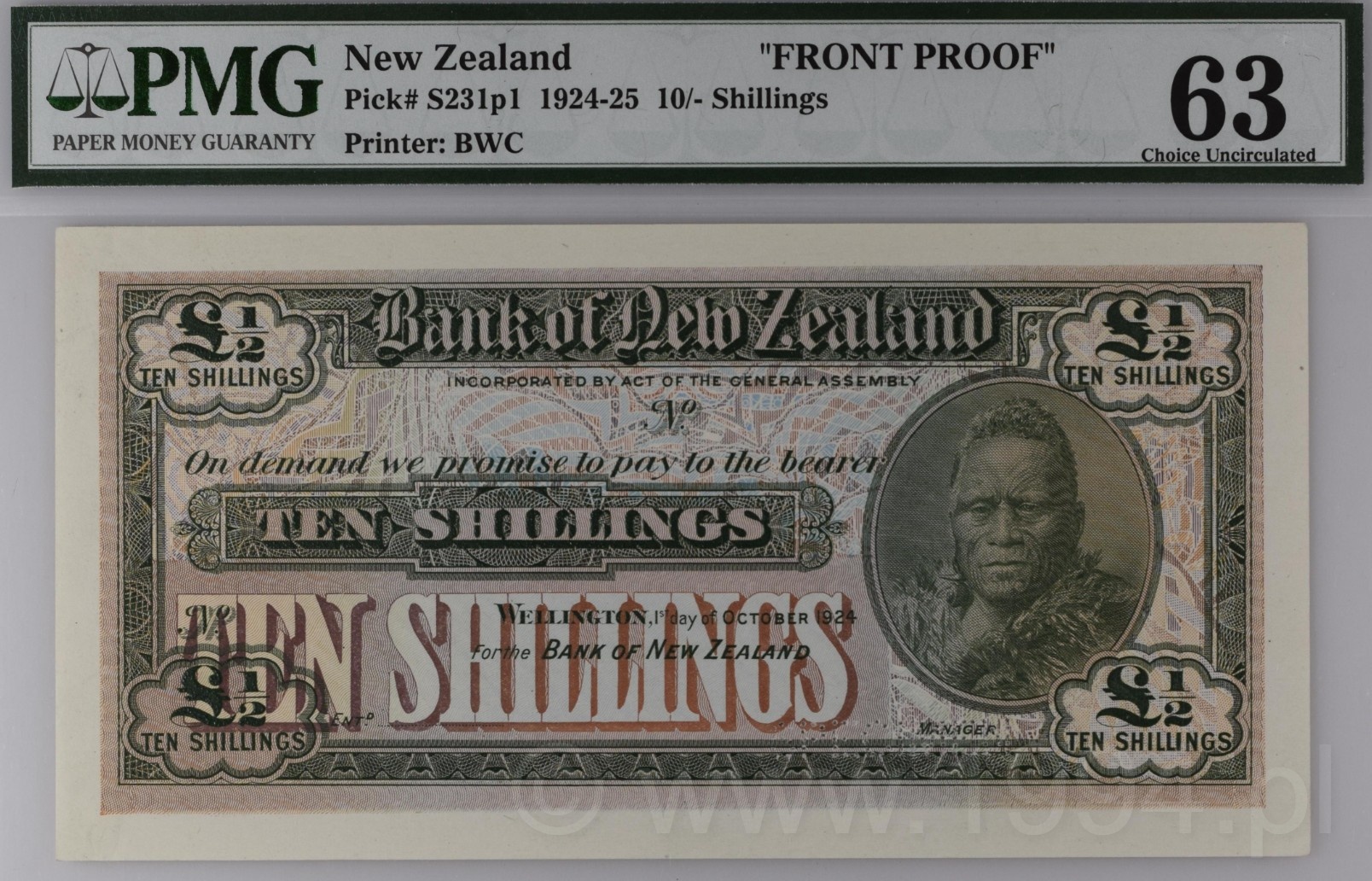
Front proof of the Bank of New Zealand 10 Shillings (Pick S231p1), printed by Bradbury, Wilkinson & Co., London, for the post-war re-engraved issue dated 1924–25. Perforated SPECIMEN through the lower margin and certified by PMG as Choice Uncirculated 63 Top Pop, this example shows the completed obverse design prior to overprinting and serial application.
The note features a finely engraved portrait of the Māori rangatira Tamati Waka Nene (1780–1871), leader of Ngāpuhi and an early ally of British settlement-one of the first indigenous statesmen ever depicted on a Commonwealth banknote. Surrounding the portrait are complex guilloché patterns and a two-tone lilac-and-ochre tint underprint demonstrating the peak of Bradbury Wilkinson’s late-Edwardian plate craftsmanship.
Front proofs such as this were retained in the printer’s reference archives and used to verify color registration, alignment, and micro-engraving before full production. The intact margins and deep relief impression make this piece an ideal teaching reference for plate-making and tint-stone layering techniques used by BWC during the interwar modernization of New Zealand’s private-issue currency. It stands as an educational artifact bridging colonial design tradition and the technical precision that would define later Reserve Bank series.
Beyond its technical and artistic importance, the 1924–25 10 Shillings proof captures a pivotal shift in New Zealand’s visual and monetary identity. The decision to place Tamati Waka Nene on the obverse marked a rare and forward-looking acknowledgment of Māori leadership at a time when indigenous representation on currency across the British Empire was almost nonexistent. His role as a stabilizing force during the early colonial period mirrored the note’s function: a unit of everyday exchange meant to circulate broadly among both Māori and Pākehā communities.
The 10 Shillings denomination was the workhorse of the New Zealand economy-circulating in stores, docks, farms, ferry routes, and railway stations. By the 1920s, heavy usage of earlier BNZ half-pound notes forced the bank to strengthen the layout: thicker borders, more assertive denomination framing, and sharper tint layers. This proof reveals the exact engraved state of that redesign before any production wear, serialing, or signature shifts touched the plate.
Historically, this issue stands at the crossroads between private banknote autonomy and centralized national control. Ten years after this proof was produced, the Reserve Bank of New Zealand assumed exclusive note-issuing authority in 1934. These late BNZ proofs therefore represent the final expression of a 60-year private-note tradition that began in the 1870s and ended when New Zealand joined the global movement toward nationalized currency systems.
Archival proofs like this survive only because Bradbury Wilkinson preserved reference sets for internal documentation. When BWC’s archives were dispersed in the late 20th century, just a handful of front proofs from this series reached collectors. With PMG 63 Top Pop status, this example is the finest-known surviving representation of the BNZ’s last major design update-a foundational artifact in the story of New Zealand’s path from provincial commercial banking to a unified national monetary identity.