Collection PL

About
9 results · Page 1 of 1
China 1920 Xinjiang textile emergency currency printed on red cloth by woodblock, showing framed inscription panel and ornamental borders

China 1920 — Xinjiang Textile Emergency Currency Printed on Red Cloth, Local Authority Issue (Pick Unlisted)

An issued textile emergency currency produced in Xinjiang (Sinkiang) in the early Republican period, printed by hand from woodblock onto coarse red-dyed cotton cloth. This note forms part of the broader tradition of frontier textile currency developed in western China under conditions of monetary instability, material shortage, and decentralized administrative control. The design is executed in dark ink directly on fabric, with the weave of the cloth clearly visible through the printed impression. ... Read more →

ChinaTextile Emergency Currency1920UnspecifiedIssued (Textile Emergency Currency) Textile BanknoteTextile Emergency CurrencyCloth BanknoteIssued Emergency MoneyWoodblock PrintingFrontier CurrencyXinjiangSinkiangLocal Authority IssueEarly Republican PeriodRegional Monetary SystemChina1920Museum GradeR9 Extremely RareUniquePick Unlisted
Held
China 1924 Dihua Official Coin Bureau 40 wen textile emergency banknote printed on red cotton with Chinese and Uyghur inscriptions

China 1924 — Dihua Official Coin Bureau 40 Wen Textile Emergency Issue (Pick Unlisted)

This 40 wen textile banknote represents a formally authorized emergency issue produced in 1924 by the Dihua Official Coin Bureau during a period of acute monetary disruption in Xinjiang. Faced with shortages of paper currency, disrupted transport routes, and limited access to centralized printing facilities, local authorities adopted cloth as an alternative monetary substrate to sustain everyday economic activity. The note was printed on coarse red cotton using traditional woodblock techniques, a method well suited to decentralized production and durable circulation under harsh regional conditions. ... Read more →

ChinaTextile Banknote192440 WenCirculated (Textile Issue) Textile BanknoteTextile Emergency CurrencyCloth CurrencyEmergency Issue40 WenWoodblock PrintingDihua Official Coin BureauXinjiangRepublican ChinaRegional Monetary SystemMultilingual CurrencyProvisional FinanceChina1924R8 Extremely RareMuseum GradePick Unlisted
Held
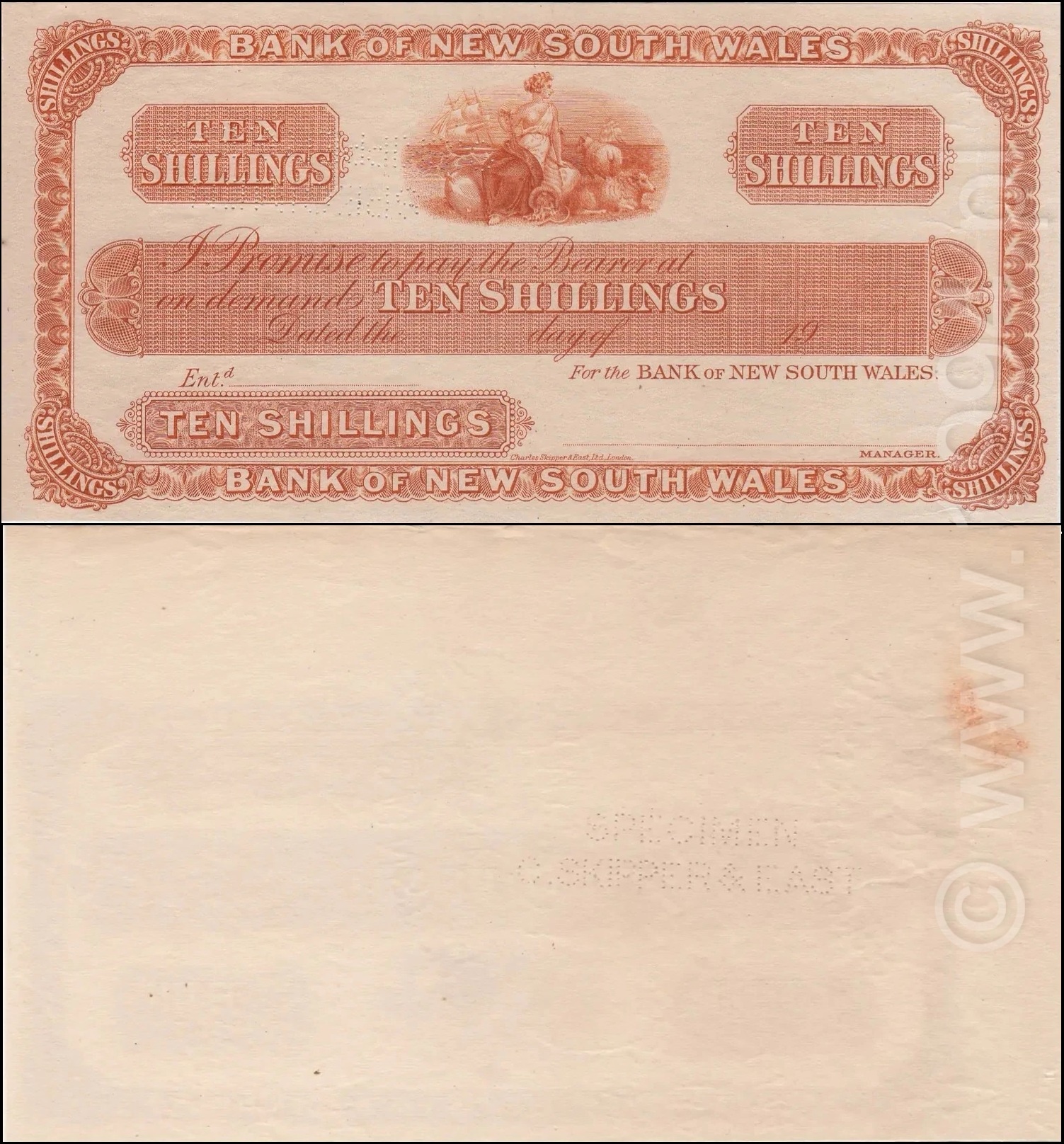
New Zealand ND 1924-1933 Bank of New South Wales ten shillings proof printed by Charles Skipper and East, perforated SPECIMEN control marking, single sided with blank reverse

New Zealand ND (1924-1933) - Bank of New South Wales Ten Shillings Proof, Perforated SPECIMEN (Pick S161s)

Printers archival proof for the Bank of New South Wales Ten Shillings, classified in the Standard Catalog and grading records as New Zealand Pick S161s (ND 1924-1933) and produced in London by Charles Skipper and East. This piece was never intended for circulation. It was created as part of the printers internal proofing, approval, and archival process and survives as a workshop original documenting the final approved design for a denomination that ultimately never entered public issue. ... Read more →

New ZealandProof192410 ShillingsChoice Uncirculated Proof Banknote10 ShillingsPrinter ProofPerforated SPECIMENPrinter Control MarkingNon Circulating ProofBank of New South WalesColonial BankingAustralasian BankingCharles Skipper and EastLondon Security PrintingGuilloche EngravingMicroletteringBlank ReverseNew ZealandND 1924-193319241933Pick S161sPick S161Museum GradeR8 Extremely Rare
Held
New Zealand ND 1924-1933 Bank of New South Wales ten shillings oversized proof printed by Charles Skipper and East, perforated SPECIMEN control marking, untrimmed margins, blank reverse

New Zealand ND (1924-1933) - Bank of New South Wales Ten Shillings Oversized Proof, Perforated SPECIMEN (Pick S161s)

Printers archival oversized proof for the Bank of New South Wales Ten Shillings, classified in the Standard Catalog and grading records as New Zealand Pick S161s (ND 1924-1933) and produced in London by Charles Skipper and East. This example survives on an oversized, untrimmed sheet and represents the most internal and earliest preserved production state of the design. Although cataloged under New Zealand, the design belongs to the broader Australasian operating structure of the Bank of New South Wales, a trans Tasman institution active in both Australia and New Zealand. ... Read more →

New ZealandProof192410 ShillingsChoice Uncirculated Proof Banknote10 ShillingsOversized ProofPrinter Archive ProofPerforated SPECIMENPrinter Control MarkingNon Circulating ProofUntrimmed MarginsBlank ReverseBank of New South WalesColonial BankingAustralasian BankingCharles Skipper and EastLondon Security PrintingGuilloche EngravingMicroletteringNew ZealandND 1924-193319241933Pick S161sMuseum GradeR9 Extremely RareUnique
Held
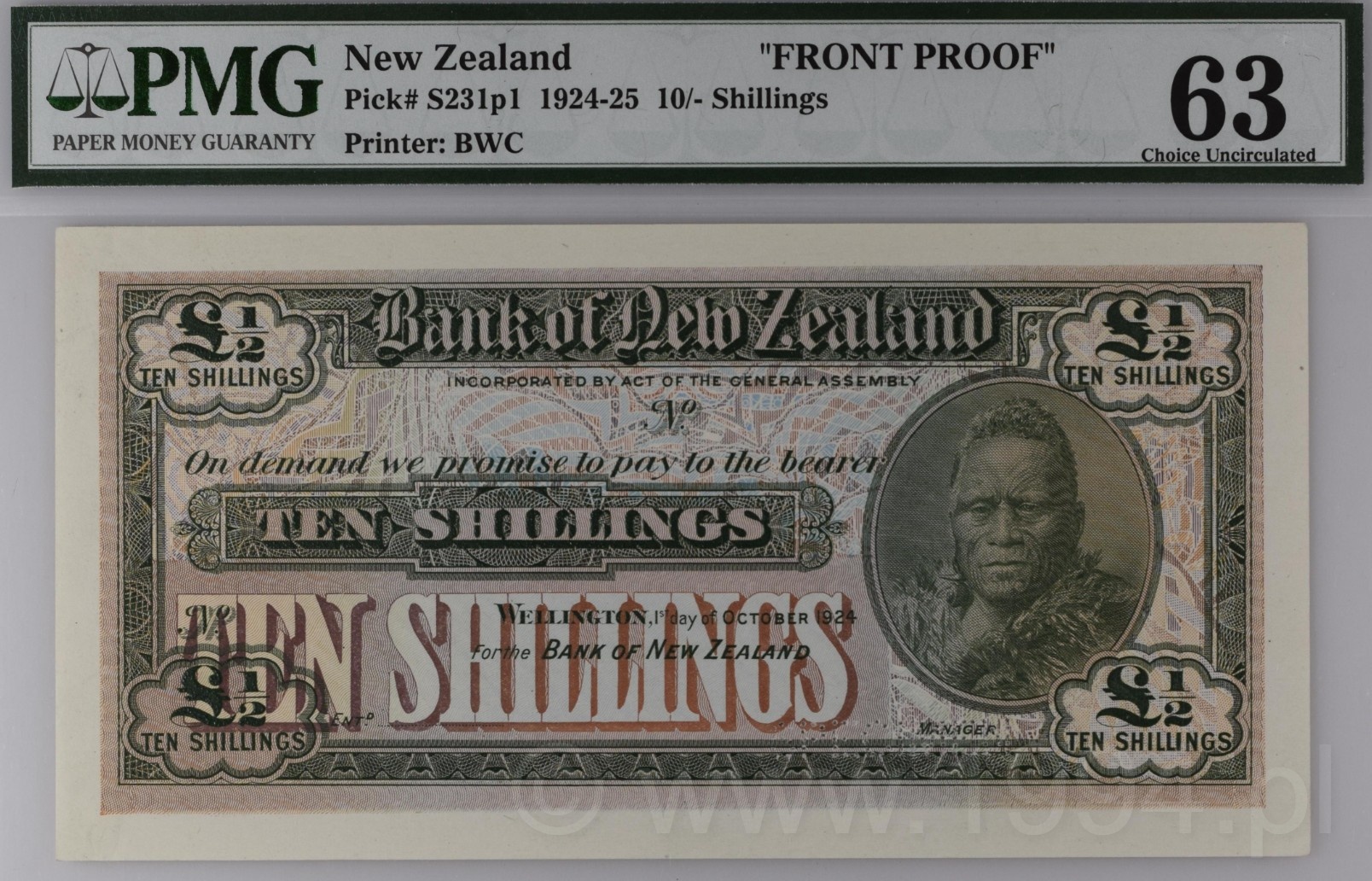
New Zealand 1924–1925 Bank of New Zealand 10 Shillings Front Proof Pick S231p1 with SPECIMEN perforation, Bradbury Wilkinson & Co.

New Zealand 1924–1925 — Bank of New Zealand 10 Shillings Front Proof with SPECIMEN Perforation (Pick S231p1)

Front proof of the Bank of New Zealand 10 Shillings (Pick S231p1), printed by Bradbury, Wilkinson & Co., London, for the post-war re-engraved issue dated 1924–25. Perforated SPECIMEN through the lower margin and certified by PMG as Choice Uncirculated 63 Top Pop, this example shows the completed obverse design prior to overprinting and serial application. The note features a finely engraved portrait of the Māori rangatira Tamati Waka Nene (1780–1871), leader of Ngāpuhi and an early ally of British settlement—one of the first indigenous statesmen ever depicted on a Commonwealth banknote. ... Read more →

New ZealandFront Proof192410 ShillingsPMG 63 Choice Uncirculated (Top Pop, Front Proof with SPECIMEN Perforation) Front Proof10 ShillingsSpecimen PerforationIntaglioBradbury WilkinsonBWCTamati Waka NeneBank of New ZealandNew Zealand Banking HistoryPre-Reserve BankPrivate Banknote EraInterwar Currency DesignEngraved Security PrintingLate Edwardian PlateworkTint-Stone UnderprintMāori Portrait SeriesNew Zealand192419251924–1925PMG 63Top PopMuseum GradeR8 Extremely Rare
Held
Poland 1919 (ND 1924) 100 Złotych, Pick 57, PMG 58 EPQ

Poland 1919 (ND 1924) — 100 Złotych Issued Note (Pick 57)

100 Złotych dated 28 February 1919, part of the first złoty issue commissioned by the newly reborn Republic of Poland. Printed by Waterlow & Sons in London, this landmark series replaced the chaotic wartime mark with a stable national currency, reinforcing sovereignty after more than a century of partitions. The obverse features Tadeusz Kościuszko, hero of both Poland and the American Revolution, whose portrait was chosen to embody sacrifice, unity, and independence. ... Read more →

PolandIssued Note1919100 ZłotychPMG 58 EPQ Choice About Unc PolandPick 57Issued NoteBank PolskiEPQFirst Zloty IssueWaterlowbanknotWaterlow & Sons100 zlotychMilczakKosciuszkozlotychII RP1919PMG 58 EPQMuseum GradeR7 Extremely Rare
Held
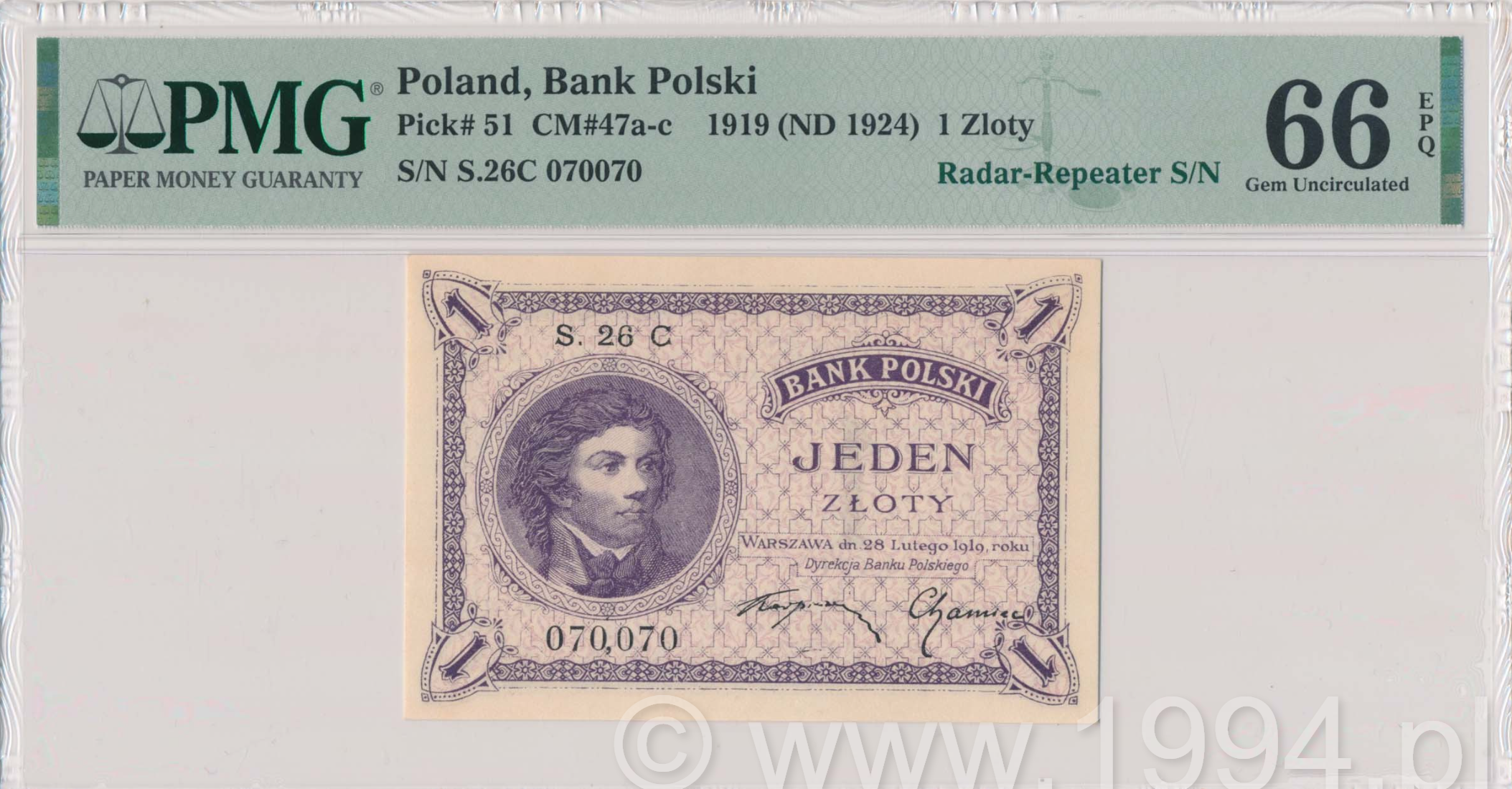
Poland 1919 1 Złoty, Radar Serial 070070, PMG 66 EPQ Top Pop

Poland 1919 (ND 1924) — 1 Złoty Issued Note Radar Serial 070070 (Pick 51)

The 1 złoty of 28 February 1919, printed in London by Waterlow & Sons, stands as the inaugural złoty of the reborn Republic of Poland following independence in 1918. It was the lowest denomination of the reform series and among the most widely used, yet it carried enormous symbolic weight: the obverse bears the portrait of Tadeusz Kościuszko, national hero of both Poland and the American Revolution, surrounded by intricate guilloches and the bold legend 'Bank Polski.' Kościuszko’s inclusion underscored the continuity of national identity after more than a century of partitions. This example is further distinguished by its serial number: a radar repeater, 070070 (Series S.26 C), a pattern highly prized by collectors for its symmetry and rarity. ... Read more →

PolandIssued Note19191 ZłotyPMG 66 EPQ (Top Pop) Bank PolskiEPQPMG 66 EPQFirst Zloty IssueWaterlowbanknotRadar SerialWaterlow & SonsPolskaPolandzlotyMilczakmiedzywojnieKosciuszkozlotychPick 51Issued NoteII RPTop Pop1919
Held
Poland 1919 1000 Złotych, Unissued, PMG 63 EPQ

Poland 1919 — 1000 Złotych Unissued Note (Pick 59a)

The 1000 złotych of the 1919 reform series, printed by Waterlow & Sons in London, is one of the largest and most ornate denominations prepared for the new złoty. Intended as part of the first złoty issue of the Second Republic, it was never officially released into circulation in 1924 due to its very high value. Some researchers suggest that a portion of the stock may have been used informally during the September Campaign of 1939 to pay Polish military officers, though no formal documentation confirms this. ... Read more →

PolandUnissued Note19191000 ZłotychPMG 63 EPQ EPQPolskaPolandII RPbanknotMilczakzlotyUnissued Noteemisja niewprowadzonaBank Polskiniewprowadzona emisjaSecond RepublicWaterlowKosciuszkoWaterlow & SonsmiedzywojniePick 59azlotychniewprowadzonanieobiegowy1919
Held
1922 to 1927 Anglo-Egyptian Bank Alexandria multicolor cheque set showing blue red and black engraved varieties

Egypt 1922–1927 — Anglo-Egyptian Bank, Alexandria Multicolor Cheque Set (Transition to Barclays DCO)

Set of four original cheques issued by The Anglo-Egyptian Bank Limited, Alexandria branch, spanning the years 1922 to 1927. Each piece is printed on period cream banking stock with engraved borders, full branch listings, manuscript completions, and clearing stamps, offering a detailed view of interwar British banking operations in Egypt. The cheques include three distinct color printings—black, blue, and red—reflecting the evolving design and internal accounting systems used by the bank before its rebranding to Barclays DCO. ... Read more →

EgyptFinancial Document1922Cheque (Egyptian Pounds)Uncertified (VF Group, Complete, Four-Piece Set) EgyptFinancial DocumentAnglo-Egyptian BankBarclays DCOAlexandriaCheque Set19221927British BankingInterwar FinanceColor Variants
Held
↑ Top