Collection · PL
Government of Barbados Treasury Bills — specimens, controls, and fiscal reference instruments under the Treasury Bills (Local) Act of 1922
Barbados did not build its modern state finance on circulating banknotes alone. Alongside everyday currency, governments rely on a quieter class of paper: short-term debt instruments that move liquidity inside the treasury system, support cash management, and provide auditable proof that public finance is being administered according to law. The Treasury Bills (Local) Act of 1922 provided Barbados with that legal authority. What survives today in private hands, however, is not a long run of early printed bills. Your inventory begins in the late 1950s and then concentrates from 1960 through the early 1980s, precisely when Barbados’s fiscal administration and printing workflows became mature enough to generate—and preserve—reference material in the modern sense.
The pieces assembled here are best read as administrative artifacts, not “banknotes.” They are reference specimens, printer controls, numbering trials, and archival invalidations—objects created so that a government and its contracted security printer could keep the system legible, auditable, and enforceable. Treasury bills are normally redeemed, filed briefly, and destroyed. Specimen material survives only when internal files are dispersed or when printer archives leak into the market. That is why this group matters: it preserves the mechanics of public finance, not just the face value of a denomination.
A crucial structural point, often misunderstood: these are not “series” in the numismatic sense. Barbados Treasury Bills are transaction tools and control documents. Differences in prefix, serial format, cancellation method, margin controls, and overprint logic are not minor variants—they are the documentary language of the system. In the inventory used for this article, none of the specimen states repeats within a denomination. Each denomination expresses a distinct control solution. That is what turns a set of bills into a fiscal narrative.
1) The system begins as law, then becomes paper
The 1922 Act matters because it defines the instrument’s legitimacy: a treasury bill is a government obligation created under statute, not a private promise. But law does not automatically produce surviving paper. The Central Bank literature makes clear that Barbados’s money and capital markets developed most rapidly after independence (1966) and the establishment of the Central Bank of Barbados (1972), when treasury bills and related instruments became part of managed liquidity and debt strategy rather than ad hoc fiscal practice.
Your Barbados treasury-bill material reflects that modern administrative maturity. What survives is not a random handful of bills. It is a mapped workflow: early design capture (photographic proof), mid-century specimen states with handwritten treasury handling, and late-period specimen formats associated with modern printing and inventory control.
2) The design stage: photographic proof as a fiscal “pre-object”
The earliest piece in the group is not a bill meant to function at all. It is a photographic proof—evidence that the bill’s language, layout, signature logic, and border geometry were being finalized as a security document before the specimen ecosystem of the 1960s and later matured. A photographic proof is the cleanest record of design intent: it captures wording and spacing before the operational burdens of serial logic, cancellations, and accounting controls are imposed on the paper. In other words, it is a design-state snapshot of the treasury’s form language.

3) 1960: specimen logic becomes operational and auditable
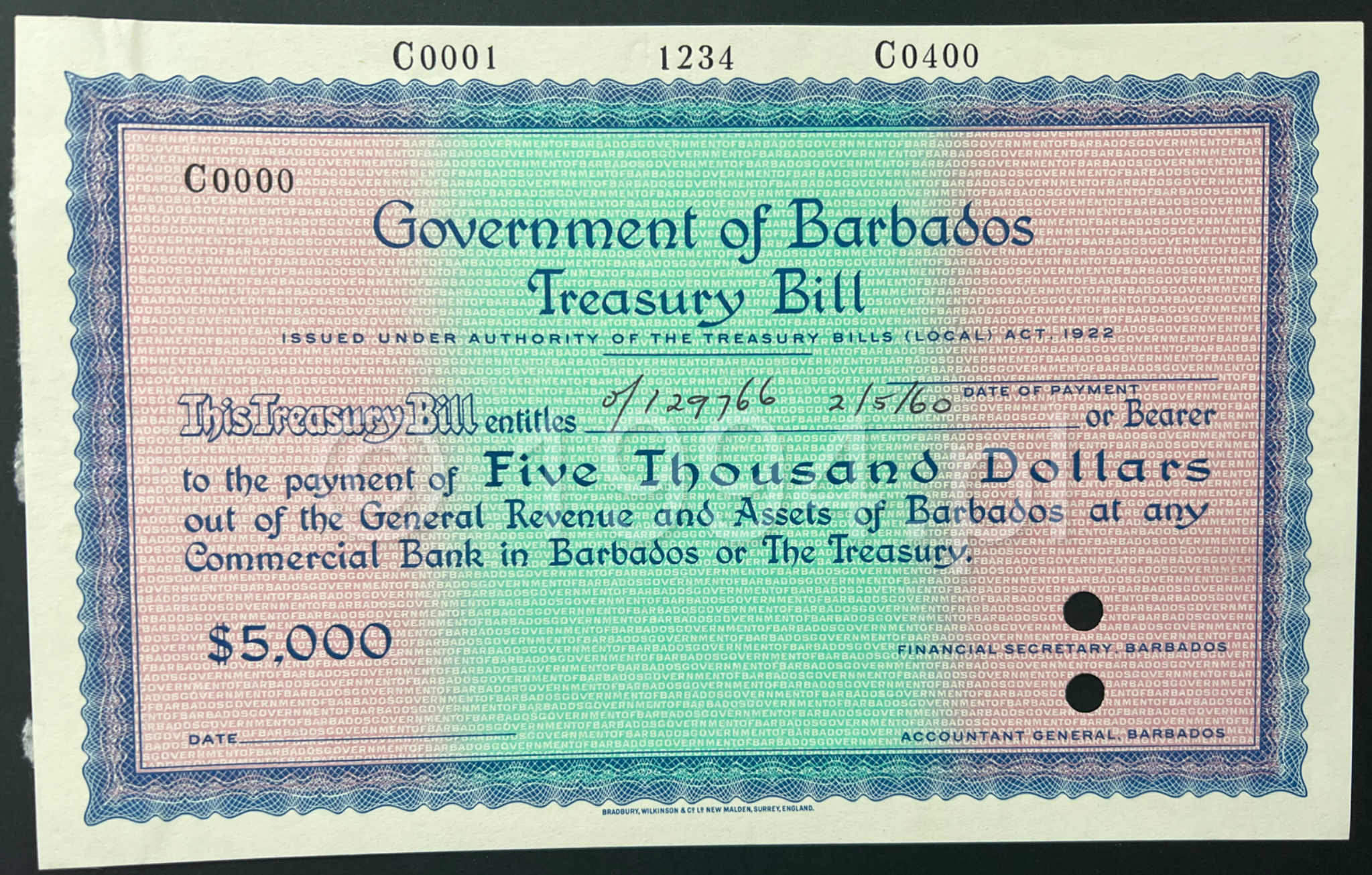
The 1960 specimens show the system becoming operational: standardized security underprints, formal place-of-issue language, and—most importantly—visible numbering trials and prefix-based serial formats. These were not decoration. They are the printer-and-treasury language of control. A printed trial line at the top margin is the mechanical equivalent of “this is how we will number it; this is how the spacing will register; this is how the bill will be tracked.” Once you see this, the bills read like technical documents rather than money.



4) Cancellation methods: how Barbados invalidated reference paper
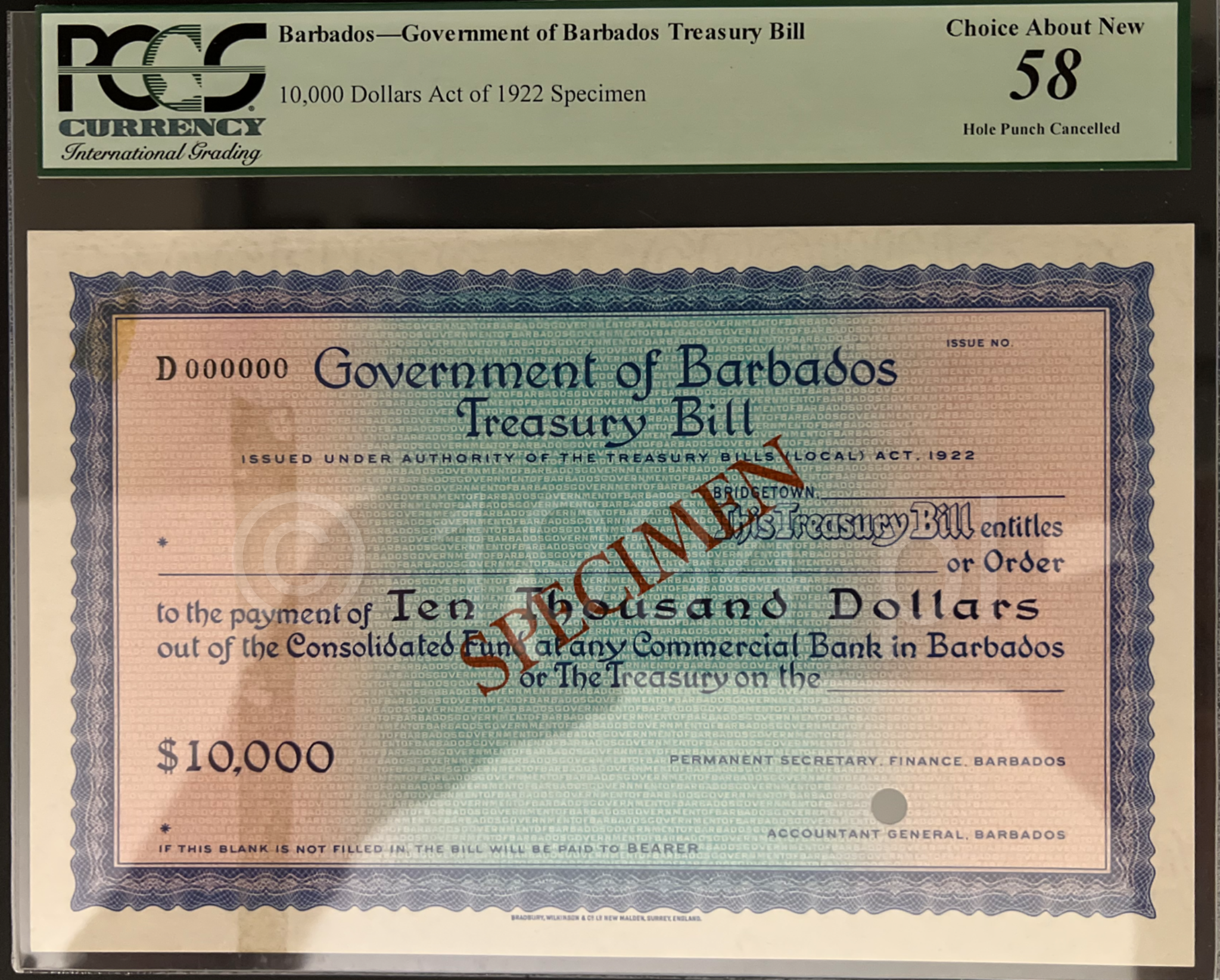
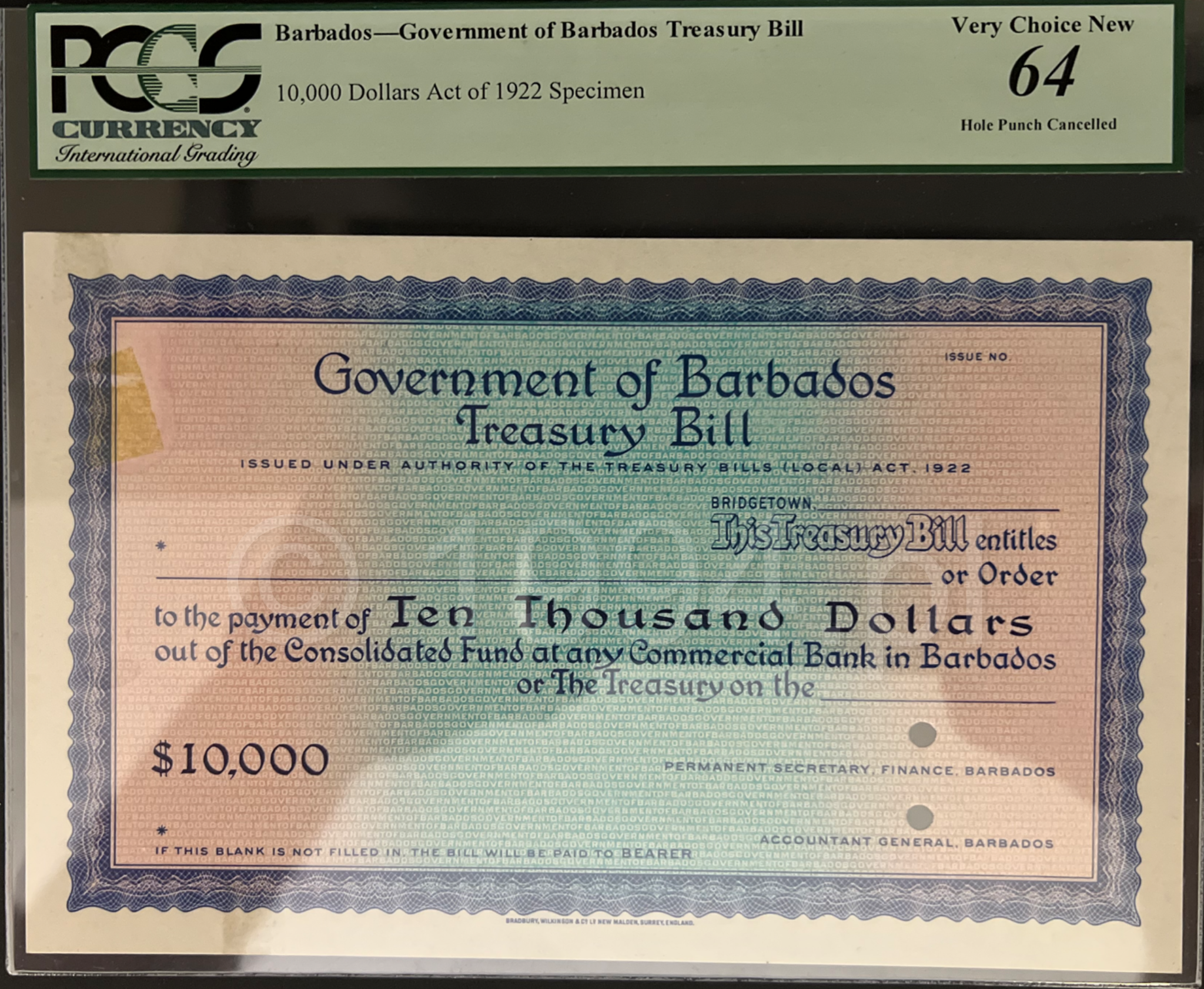
A specimen is only useful if it cannot be redeemed. Barbados uses three main invalidation languages in this inventory: punch holes (physical destruction of negotiability), perforated CANCELLED (archival invalidation with high legibility), and later SPECIMEN overprints coupled with zero-serial conventions. These are not aesthetic choices; they are control strategies that balance security, legibility, and archival retention.


5) Independence-era finance and the rise of managed liquidity
After independence (1966) and especially after the Central Bank’s establishment (1972), Barbados’s fiscal and monetary policy tools expanded: treasury bills, central bank holdings, and commercial bank participation become legible as part of an evolving money and capital market. Treasury bills are not “side paper” in such systems—they become the adjustable instrument through which liquidity is absorbed or released, and through which government debt management becomes operational rather than incidental.
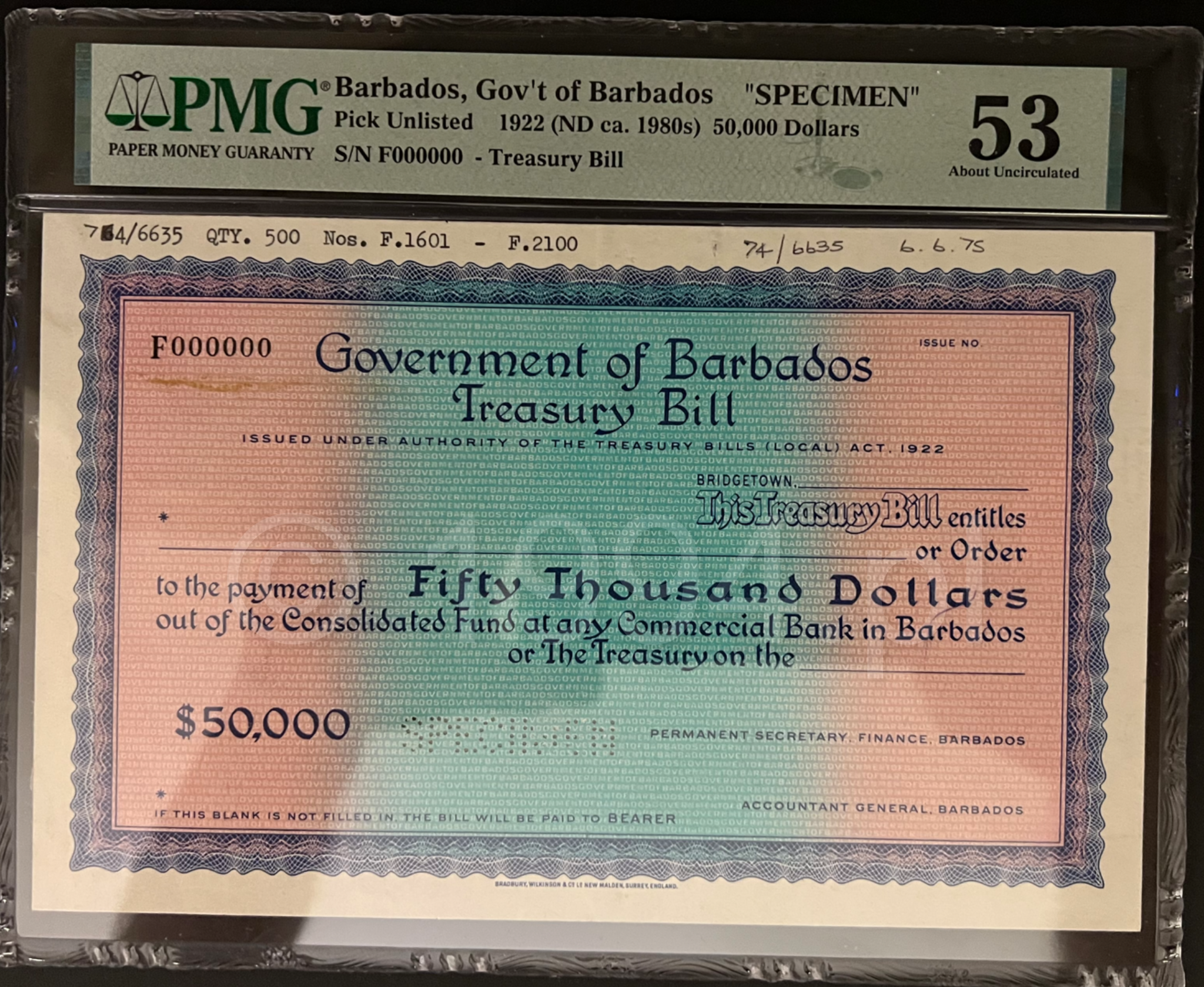
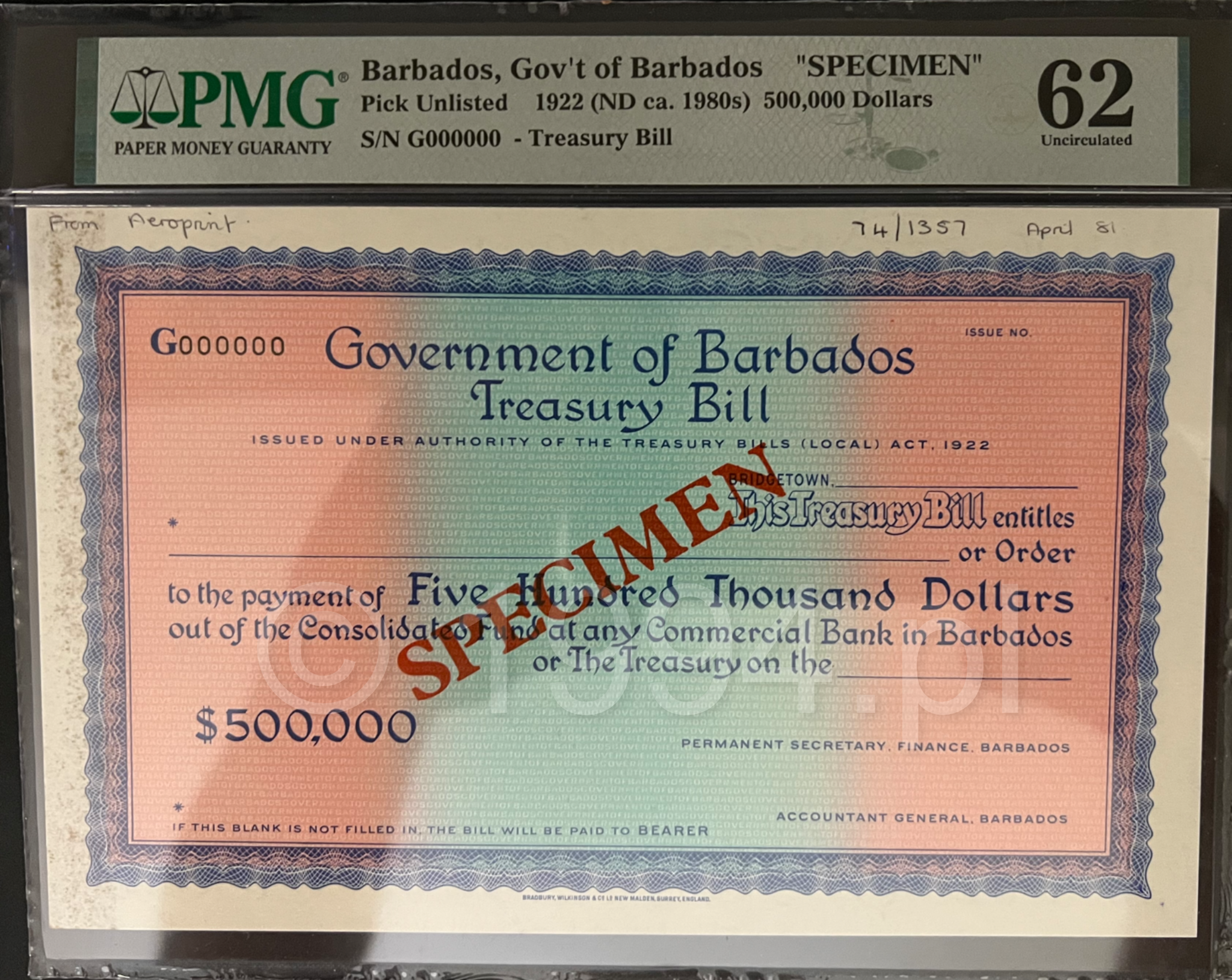
These specimens map the documentary side of that shift. The 1971 and 1976 control formats, the 1975 perforated SPECIMEN treatment, and the early 1980s AeroPrint-annotated pieces are not random survivors. They are the paper footprints of a treasury system becoming fully modern: batch allocations, serial-range references, controlled zero-serial formats, and “printer-to-treasury” handoffs encoded as marginalia.


6) The late-period specimen grammar: red overprints, zero serials, and AeroPrint handling
By the early 1980s, the specimen language becomes blunt and standardized: bold diagonal red SPECIMEN overprints, controlled zero-serial formats, and marginal annotations that point to modern production and handling. This is not cosmetic evolution. It is a shift toward administrative clarity: anyone handling the paper can immediately see that it is a reference instrument and cannot be treated as live fiscal paper.



What this Barbados group demonstrates
First, Barbados treasury paper is best understood as the visible edge of invisible finance. These objects encode how a government made debt instruments legible inside its own system—through serial logic, cancellation vocabulary, and printer–treasury control lines.
Second, the shift from the 1960 specimen logic to the late 1970s and early 1980s formats mirrors the broader development of Barbados’s financial system and money markets after independence, when treasury bills became integrated into managed liquidity and debt operations rather than standing as isolated fiscal paperwork.
Third, the group preserves workflow, not repetition. Within a denomination, the specimen state is not duplicated; across denominations, the same security-printing language is repurposed with different control solutions. That is why this is a research set: it allows reconstruction of how a small state executed a modern treasury program through paper that was never meant to survive.
Research sources used
- Central Bank of Barbados publications on money and capital markets and treasury bill usage: Money and capital markets in Barbados (Central Bank of Barbados) and Recent Economic Policy in Barbados 1970–84 (Central Bank of Barbados) .
- Government debt and financial system development references: Barbados’ Government Debt, 1966 to 1990 (CERT) .
- Documented auction records demonstrating the specialist-market appearance of Barbados Treasury Bill proof material: Archives International Auctions — Government of Barbados Treasury Bill Proofs .
Related material — including individual Treasury Bill specimens, photographic proofs, and issued instruments — is documented in the Barbados collection overview , which presents the item-level records supporting the institutional context outlined above.