Description and research notes
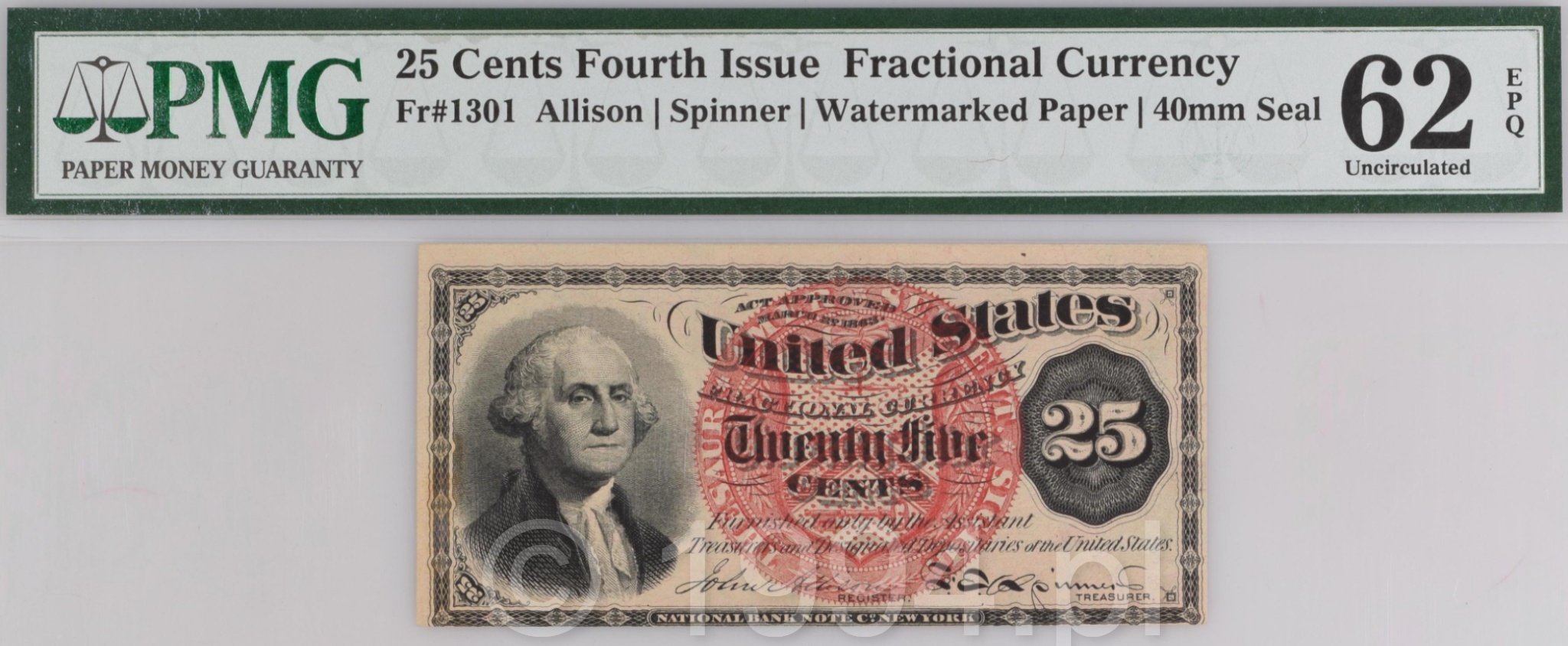
The Fourth Issue 25 Cents Fractional Currency note, cataloged as Friedberg 1301, represents the mature phase of the Civil War–era fractional paper money system. Fractional currency was introduced during the coin shortages of the early 1860s when hoarding of silver created a critical absence of small change in circulation. By the Fourth Issue, the United States Treasury had refined both design and anti-counterfeiting measures to a high degree of technical sophistication.
This example bears the portrait of George Washington and carries the signatures of Treasurer William Allison and Register of the Treasury Francis E. Spinner. It is printed on watermarked paper and features the 40 millimeter red Treasury seal - both characteristics explicitly identified on the certification holder and essential to correct subtype classification within the Friedberg system.
The large red seal dominates the face not merely as ornament but as an anti-counterfeiting device and declaration of federal authority. Watermarked paper added an additional layer of protection against imitation, reflecting the Treasury’s evolving response to widespread contemporary counterfeiting of earlier fractional issues.
Although fractional currency was initially conceived as an emergency measure, the Fourth Issue circulated well into the Reconstruction period. These notes represent the final refinement of the fractional currency experiment before its discontinuation in favor of restored metallic coin circulation.
Certified PMG 62 EPQ Uncirculated, this example retains original paper integrity as confirmed by the Exceptional Paper Quality designation. Embossing and engraving detail remain crisp, preserving the intricate border design and clarity of Washington’s portrait. As a high-grade survivor printed on watermarked paper with the 40 millimeter seal, this note stands as a technically complete and historically significant representative of United States fractional currency production.