Xinjiang Cloth Money (Sinkiang) 1880-1924 - Textile Emergency Currency on Red Cloth, Seven-Note Reference Set
This Spotlight documents a rare, internally consistent set of seven textile emergency-currency notes from Xinjiang (historically spelled Sinkiang), spanning 1880 to 1924. They are not “oddities” or decorative folk pieces. They are operational money instruments made to work in a frontier economy where materials, transport, and administrative reach often failed to match the basic needs of trade, tax, provisioning, and settlement.
The public record for comparable material is extremely thin. In practical terms, collectors and researchers usually encounter this topic as scattered references rather than a coherent series. That is exactly why a structured set matters: when you can place multiple examples on one timeline, patterns appear - not only in design language, but in authority signals, denomination logic, and production technique.
The core idea this Spotlight defends is simple: textile money in Xinjiang was a frontier technology. It was a practical response to constraints - a substitute medium chosen for durability and availability, produced with local tools, and made legible across communities that did not share a single language.
What this set is (and why it changes the conversation)
Most writing you see online about “cloth money” drifts into one of two traps: either it becomes a shallow visual curiosity, or it becomes a single-object description that cannot answer the bigger questions. A set allows a different approach:
- WHEN: why this medium appears, disappears, then reappears in the early 20th century.
- WHY: what problem cloth solved better than paper (and sometimes better than coin).
- WHO: which kinds of authorities issued such notes (local civil, military, bureau-level).
- HOW: why woodblock printing, heavy overprints, and bilingual text are not “primitive” but fit-for-purpose.
- WHAT NEXT: how to classify and study them as a research group, not seven isolated artifacts.
This Spotlight is therefore written as a reference framework. It is designed to stand on its own as a source page, not as a short blog post.
The frontier problem: why “normal money” fails at the edge
Xinjiang is not a “normal” monetary environment in the way coastal or central provinces were. Distance and geography matter. The region’s economy historically tied together oasis towns, caravan routes, garrisons, and administrative centers. That creates a recurring problem: coin and paper supply can be interrupted by transport, security, politics, and simple shortage of suitable materials.
In those conditions, money has to be locally manufacturable, durable, and recognizable. It also has to survive handling in ways that fragile paper often does not, and it must be difficult enough to fake within the production capacity of the same environment. Cloth currency is one of the most direct answers to that frontier reality.
Why cloth?
Cloth as a monetary substrate is not symbolic. It is functional. On a frontier, cloth can be easier to obtain locally than consistent paper stock, and it can be stronger under hard circulation. The weave structure absorbs pigment in ways that make erasure and alteration harder than many people assume. In short: textile supports a low-infrastructure but high-survival form of money.
Textile currency also has an overlooked advantage: it can carry authority marks without requiring fine engraving. Woodblock printing provides the base frame and text; overprints and validation chops provide control. That is not “cheap money.” It is money engineered for an environment where the key constraint is not artistry - it is logistics.
Why red cloth keeps appearing in this group
Across this set, the consistent “red cloth” substrate is itself meaningful. It acts as a built-in visual standard: recognizable at a glance, difficult to imitate precisely without the same local textile supply, and readable under low light. A repeated substrate is also a strong clue that we are not looking at random survivals. We are looking at a regional production habit.
How to read Xinjiang textile notes like a researcher
If you approach these notes like modern banknotes, you miss the point. The security model is different. For textile issues, the “authentication stack” usually looks like this:
- Substrate control: a specific cloth type and dye tone (often consistent within a region/time window).
- Base impression: woodblock frames and text panels (repeatable, but not perfectly uniform).
- Authority language: titles, bureau names, or military identifiers that establish who stands behind it.
- Multi-script legibility: Chinese alongside Turkic script where circulation required it.
- Validation marks: overprints, chops, or thick stamps that are easier to control than fine engraving.
That last point matters. On a frontier, the most reliable control method is often the one that can be applied quickly, repeatedly, and visibly in the same places every time. Thick overprints and stamps are not decorative. They are a control system.
At a glance: the seven-note timeline
The seven pieces are presented here in chronological order (1880 to 1924). That ordering best supports the goal of this Spotlight: to show how a frontier monetary tool evolves across regimes and administrative phases, while keeping a recognizable regional “grammar.”
| Year | Issue (as cataloged on 1994.pl) | Denomination | Key marker |
|---|---|---|---|
| 1880 | Sinkiang textile emergency currency, cloth note (Pick unlisted) | Unspecified | Early frontier format; multi-script presence |
| 1915 | South Sinkiang Border Defence Headquarters textile emergency issue (Pick unlisted) | 1 Tael | Formal military authority; strong validation logic |
| 1918 | Xinjiang local authority textile emergency currency on red cloth (Pick unlisted) | Unspecified | Winged emblem; wave-band vocabulary |
| 1920 | Xinjiang local authority textile emergency currency on red cloth (Pick unlisted) | Unspecified | Heavier borders; denser calligraphy |
| 1921 | Xinjiang textile emergency currency with sun emblem (Pick unlisted) | Unspecified | Sun motif enters the emblem system |
| 1922 | Xinjiang local authority textile emergency currency on red cloth (Pick unlisted) | Unspecified | Later workshop phase; darker impression |
| 1924 | Dihua Official Coin Bureau textile emergency issue (Pick unlisted) | 40 Wen | Official bureau form; institutional comparator exists |
Next comes the illustrated sequence. Each image links directly to its full Collection record.

The early anchor piece: late-Qing frontier format on red-dyed cloth, establishing the substrate-and-block vocabulary that reappears later.

A militarized emergency denomination: the 1 tael value signals higher-level settlement logic (provisioning, supply, administration), not casual small trade.
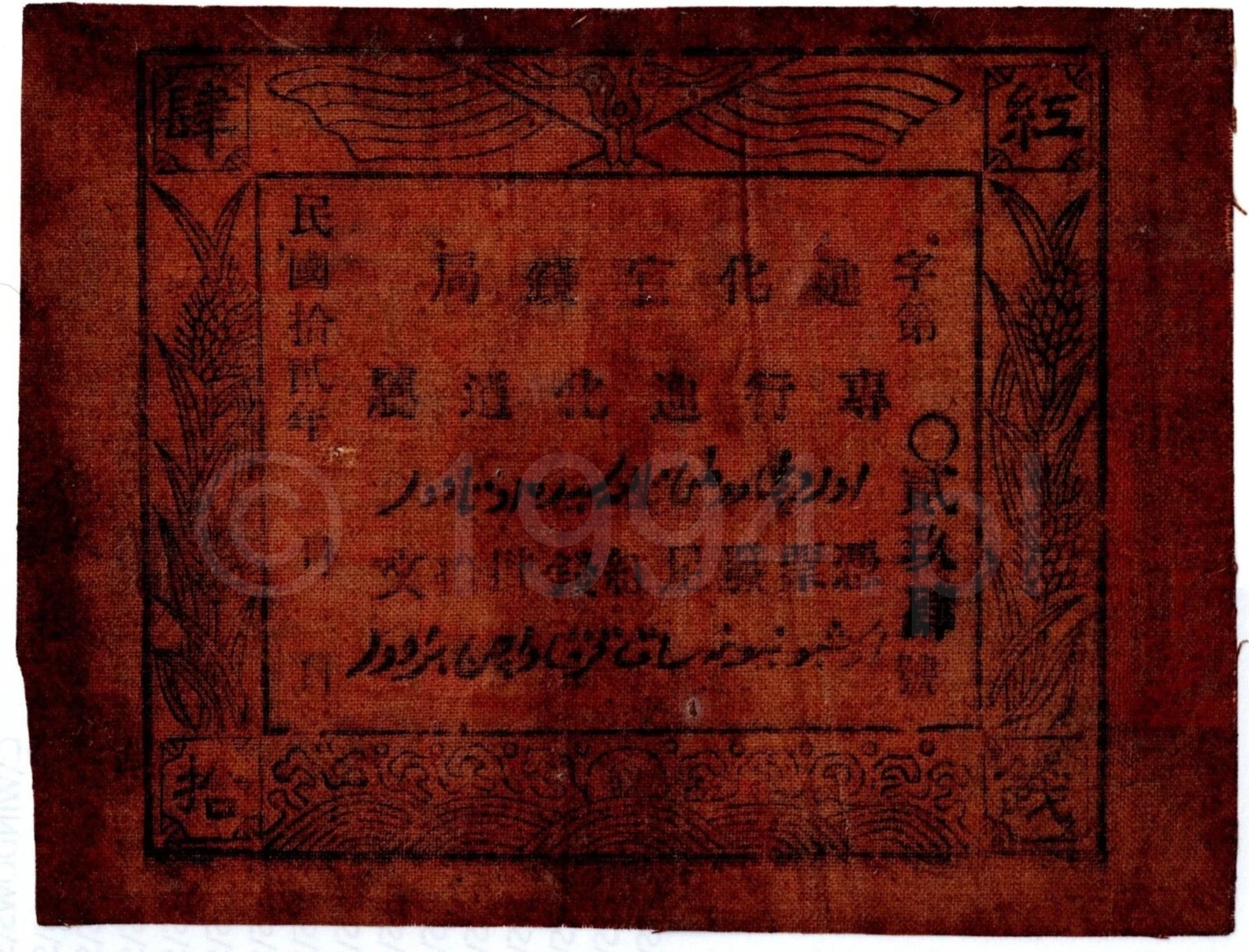
A later frontier form with stronger emblem framing and a wave-band vocabulary that becomes a repeated regional signature.

Heavier vertical articulation and denser calligraphy: a strong marker that blocks and layouts were being re-cut, refined, and standardized within a local workshop tradition.
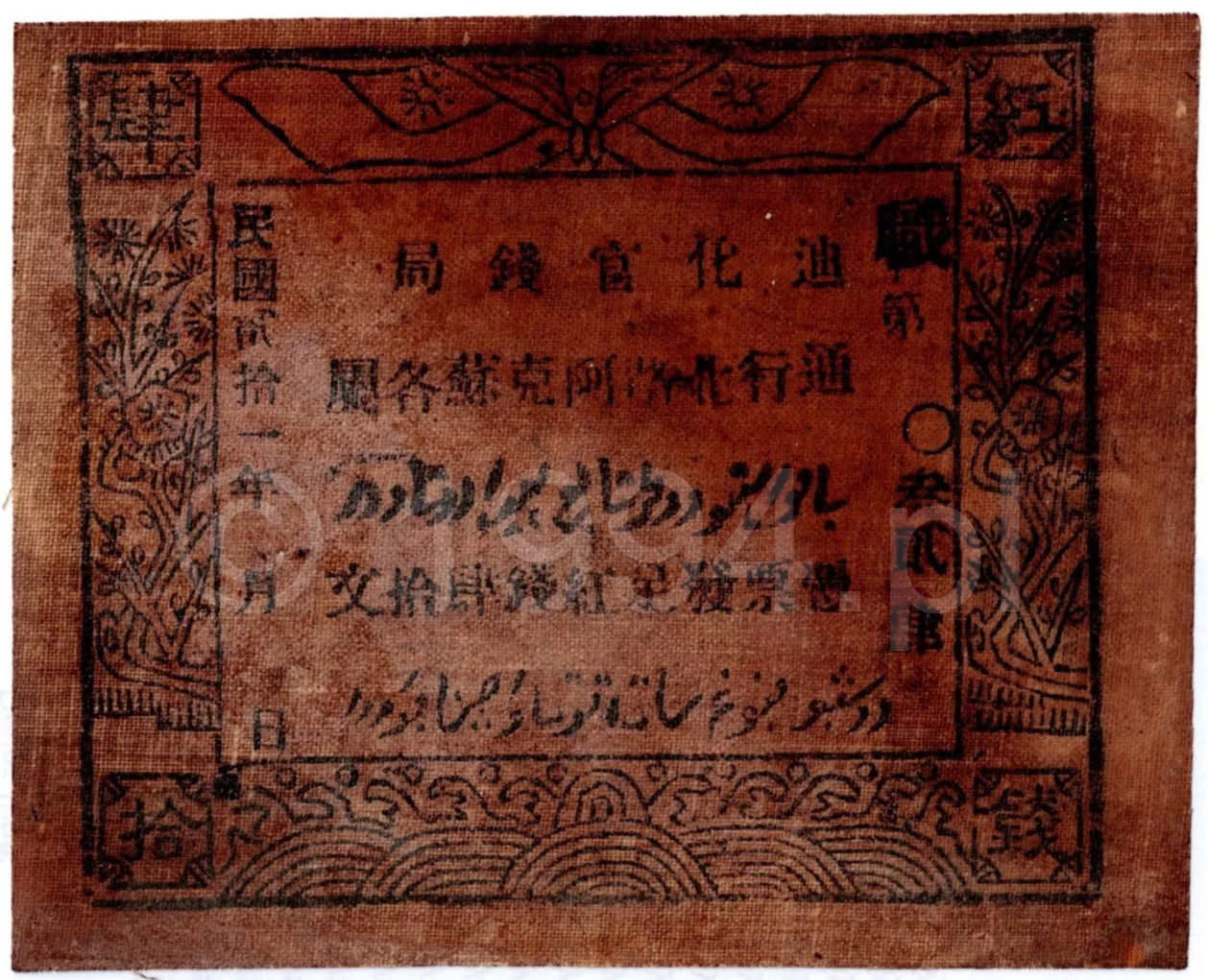
The sun motif enters the emblem system. On a frontier issue, symbols like this are not decoration; they are fast authority-signals that travel across language boundaries.
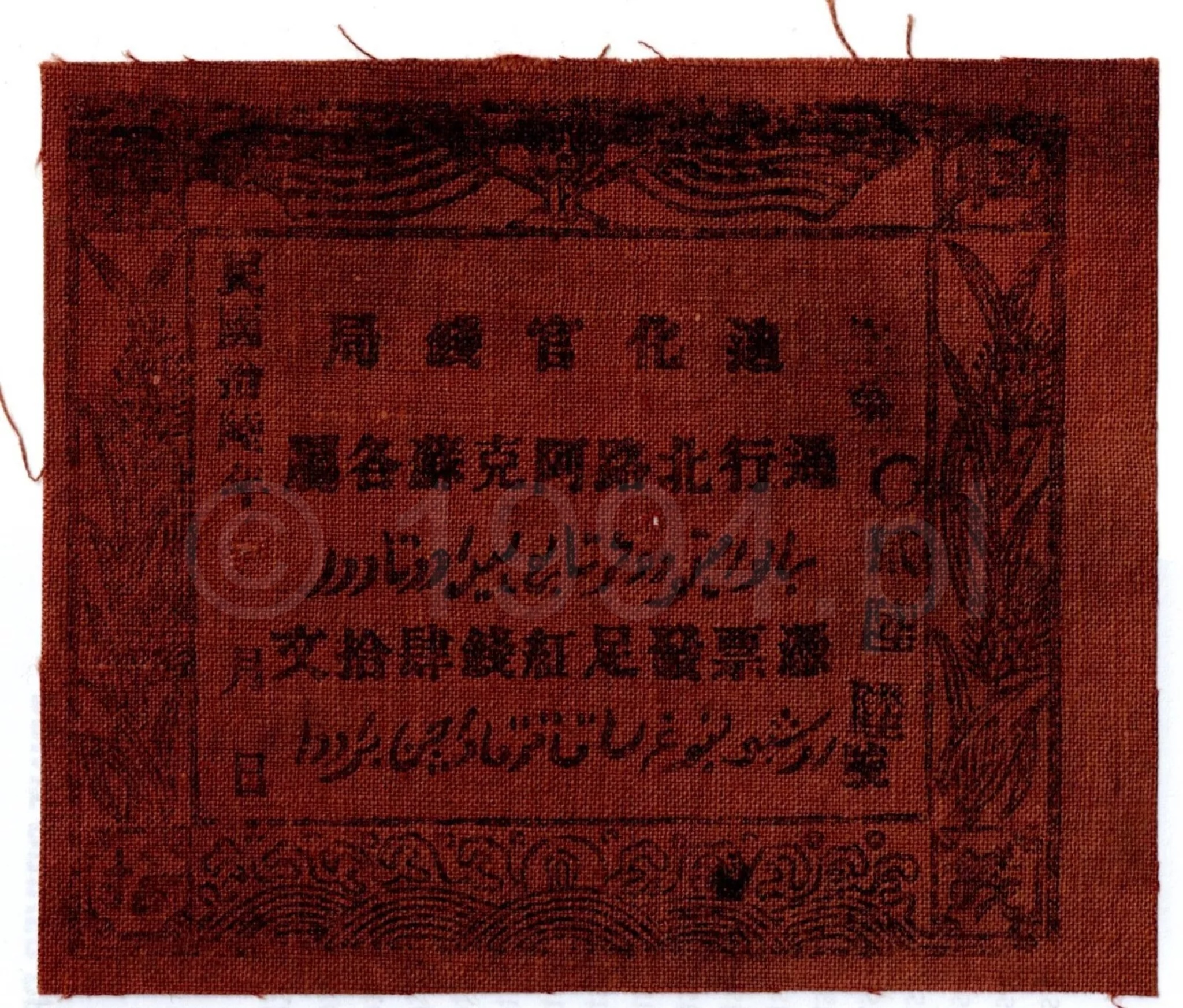
A late phase in the local red-cloth series. Ink density and composition show a workshop that already knows its production “grammar” and repeats it efficiently.

The bureau-level anchor: a formally identified issuing authority and denomination, with an institutional comparator known for this general type.
What the seven-note structure tells us (beyond “seven rare notes”)
With the images in order, the key point is no longer “these exist.” The point becomes: they behave like a system. Even without relying on modern catalog infrastructure, the group shows repeated solutions to the same frontier problems: substrate control, workshop repetition, fast authority signals, and bilingual usability.
1) The medium is part of the message
Modern collectors often treat paper as neutral and design as the “real” content. On Xinjiang cloth issues, the opposite is closer to true: the medium is an administrative choice. Cloth is durable, locally manufacturable, and visually standardized. If you want money to survive harsh handling and you cannot guarantee consistent paper supply, cloth is not a gimmick. It is a solution.
2) Woodblock printing is a rational technology here
Woodblock printing is sometimes misunderstood as “primitive.” In frontier monetary production, it is best understood as a repeatable local manufacturing method. It does not require steel plates, imported intaglio skill, or large industrial infrastructure. It is compatible with short runs, re-cutting, and local control - exactly what emergency finance often demands.
3) Overprints and chops are the security layer
In a low-infrastructure environment, you do not defend money with micro-engraving. You defend it with visible, controllable validation. Thick overprints and authority marks are easy to apply consistently and hard to replicate precisely without access to the same workflow. They also allow a note to be “activated” after printing, which is a powerful control concept: base stock can exist, but value is granted through validation.
4) Multi-script design is not decoration - it is circulation engineering
Xinjiang’s circulation environment demanded legibility across communities. The presence of Chinese text alongside Turkic script forms reflects a practical reality: money must be understood, accepted, and enforceable within a multilingual trade world. In that sense, bilingual text is a circulation feature as real as a denomination.
The 1924 Dihua issue as an anchor point
The 1924 Dihua Official Coin Bureau 40 Wen is the strongest institutional-style anchor in the seven-note set because it is: (1) explicitly bureau-level in naming, and (2) denominated in a clear small unit (wen), consistent with practical circulation use. This is also the point where the public institutional record is known to contain at least one comparable textile issue for the broader type, which matters because it ties frontier cloth money to documented official practice rather than rumor.
The deeper value of that anchor is methodological: it allows the earlier and intermediate pieces to be studied not as “mystery cloth,” but as part of a continuum that includes official bureau solutions. This is exactly how thin topics become thick: a set allows you to move from “object description” to “process reconstruction.”
Research questions this Spotlight is designed to answer
A real source page does not end at description. It builds the research agenda. This set forces several questions that can be asked and answered systematically:
- Authority chain: which issues are civil, which are military, and which are bureau-level - and what that shift means over time.
- Denomination logic: why the set contains both tael-level and wen-level expression, and what that implies about usage contexts.
- Workshop lineage: where blocks appear copied, re-cut, or refined (1918-1922 especially), and whether this is one workshop tradition or several.
- Validation practice: what is printed in the base layer versus what is applied as a control layer (overprints, stamps).
- Language strategy: how script choice tracks the intended circulation environment, not a “decorative” preference.
- Survival logic: why textile notes survive in single-digit populations: heavy circulation, organic decay, and lack of archival retention.
This Spotlight is written so future finds can be compared against a clear framework: substrate, print method, authority expression, validation layer, and design vocabulary. If additional examples surface, they will have a structured place to land - either confirming the pattern or forcing it to evolve.
Why a seven-note Xinjiang textile set matters to world paper money research
“World paper money” research is often paper-centric and catalog-centric. Textile issues sit outside that comfort zone. Yet they may be some of the most honest records of how money truly functions when a state’s standard infrastructure cannot reach the edge.
The lesson is not that Xinjiang is “weird.” The lesson is that frontier finance produces repeatable solutions: durable media, fast validation, and multi-community legibility. What you see here is not seven accidents. It is frontier administration expressing itself through material choice.
References and context sources
This section is intentionally compact. The subject is thin in public documentation. As additional primary sources are identified, this list will expand.
- 邊事研究 (Border Affairs Studies), 1939, issue 6 (PDF) - historical-era discussion containing references to Xinjiang monetary instruments including cloth-note terminology.
- 1994.pl Collection - Textile emergency issues (browse) - internal reference pages for the seven-note set.
Contributions / additional examples: if you have verified images, documented provenance, or institutional references for Xinjiang textile issues (1880-1920s), contact: info@1994.pl