Description and research notes
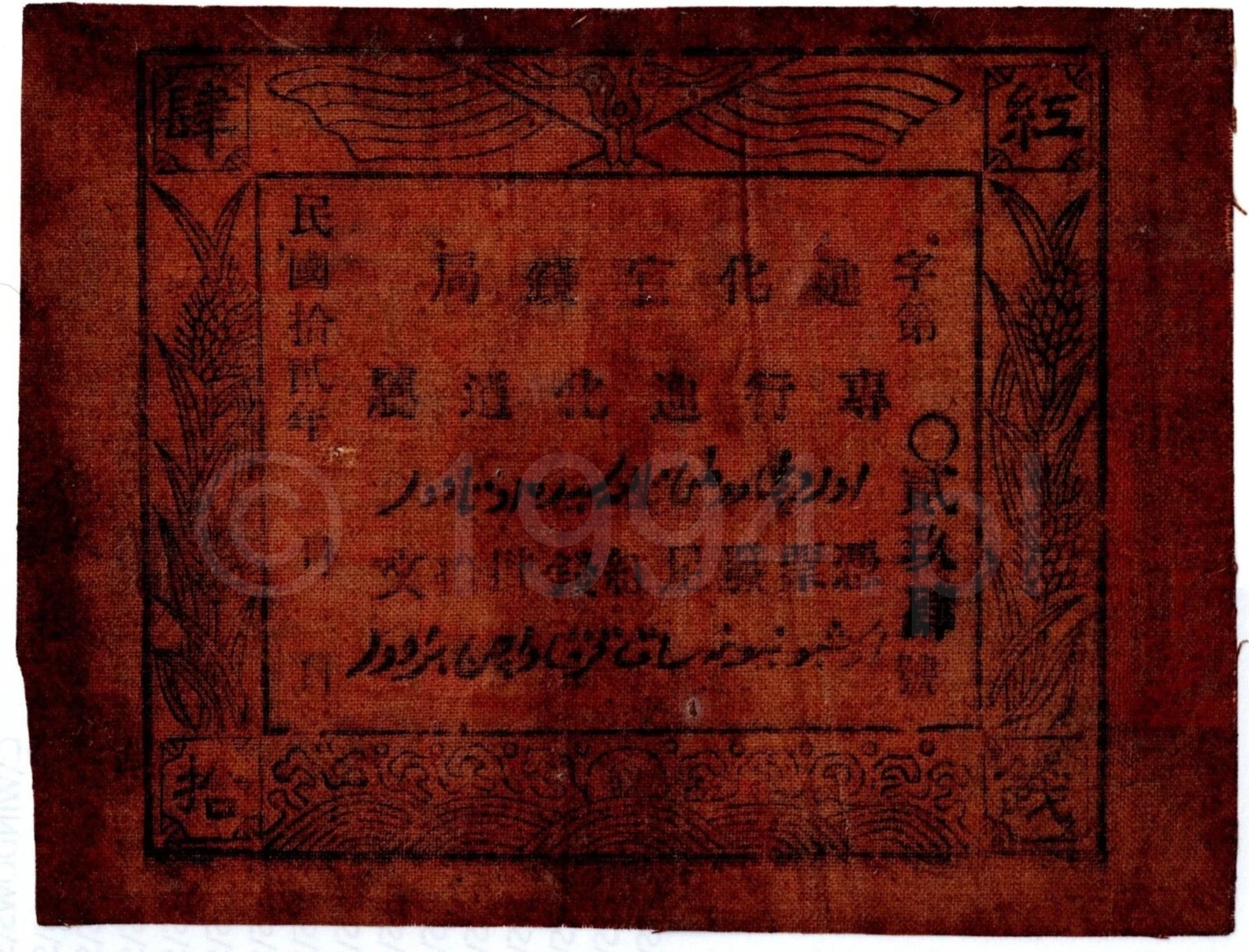
This 1 tael textile banknote represents a formally authorized military emergency issue produced in 1915 by the South Sinkiang Border Defence Headquarters during a period of severe administrative and monetary fragmentation in western China. Issued within the southern frontier zone encompassing Khotan, Yarkand, and Karghalik, the note reflects a localized system of fiscal control exercised by military authorities operating with substantial autonomy from central government structures.
The banknote is printed on hand-woven textile rather than paper, a deliberate and practical choice dictated by frontier conditions. The cloth substrate displays visible horizontal striping consistent with regional weaving traditions, providing durability and resistance to casual counterfeiting. Printing was executed using woodblock techniques, producing uneven ink penetration characteristic of authentic frontier textile issues.
At the center of the design appears a radiating sun emblem enclosing Chinese characters identifying the issuing authority. Surrounding ornamental frames incorporate geometric and vegetal motifs that draw from both Han Chinese and Islamic decorative traditions. This hybrid visual language reflects the multiethnic administrative environment of southern Sinkiang, where monetary instruments had to function across linguistic and cultural boundaries. Inscriptions appear in both Chinese and Uyghur or Chagatai script, reinforcing the note’s official status within a bilingual bureaucratic system.
The prominent red overprint applied across the design served as both validation and control. Executed in thick pigment and applied unevenly, it functioned as an authentication device rather than a decorative element. Such overprints are a consistent feature of genuine military textile currency from the region and period.
The denomination of one tael places this issue above small-denomination cash notes and indicates its use in higher-value transactions. These likely included military provisioning, payments to local suppliers, bullion-equivalent accounting, and administrative settlements within the frontier command structure. The note was not intended for symbolic circulation but for practical fiscal function under conditions where standard monetary channels were unavailable.
At present, only one example of this specific 1 tael textile issue is documented. There are no confirmed specimens recorded in the holdings of the British Museum, the American Numismatic Society, the Smithsonian Institution, or major Chinese public collections. No repeat auction appearances or archival groupings are known. On the basis of observable, verifiable evidence alone, the issue qualifies as R9 - unique.
As a historical artifact, this note documents how military authority on China’s western frontier constructed a functioning monetary instrument using locally available materials, established visual conventions, and bilingual administration. Its combination of textile substrate, woodblock printing, military symbolism, and frontier iconography places it among the most distinctive and academically significant emergency currencies of early twentieth-century China.
Xinjiang Cloth Money (Sinkiang) 1880-1924 - Textile Emergency Currency on Red Cloth, Seven-Note Reference Set