Collection · PL
China (Xinjiang) 1880-1924 - Textile emergency currency and oil-cloth notes: a seven-piece frontier archive
Xinjiang is one of the few places on earth where "money on cloth" was not a metaphor, not folk art, and not a curiosity. It was a practical monetary tool used on a frontier that routinely faced supply gaps, transport delays, and a fragmented mix of coin, silver-weight accounting, and locally authorized substitutes.
This Spotlight documents a seven-piece, front-only archive spanning 1880 to 1924: textile emergency currencies printed by hand from carved blocks onto dyed cloth, plus a later officially issued small-change textile note from Dihua (Urumqi). As far as publicly documented institutional material goes, the baseline is shockingly thin: even major collections record very little, and standard references do not provide a complete structure for this category. Against that backdrop, a continuous seven-piece run across four decades is not "another set" - it becomes a reference line.
What this article is (and is not)
- This is not a rehash of seven catalog cards. The cards describe the objects. This Spotlight explains the system those objects belonged to: when these were needed, why textile was used, who issued them, and what the recurring design logic means.
- This is not a forensic investigation of the backs. The backs are blank, and the story is on the front: substrate, ink, scripts, motifs, layout, denomination logic, and authority markers.
1) Why textile money exists in Xinjiang at all
Cloth currency in Xinjiang sits at the intersection of three realities:
- Frontier distance and logistics: Xinjiang was administered as a frontier region and then made a formal province in the late Qing era, but its currency supply still depended on long supply chains and uneven access to centralized printing and minting.
- Mixed monetary ecology: in practice, people transacted across small coin systems and larger silver-weight accounting. When small change or reliable paper supply breaks, substitute instruments appear.
- Material pragmatism: textile is locally obtainable, physically tough, and (crucially) can be processed to become more resistant to fading and handling than ordinary paper in harsh conditions.
Xinjiang textile notes are often described under the umbrella term bu bi (cloth money). A key sub-type is the oil-cloth note known as you bu tie (often written as 油布帖 / 油布票), where printing was done on cloth and then treated with tung oil to improve durability and reduce fading. This is not speculation - it is directly described in Chinese numismatic literature as the defining production method for the youbu category.
2) The monetary system these notes served (what "tael" and "wen" are doing here)
The important point is not to force Xinjiang textile money into a modern, uniform "banknote" framework. These are instruments built to function inside a frontier system that routinely ran on:
- Small-change logic (cash / wen style denominational thinking for daily exchange), and
- silver-weight logic (tael / liang accounting for larger settlement).
Published regional history notes that official oil-cloth issues included denominations expressed in the local system and also describes a conversion logic used in Xinjiang (for example, 400 "red cash" to 1 tael in the Dihua official issue context). That matters because it explains why a textile note can be denominated in taels (higher-value settlement) while another is a small-change textile note like 40 wen (day-to-day subsidiary circulation).
3) Timeline: how textile money moves from late Qing to early Republic
The easiest mistake is to treat every textile note as an isolated "local oddity." The historical record instead points to repeated, structured use of textile issues in Xinjiang:
- Late Qing framework: Xinjiang was established as a province by the Qing in 1884, giving the region a more formal administrative structure, but frontier monetary improvisation remained a reality.
- Documented oil-cloth issuances start in the late 1880s-1890s: regional history describes oil-cloth notes issued in Ili in 1889 and then an official Dihua bureau issuance in 1890, including stated totals and denominations.
- Early Republican continuity: textile and paper substitutes continued to appear through the 1910s and 1920s as local authorities and offices issued emergency or subsidiary instruments under practical constraint.
- 1923-1932 window for 40 wen textile subsidiary notes: the same regional history explicitly places a 40-wen oil-cloth note issue into a 1923-1932 period and ties it to provincial-level production (treasury mint bureau / official production apparatus).
That timeline matters because it lets us position the 1924 Dihua 40-wen textile note correctly: it is not a random outlier. It sits inside a documented late stage where textile notes appear as a small-change solution.
4) A working typology (so this becomes a reference, not a gallery)
With the published timeline in mind, the seven notes in this archive fall naturally into a practical structure:
-
Category A: Early frontier textile issues (pre- or proto-oil-cloth stage)
A coarse dyed-cloth issue attributed here to circa 1880. Published accounts often emphasize formal oil-cloth issues starting in the late 1880s; this earlier piece functions as an "antecedent tier" - either an earlier local practice or a dating that represents the early phase of the same frontier textile logic. -
Category B: Military-authority textile issue (tael-denominated)
A 1915 1-tael issue attributed to the South Sinkiang Border Defence Headquarters, reflecting the fact that in the early Republic, military and frontier administration often handled provisioning and settlement with localized instruments. -
Category C: Local authority textile emergency notes (1918-1922)
A sequence of visually related Xinjiang textile types printed on red cloth, showing an internal design vocabulary evolving over a few years. -
Category D: Official small-change textile note (40 wen, Dihua, 1924)
An officially named issuing authority, explicit denomination, and a documented period where 40-wen textile notes are recorded as a provincial-level subsidiary issue.
At a glance: the 7 textile notes (1880-1924)
| Year | Authority / Issuer | Denomination | Format | Collection item |
|---|---|---|---|---|
| c.1880 | Xinjiang (Sinkiang) local frontier issue | Unspecified | Red-dyed cloth, woodblock style | View item |
| 1915 | South Sinkiang Border Defence Headquarters | 1 Tael | Textile emergency issue, authority emblem + overprint | View item |
| 1918 | Xinjiang local authority issue | Unspecified | Red cloth, woodblock printing, framed inscription panel | View item |
| 1920 | Xinjiang local authority issue | Unspecified | Red cloth, evolved block design, heavier side panels | View item |
| 1921 | Xinjiang local authority issue | Unspecified | Red cloth, winged emblem with sun motif | View item |
| 1922 | Xinjiang local authority issue | Unspecified | Red cloth, compact calligraphy, later workshop phase | View item |
| 1924 | Dihua Official Coin Bureau | 40 Wen | Official textile issue (documented small-change category) | View item |
5) The seven-note archive (images, with how each fits the story)
Layout below is chronological. Each caption is written as a "why it matters" statement - what it contributes to the system-level picture. Click any image to open full size.

Why it matters: this is the earliest anchor in the run. Published accounts often emphasize formal oil-cloth notes from the late 1880s onward. This piece functions as an antecedent tier: a frontier textile money logic already present at (or attributed to) circa 1880, before the better-documented official issuances that follow.

Why it matters: the denomination is in tael (liang) terms, which signals a higher-value settlement function. This is the "military-authority" branch of the same textile-money ecosystem: provisioning and frontier administration using durable local instruments.
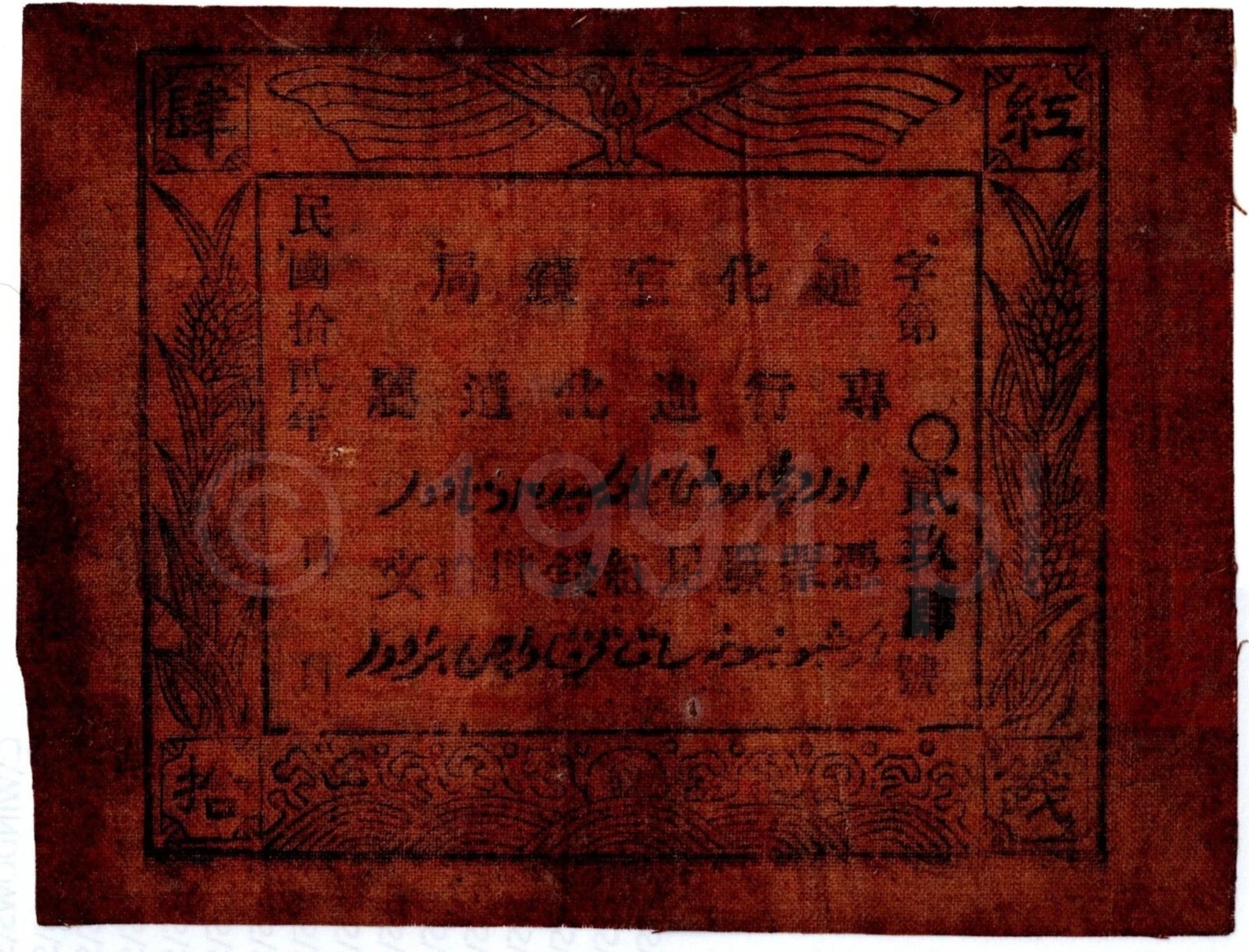
Why it matters: this begins a visually related 1918-1922 run. Framed inscription panel, ornamental borders, and a consistent lower-band vocabulary show a workshop tradition rather than a one-off improvisation.

Why it matters: the same design language persists, but the composition tightens. This is exactly what a living workshop tradition looks like: blocks get re-cut, motifs get standardized locally, but production stays non-centralized.
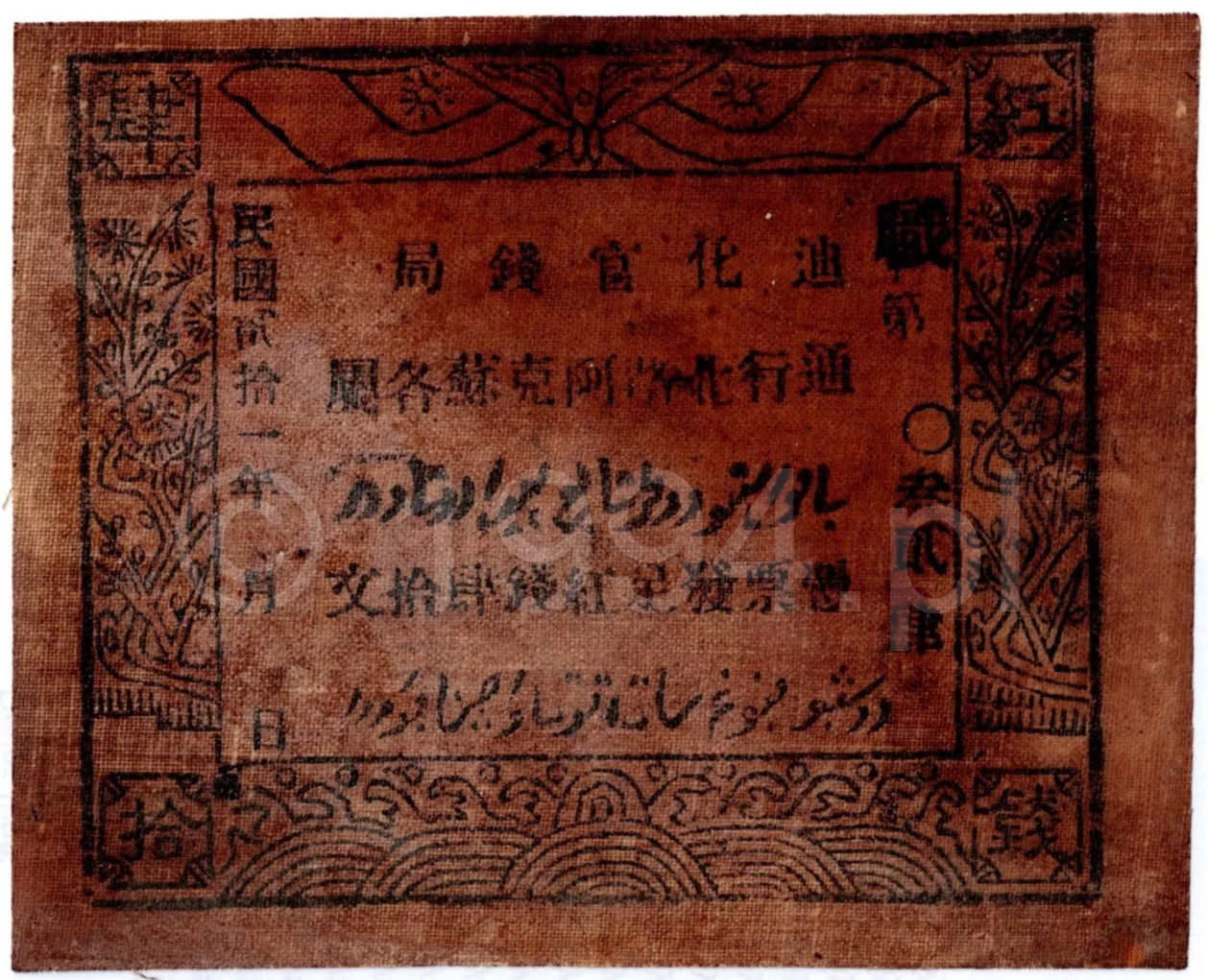
Why it matters: the sun-emblem element signals a shift in symbolic vocabulary (Republican-era visual language entering frontier instruments), while the rest of the layout remains recognizably Xinjiang textile tradition.
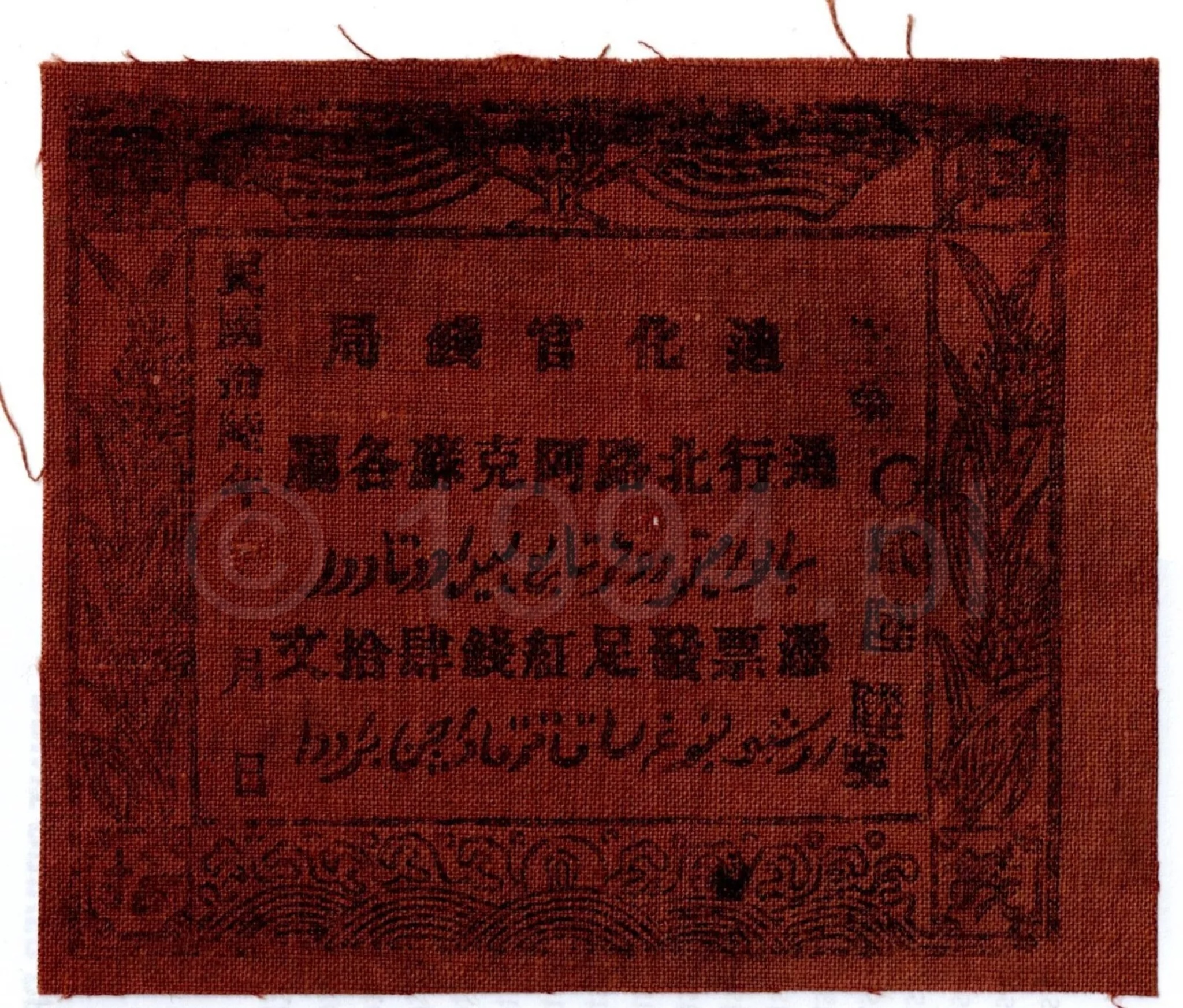
Why it matters: this is the late point of the red-cloth local run before the documented 40-wen subsidiary textile issue. The sequence demonstrates continuity, not randomness: 1918 to 1922 reads like a moving design system.

Why it matters: this is the official small-change endpoint of the archive. Regional history explicitly describes a 40-wen oil-cloth note issuance window (1923-1932) as a subsidiary currency solution. This note therefore anchors the set into documented institutional practice rather than leaving it entirely in "unrecorded frontier" space. (The item page also documents the British Museum as holding an institutional example of a related 1924 textile issue, underlining how thin the public institutional baseline is.)
6) What the seven together reveal (the parts you cannot get from any single note)
A single textile note can always be dismissed as an odd survival. A seven-note run over 44 years cannot. This archive makes three things visible:
- Continuity of method: across decades, the production grammar stays consistent with frontier textile money: block-printed structure, ink saturation variability, and a layout style optimized for recognizability and legitimacy rather than machine precision.
- Evolution of visual vocabulary: the 1918-1922 run reads like a workshop lineage: motifs persist, blocks are re-cut, composition tightens, and political-era symbols enter without replacing the underlying local format.
- Authority layering: the archive contains local/civil types, a military-authority tael piece, and an official 40-wen issue. That is the system: different authorities solving the same frontier money problem at different transaction levels.
7) The "WHEN / WHY / WHO" questions this set is built to answer
When are textile notes used?
The historical record explicitly places oil-cloth note issuance in Xinjiang from the late 1880s onward, and it also records a 1923-1932 period for 40-wen textile subsidiary notes. This seven-note archive shows the practice spanning 1880-1924 in collectible, comparable form.
Why cloth and not paper?
Because cloth is available, durable, and can be treated. The defining youbu production method is described as printing on cloth (woodblock or lead plate) and then processing with tung oil to improve durability and reduce fading - which is exactly what you would do when paper supply and climate conditions make ordinary paper unreliable.
Who issues these?
Multiple layers: local authorities, military commands, and official bureaus. That is the point. Xinjiang textile money is not one "issuer." It is a frontier monetary response appearing wherever responsibility for provisioning and exchange actually sat.
Why do we care (beyond rarity)?
Because these are operational artifacts. They document how an economy keeps moving when standardized money fails locally. This is not "exotic material." It is monetary infrastructure under constraint.
8) Research notes and terminology (kept practical)
- Xinjiang / Sinkiang: older Western romanization commonly used in numismatic references.
- Dihua: historical name for present-day Urumqi, used on official issues and administrative references.
- Bu bi (cloth money): textile currency category in regional numismatic discussion.
- You bu tie / you bu piao: oil-cloth note format (printed on cloth and treated with tung oil).
- Tael (liang): silver-weight accounting denomination used for larger settlement.
- Wen / cash: small-change accounting unit used in daily exchange; the 40-wen textile note sits in that lane.
9) Selected references (starting points, not a finished bibliography)
-
Shaanxi Provincial Library - regional monetary history notes with specific Xinjiang oil-cloth issuance details (late Qing and Republican period),
including the 1889 Ili issue, 1890 Dihua official bureau issue, and the 1923-1932 40-wen textile subsidiary issue.
sxlib.org.cn reference page -
"Xinjiang cloth money has many types" (Xinjiang numismatic discussion) - describes youbu production method: printing on cloth and treating with tung oil
(you bu tie / oil-cloth notes).
alljournals.cn excerpt -
Encyclopaedia Britannica - background on Xinjiang becoming a province (1884) and the region's early Republican governance context.
Britannica: Xinjiang -
Collection anchor - Dihua 1924 40-wen textile issue (includes the institutional note reference used on 1994.pl).
1994.pl item page
Contact
If you hold any comparable Xinjiang textile issues, have archival references, or can point to institutional records beyond the currently cited baseline, contact: info@1994.pl
``` Research anchors used for the historical framework (not guesses): China - Xinjiang textile emergency currency on red cloth (1880-1924): decentralization under stress Need canonical URL for the generator pls : https://1994.pl/spotlight/China - Xinjiang textile emergency currency on red cloth (1880-1924): decentralization under stress
This Spotlight documents seven surviving Xinjiang textile issues spanning 1880 to 1924. Taken together, they form a coherent frontier monetary system rather than a curiosity: the same basic production logic repeats across decades, across changing authorities, and across shifting political vocabulary. Cloth becomes money not because it is symbolic, but because it is workable. Woodblock printing becomes the technology not because it is refined, but because it is locally controllable. The result is a long-running monetary practice at the edge of state infrastructure, where legitimacy is produced by recognizability, durability, and administrative habit rather than by centralized paper supply.
The Xinjiang setting matters. This is a region of enormous distances and multiple linguistic communities, where the physical movement of coin, paper stock, and printing expertise was always vulnerable to interruption. When supply chains fail, currency does not disappear; it mutates. In these seven pieces we can watch that mutation stabilize into a system. Red-dyed cloth, deep pigment, and repeated ornamental grammars act as the substitute for formal security printing. Bilingual text is not decoration but an operational requirement. And control devices shift over time from purely visual authority to more explicit validation practices, culminating in an official bureau issue in 1924.
The structure below is chronological on purpose. The goal is not to group by issuing office, but to show continuity under stress: how the same material and method persist while authority migrates between local civil practice, military administration, and eventually a formally named bureau. Each entry below is presented as an object and as a piece of a larger administrative record.
1880 - Late Qing frontier cloth note (Sinkiang), woodblock printed
The 1880 example sits close to the late Qing reconstruction of Xinjiang as a governed frontier. It reads as a practical substitute currency produced in an environment where official coin and paper were chronically scarce, and where the administrative toolkit still leaned heavily on pre-modern production: locally sourced cloth, hand-carved blocks, and the kind of ink saturation that comes from manual pressure rather than mechanized control. The visual result is not a flaw; it is a fingerprint of method. Misalignment, uneven strike, and variable density are what you get when the objective is usability, not uniformity.
Cloth as a substrate solves multiple frontier problems at once. It survives handling better than fragile paper in harsh climates, it absorbs pigment deeply, and it resists casual alteration because the weave holds the ink in the fibers rather than on a surface film. In a region where formal engraving and serial-number infrastructure cannot be relied upon, the substrate itself becomes part of the security story: durability and deep strike are the anti-tamper logic.
1915 - South Sinkiang Border Defence Headquarters, 1 tael: military authority as monetary issuer
By 1915 the set shows a clear escalation in institutional intent. This is not merely a local stopgap; it is a formally authorized emergency issue attributed to a military headquarters operating within the southern oases. The denomination of one tael signals a higher-value accounting environment than casual market exchange. This is frontier finance written in administrative terms: provisioning, supplier settlement, bullion-equivalent bookkeeping, and command-level control.
The bilingual and hybrid decorative vocabulary is not cosmetic. In southern Xinjiang, money had to be legible across communities involved in trade, taxation, and logistics. The visual language therefore combines recognizability with authority signals: emblems, framed inscriptions, and a prominent red validation layer that functions as control rather than ornament. In textile issues, overprint pigment acts like a seal: thick, uneven application is expected, because the goal is to leave a distinct intervention on cloth.
1918 - Local authority cloth money: continuity with refinement
The 1918 issue returns the focus to local circulation needs, but with evidence of workshop evolution. Compared to the earliest frontier cloth style, the composition is more settled: darker ink, denser calligraphy, and a clearer separation of registers. This is still woodblock and still cloth, but it shows what happens when a technique is repeated enough times to develop an internal standard. In non-centralized systems, standardization does not arrive as a decree. It arrives as habit.
The visible textile weave remains part of the authentication logic. Unlike paper notes, where the substrate is meant to disappear under print, textile issues display the substrate as proof of material. The eye reads weave plus strike plus red cloth as the correct object category. That category recognition is itself a defense: it makes substitution harder without access to the same cloth and dye practice.
1920 - Repeated local issue: the system becomes routine
The 1920 issue shows the key characteristic of a durable emergency system: repetition without apology. The point is not to look new; the point is to keep functioning. Design vocabulary descends through copying, re-cutting, and local adaptation. That is exactly how woodblock currency behaves when there is no central plate archive: blocks wear out, a new block is cut, motifs migrate, and the tradition stays recognizable even as details shift.
This is the monetary logic of a frontier economy that cannot wait for paper supply. The note is not a ceremonial object; it is a transaction tool. Its authenticity is anchored in the convergence of material (coarse red cloth), method (woodblock), and administrative look (framed inscriptions, repetitive ornament). The continued use across years implies that the community knew how to read it, and that the issuing authority could enforce acceptance within its zone.
1921 - The sun emblem: Republican-era vocabulary enters the frontier textile tradition
The 1921 issue introduces a distinct symbolic shift: a sun motif appears within the emblematic register. This matters because it shows how political vocabulary can be adopted without changing the production infrastructure. The state may change its symbols, but the frontier keeps its methods. In this set, that is the broader lesson: iconography can evolve while substrate and technology remain constant.
The sun emblem also functions as a legitimacy marker. On a cloth note that lacks modern engraving and serial numbering, emblematic vocabulary becomes part of the authority claim. This is not about aesthetics. It is the visual shorthand that tells a multi-lingual audience that this is not a random textile token, but a note aligned with a recognized political order.
1922 - Late local issue: mature workshop phase before bureau absorption
The 1922 example reads as a mature workshop phase within the same non-centralized system. Calligraphy appears heavier and more compact, borders more emphatic, and the overall design language suggests re-cutting rather than reuse. That is exactly what one expects from long-lived woodblock practice: blocks are copied, reinterpreted, and reinforced over time. The output stays within a shared grammar while exhibiting distinct individual hands.
This note also highlights the tension at the heart of decentralized emergency finance. It is stable enough to be repeated, but it remains outside the standard paper infrastructure of modern state currency. This tension is what makes the set historically valuable: it captures a long interval in which local systems were strong enough to sustain circulation while central systems were weak enough to leave space.
1924 - Dihua Official Coin Bureau, 40 wen: institutionalization of the cloth-money method
The 1924 Dihua issue is the natural endpoint of this sequence because it represents the same cloth-money method under an explicitly named issuing bureaucracy. Dihua, the historical name for Urumqi, served as the administrative capital in the northern sphere. Here, the emergency solution becomes an official response: a bureau issue addressing shortages of paper currency, disrupted transport, and limited access to centralized printing facilities. Cloth is no longer a purely local improvisation; it is a formal substrate deployed by an office to keep transactions moving.
This final piece also clarifies what the set has been showing all along: frontier monetary systems do not simply collapse into modern paper money overnight. They pass through phases where older methods are absorbed into bureaucratic practice. The woodblock and red cloth remain, but the language of issuance becomes more explicitly administrative, including a clearly stated denomination (40 wen) and a bureau identity that frames the note as part of fiscal order rather than local necessity.
What the seven-note sequence demonstrates
Seen as a whole, this set is not about unusual material. It is about administrative continuity when central infrastructure cannot supply money. Across 1880 to 1924, the same components repeat: red cloth, woodblock printing, framed inscriptions, ornamental borders, and bilingual or multi-community legibility. What changes is the surface vocabulary of authority: local frontier production, explicit military administration, and finally bureau issuance at the provincial capital. This migration of authority is the core story. Under stress, legitimacy moves downward. When conditions permit, legitimacy moves back upward, carrying the local method with it.
The woodblock method is often treated as primitive in comparison with engraved banknotes, but in the Xinjiang context it is a rational technology. It is local, reproducible, and controllable without an industrial printing plant. The cloth substrate is similarly rational: durable, widely available, and hard to erase. Together they form a pragmatic frontier security model built on physical constraints, not on fine-line engraving. The result is a monetary system that can operate beyond centralized control while still maintaining recognizability and enforceable acceptance within a defined circulation zone.
That is why these seven notes matter as a set. They record not merely an emergency, but a long-running frontier response to isolation and disruption. They provide a chronological map of how money remains possible when official supply fails: first as local necessity, then as military instrument, and finally as a bureaucratic solution that formalizes what the frontier has already been doing for decades.