Description and research notes
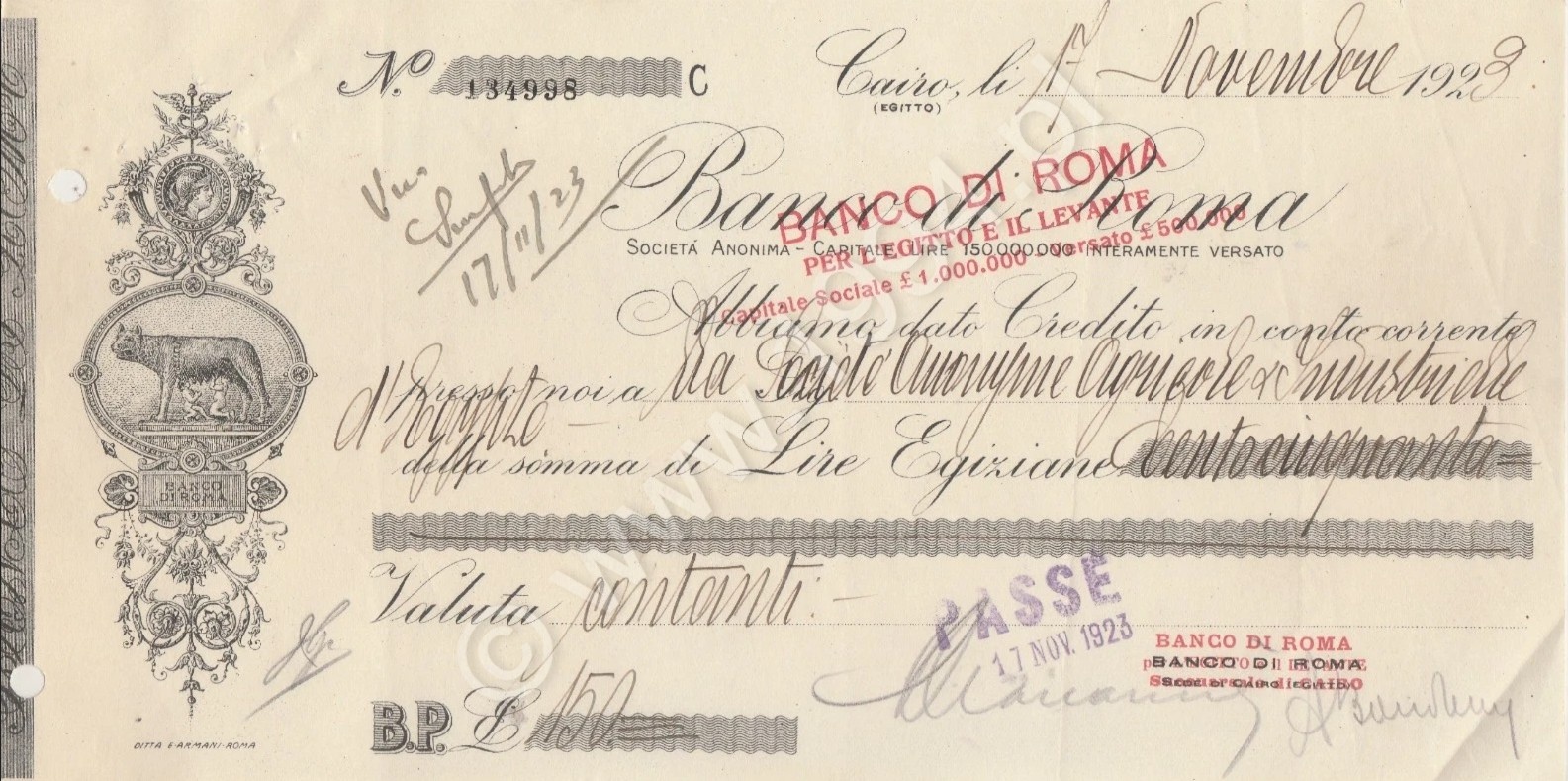
Original Banco di Roma cheque issued in Cairo on 17 November 1923, printed on cream security paper with a richly engraved Roman header characteristic of interwar Italian banknote and cheque design. At the upper left, within an elaborate vertical cartouche of scrollwork and rosettes, appears the iconic Capitoline Wolf suckling Romulus and Remus. This emblem served as the visual shorthand for Banco di Roma's institutional identity and its projection of Italian national symbolism abroad. The engraving is attributed to the Ditta Farani–Roma printing house, whose small imprint is placed discreetly at the lower margin, consistent with commercial security work of the period.
The cheque is completed in multiple period inks. The handwritten date '17 Novembre 1923' appears at top, with payee information and the manuscript amount entered across the lower guilloche band designed to prevent alteration or erasure. A prominent red BANCO DI ROMA overprint identifies the Cairo branch and displays the bank’s fully paid capital in both lira and sterling. This bilingual capital declaration was typical of Banco di Roma's overseas branches, which catered to clients who settled payments in multiple currencies across the Mediterranean. At lower right, a violet PASSÉ clearing stamp dated 17 NOV. 1923 confirms same-day internal settlement. Pencil notations and endorsement initials along the left margin reflect the routine processing steps performed by bank clerks and receiving institutions.
Banco di Roma played a significant role in the financial and commercial world of interwar Egypt. By the 1910s and 1920s, Italy maintained a broad expatriate community in Alexandria and Cairo, with active merchant houses, construction firms, shipping agents, agricultural exporters, contractors, and artisans. To serve this community and strengthen Italy’s economic footprint in the region, Banco di Roma established branches across the eastern Mediterranean-Alexandria, Cairo, Beirut, Smyrna-acting as both a retail bank and a conduit between Italian capital markets and Near Eastern commerce. Its Cairo branch offered current accounts, trade financing, documentary clearing, foreign exchange services, remittances to Italy, and the management of contractors' payrolls engaged in infrastructure and building projects.
The use of engraved Roman imagery on its cheques was more than decorative. It communicated the bank's aspiration to represent national strength, reliability, and cultural continuity. Italian overseas institutions at the time often combined national symbolism with modern security printing to compete with British, French, Belgian, and Greek banks already entrenched in Egypt. Cheques served not only as negotiable instruments but also as branding devices that reinforced confidence among merchants handling cross-border payments.
The 1920s were a transitional period for Egypt's financial sector. Although still under British influence, Egypt’s commercial environment was increasingly cosmopolitan, with Italian, French, Belgian, Greek, and local Egyptian banks all competing for deposits and trade-finance operations. Cheques like this one passed through a complex clearing ecosystem involving correspondent banks, foreign exchange houses, and the Egyptian postal and telegraph systems. The violet PASSÉ stamp captures a snapshot of this network in action, documenting the internal daily settlement operations of Banco di Roma’s Cairo branch.
Surviving Cairo-issued Banco di Roma cheques from the early 1920s are uncommon. Most were destroyed during archival reductions, especially during mid-century bank liquidations or mergers, or when financial institutions disposed of decades-old clearing paper. Many surviving examples are heavily trimmed, defaced, or reduced to fragments. This complete specimen-with full engraving, intact overprints, clear clearing stamp, and uninterrupted manuscript entries-stands as a valuable artifact of Italian overseas banking operations in Egypt during the interwar period and contributes meaningfully to the broader documentary history of Egypt’s multi-national financial landscape.


