Description and research notes
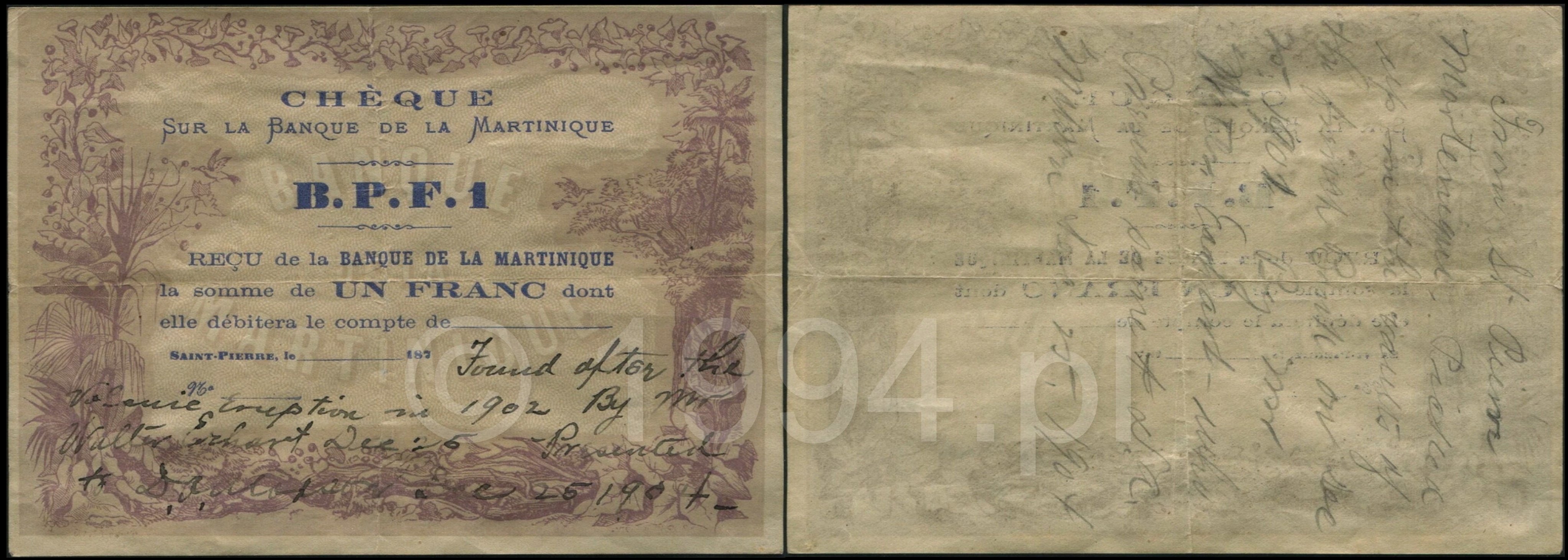
An unissued cheque for one franc prepared for the Banque de la Martinique and intended for use at Saint-Pierre, dating from the early period of organized colonial banking on the island. Classified as Pick P.5A, this form represents a non-circulating banking instrument rather than a circulating banknote, designed for internal settlement, account debiting, and controlled monetary transfers within the colonial financial system.
The Banque de la Martinique was established as part of France’s overseas banking framework, created to stabilize currency supply and facilitate commercial credit in the Caribbean colonies. Unlike metropolitan France, where centralized banking instruments were already standardized, colonial institutions relied on a mixture of notes, cheques, receipts, and drafts adapted to local economic realities. This cheque format reflects that transitional monetary environment, bridging formal banking practices and localized colonial commerce.
The printed text confirms receipt of one franc by the Banque de la Martinique, with the amount to be debited from the account of the named holder. The layout follows classic mid-19th-century French security printing conventions, with balanced typographic hierarchy, engraved ornamental borders, and floral corner motifs designed to deter alteration and counterfeiting. The denomination is expressed both numerically and in full text, reinforcing its accounting function rather than use as hand-to-hand currency.
The place of issue, Saint-Pierre, anchors the document historically. Before the catastrophic eruption of Mount Pelée in 1902, Saint-Pierre was the economic and administrative center of Martinique, often referred to as the "Paris of the Caribbean." Banking instruments originating from Saint-Pierre are therefore directly connected to the island’s lost commercial capital and its pre-disaster financial infrastructure.
The absence of signatures, dates, and account details confirms that this example was never activated or negotiated. Its clean, unused state indicates archival retention, printer surplus, or internal bank preservation rather than circulation. Such unissued cheques were commonly retained for control, auditing, or administrative reference and rarely survived once banking systems modernized and obsolete forms were discarded.
Printed by Claverie et Fils with engraved elements attributed to Reschérer, the cheque demonstrates the continued reliance on metropolitan French printers and engravers for colonial financial instruments. This practice ensured visual consistency, security quality, and institutional authority across France’s overseas territories.
As a surviving unissued example, this cheque serves as a documentary artifact of colonial banking mechanics rather than a monetary substitute. Pick P.5A is infrequently encountered, and examples in fully unused condition are especially scarce. The piece occupies a specialized niche within French colonial numismatics, valued for its institutional context, documentary clarity, and direct association with Martinique’s pre-1902 financial history.