Description and research notes
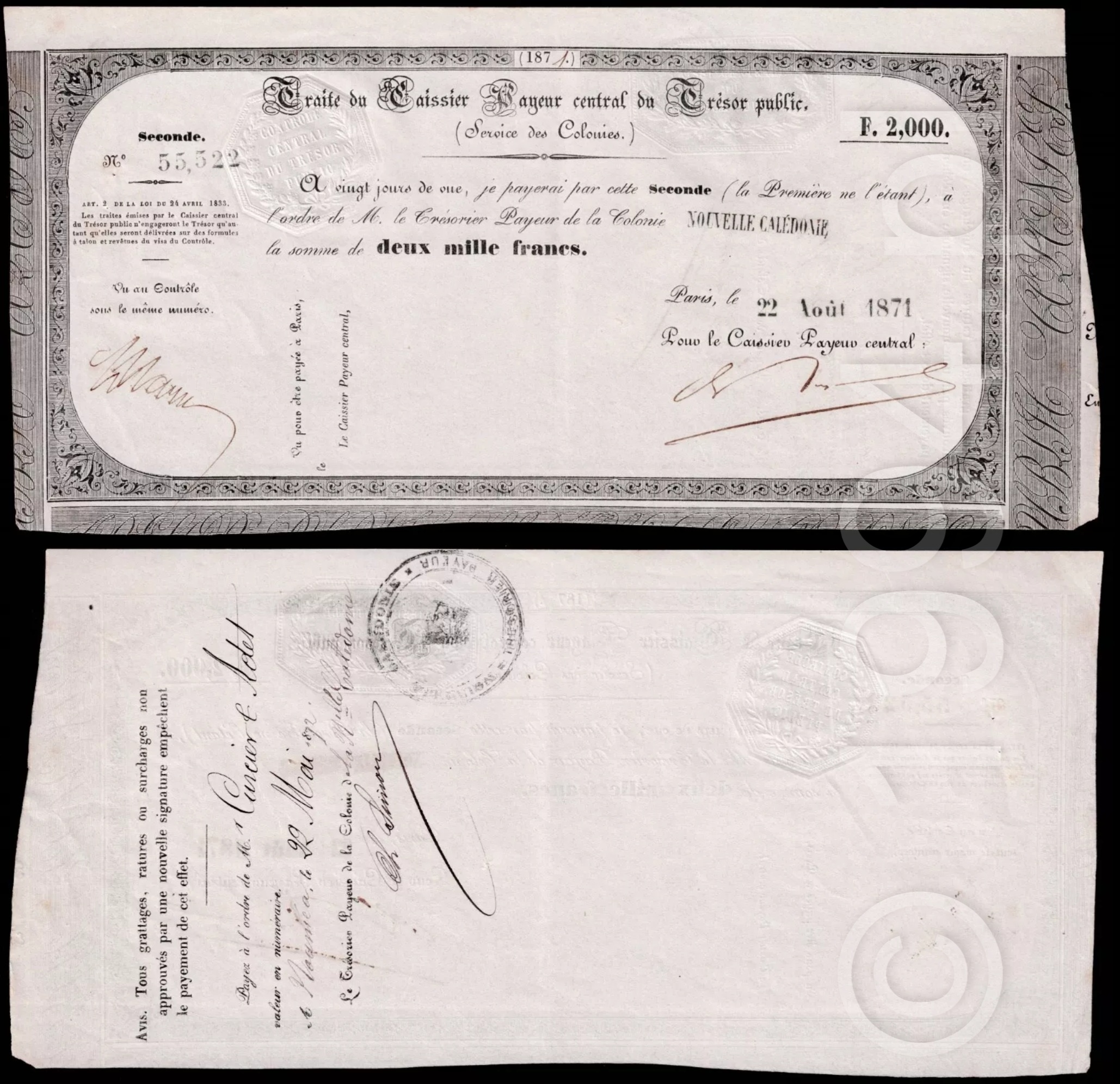
A colonial treasury bill of exchange issued in 1871 under the authority of the French public treasury for the colony of New Caledonia. This document represents the second of exchange (*seconde*), forming part of a standard multi-part financial instrument employed by the French administration to execute high-value intercontinental payments within the colonial fiscal system.
The bill was drawn by the *Caissier Payeur central du Trésor public (Service des Colonies)* and made payable to order in New Caledonia for the sum of two thousand francs. Dated in Paris on 22 August 1871, it belongs to the immediate post–Franco-Prussian War period, when French state finances were being reorganized and colonial treasury control was reasserted through formal, document-based instruments rather than circulating currency.
The face presents a formal printed layout typical of French treasury paper of the period, combining engraved text with manuscript completion. It explicitly identifies the instrument as the second of exchange, issued alongside a corresponding first, each holding independent legal standing. This duplication was a deliberate safeguard against loss, delay, or interception during long-distance transmission between France and overseas territories.
The reverse carries manuscript endorsements, treasury markings, and control annotations applied during validation and processing. These elements document the administrative life of the instrument rather than serving any decorative or public function. Together, the front and back constitute a single treasury document associated with one specific authorization and payment instruction.
Bills of exchange of this type were not generic issues but transaction-specific payment orders. Each example corresponded to an individual treasury authorization, defined by its date, serial number, signatories, designated colony, and amount. Differences in year, colony, or signatures therefore represent distinct fiscal transactions rather than variants or duplicates of a single issue.
Instruments of this nature were never intended for public circulation. They functioned as internal state payment orders used to transfer funds, settle colonial accounts, and finance administration, infrastructure, and provisioning within overseas possessions. Once honored, such documents were normally redeemed and destroyed or retained selectively within official archives.
No other examples of this 1871 New Caledonia second of exchange in the denomination of 2,000 francs are currently documented. On the basis of observable and verifiable evidence alone, this instrument is treated as a one-on-one survivor and classified as R9.
As a historical artifact, this document provides direct insight into the mechanics of French colonial finance in the late nineteenth century. It records the practical operation of treasury credit, legal redundancy, and administrative oversight at a moment when New Caledonia was transitioning from penal-colony administration toward a more structured colonial economy governed through centralized fiscal authority.