Collection PL

About
Results for “r9 extremely rare”
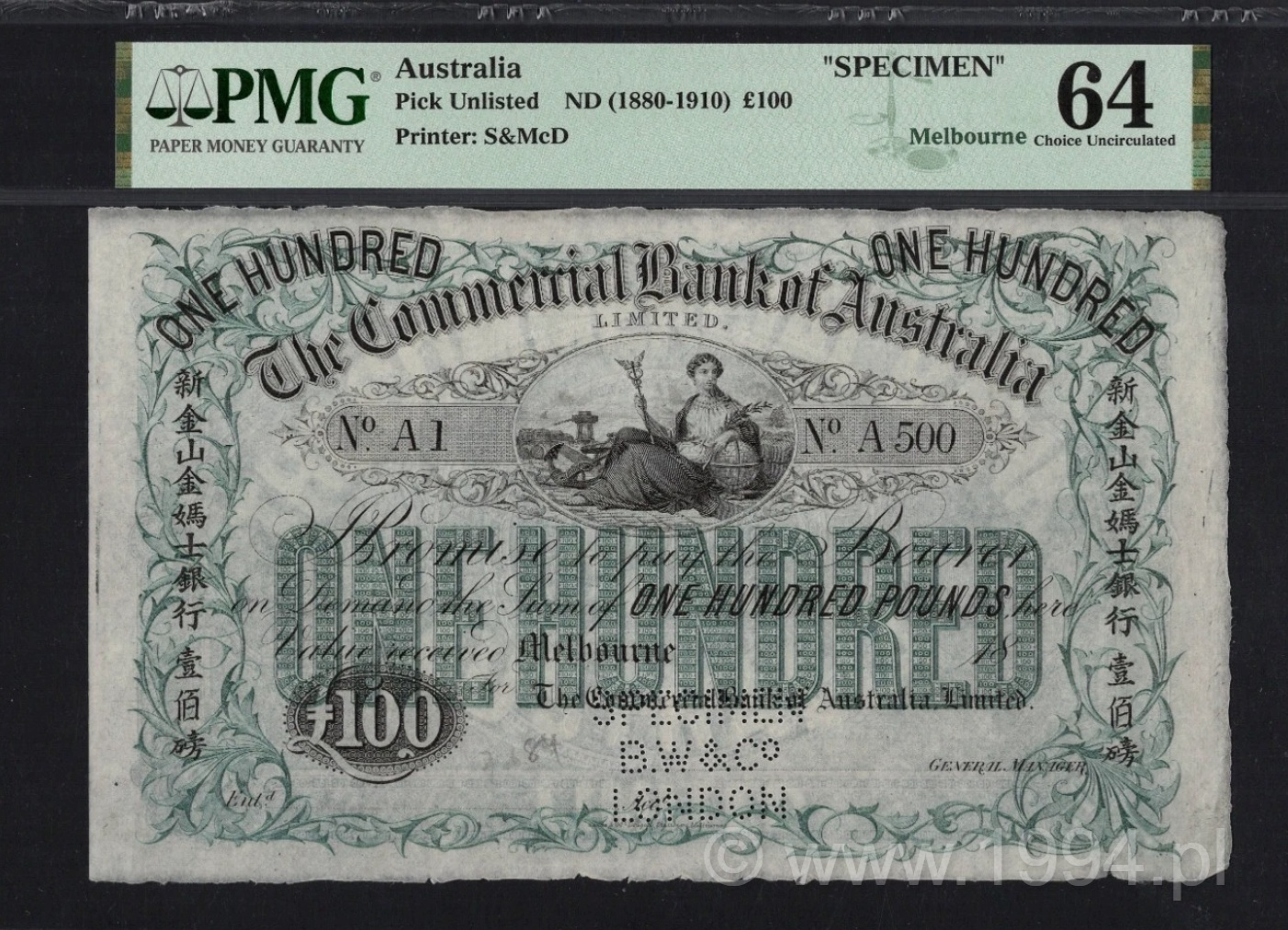
Australia 1880–1910 Commercial Bank of Australia £100 specimen, PMG 64 Choice Uncirculated

Australia 1880–1910 - Commercial Bank of Australia £100 Specimen (Pick Unlisted)

The Chinese text was not an incidental decorative feature added to a later issue. It formed part of the Commercial Bank of Australia’s note design from the bank’s establishment in 1866. The winning note design announced in June 1866 specifically incorporated the bank’s name and the denomination in Chinese characters into the border. This was a deliberate commercial distinction aimed at Chinese customers at a time when Chinese merchants, miners, laborers, trading houses, and investors formed an important part of the Victorian economy. Contemporary reporting explicitly connected the Chinese inscriptions with the bank’s desire to attract Chinese depositors, making the notes an early and unusually direct example of financial-product localization and customer acquisition embedded in the currency itself. Read more →

AustraliaSpecimen1880100 PoundsPMG 64 Choice Uncirculated Specimen100 PoundsHigh DenominationCommercial Bank of AustraliaBradbury WilkinsonBWCSands & McDougallColonial SpecimenBilingualChinese-EnglishPick UnlistedColonial Banking HistoryAustralian Private BanknotesPre-Notes Act Era19th Century BankingMulticultural Trade NetworksSecurity Printing HistoryBritish Engraving InfluenceAustralian Monetary HistoryAustralia188019101880–1910PMG 64Museum GradeR9 Extremely RareUniqueAnnotationsHandwritten Annotations
Held
New Zealand 1907–1926 Bank of New Zealand £20 Blue audit-range serial-prefix specimen with dual control numbers, Bradbury Wilkinson & Co., PMG 55 AU, Pop 1/1, R9 Extremely Rare

New Zealand 1907–1926 - Bank of New Zealand £20 Blue Serial-Prefix Audit Specimen (Pick S194s)

A unique high-denomination Bradbury Wilkinson audit-range specimen and the rarest surviving document from New Zealand’s private-banknote era, the £20 Blue (Pick S194s) represents the apex of BNZ’s color-coded denomination hierarchy. This specimen is not a generic zero-serial example: it carries dual live serials (No. 061001 and No. 066000), identifying it as an internal audit-range piece used by Bradbury Wilkinson for plate alignment, tint calibration, and numbering verification during the official approval process. Read more →

New ZealandSpecimen190720 PoundsPMG 55 About Uncirculated (Pop 1/1) Specimen20 PoundsBlueBNZ Color LineageHigh Denomination Color TierHigh DenominationAudit-Range SpecimenSerial PrefixDual Serial NumbersPerforated SpecimenBradbury WilkinsonBWCPick S194sBank of New ZealandPrivate Banknote EraPre-Reserve BankNew Zealand Banking HistoryBritish Engraved NotesMāori Portrait VignettesSecurity Printing HistoryHigh-Value NotesAudit Control SheetNew Zealand190719261907–1926PMG 58Pop 1Top PopMuseum GradeR9 Extremely RareUnique
Held
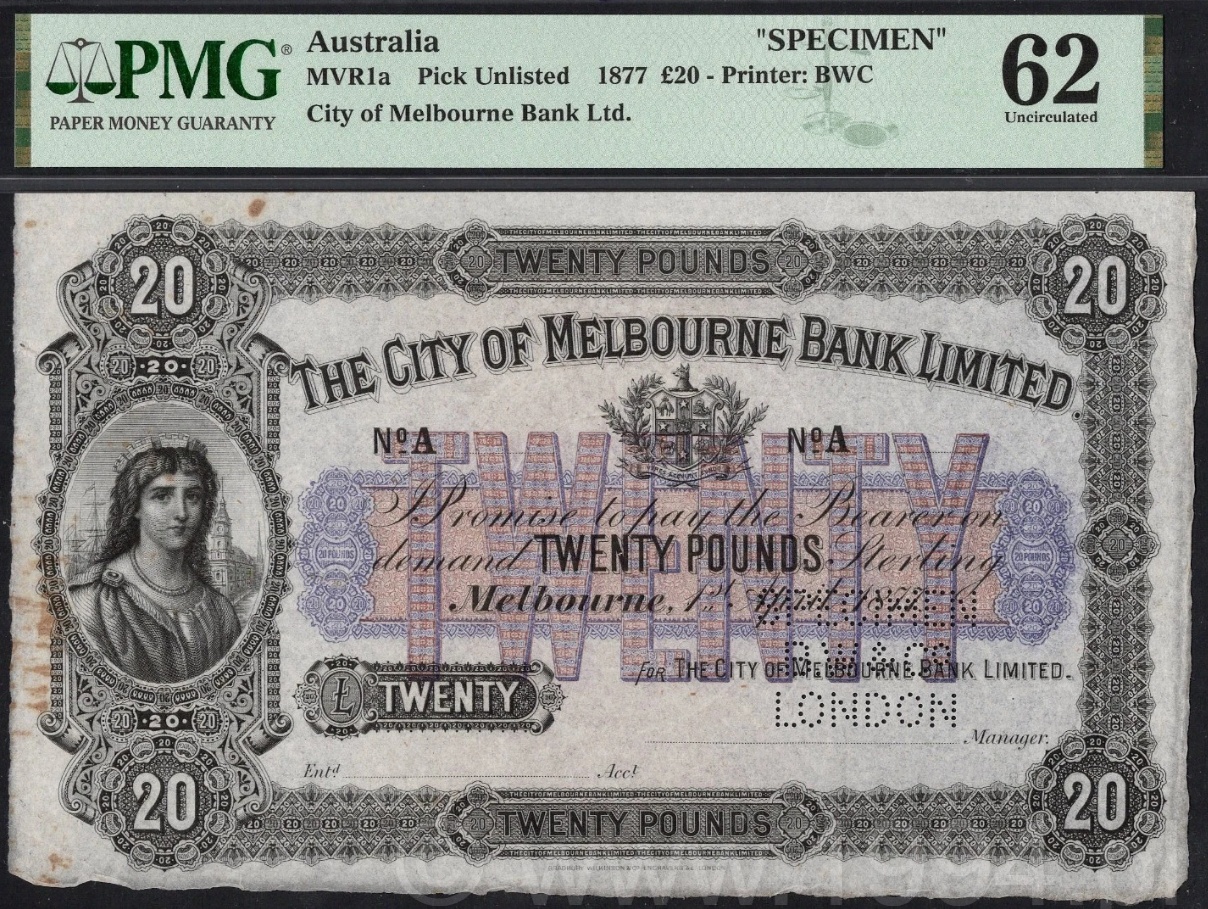
Australia 1877 City of Melbourne Bank Limited £20 specimen engraved by Bradbury Wilkinson, PMG 62 Uncirculated, unique surviving example

Australia 1877 - City of Melbourne Bank Limited £20 Specimen (Pick Unlisted)

Certified PMG 62 Uncirculated, the note stands as a singular artifact of Australia’s private-banknote era. It represents the intersection of rarity, engraving excellence, and financial history, and qualifies unequivocally for classification as R9 - Unique. Read more →

AustraliaSpecimen187720 PoundsPMG 62 Uncirculated Specimen20 PoundsCity of Melbourne Bank LimitedBradbury WilkinsonBWCPick UnlistedColonial SpecimenEngraved Security PrintingAustralian Private BanknotesVictoria Banking HistoryPre-Federation FinanceGold Rush Era BankingSecurity Printing History19th Century BankingAustralian Monetary HistoryAustraliaVictoria1877PMG 62Museum GradeR9 Extremely RareUnique
Held
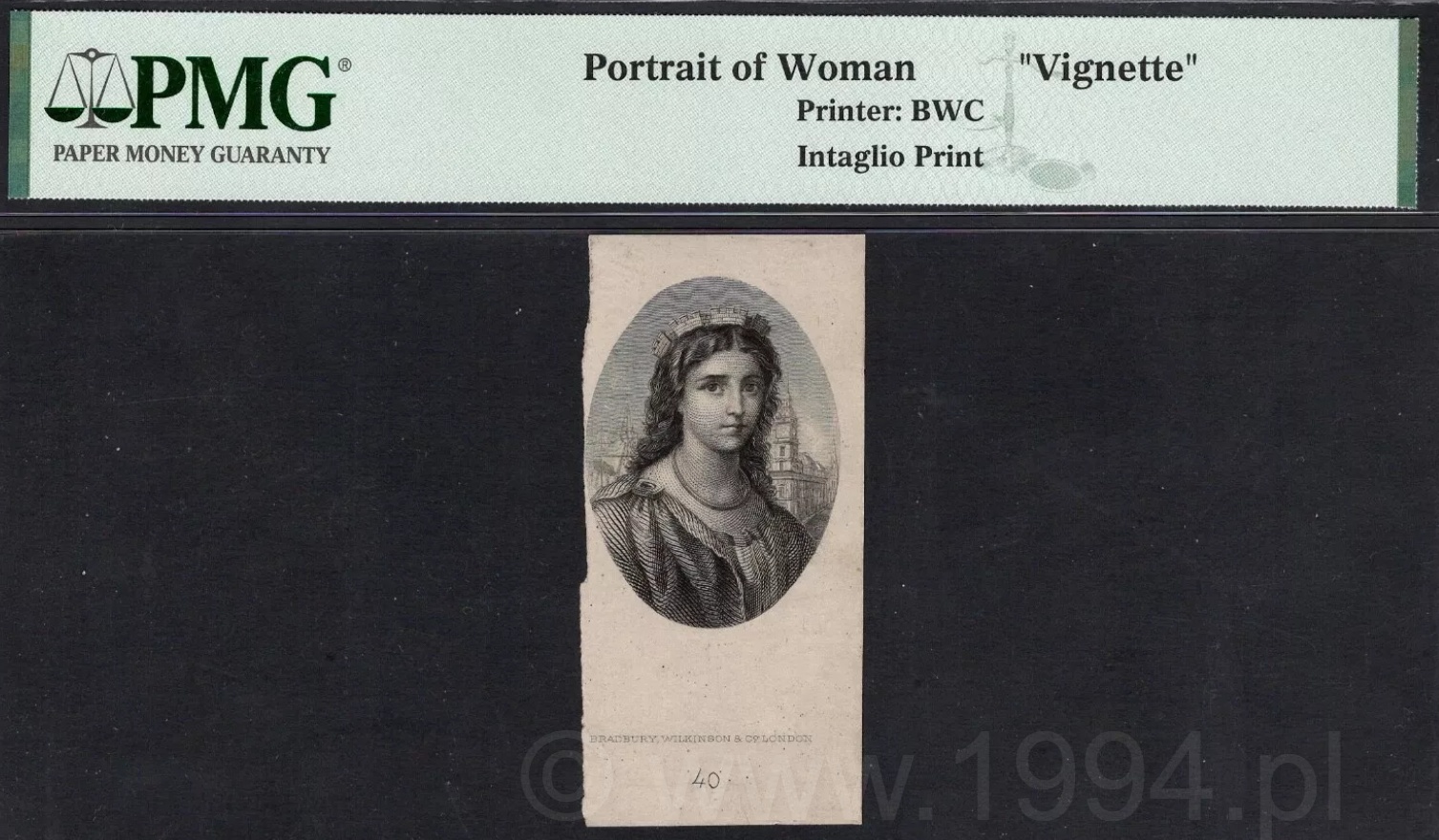
Bradbury, Wilkinson and Company 1877 Portrait of Woman intaglio vignette proof, printer's library design element associated with the City of Melbourne Bank Limited 20 Pounds colonial Australian banknote design

Australia 1877 - Bradbury, Wilkinson and Company Portrait of Woman Intaglio Vignette Proof for City of Melbourne Bank Limited 20 Pounds Design (Pick Unlisted)

As a stand-alone intaglio impression, the vignette preserves the original pictorial element independently from the financial instrument in which it was used and documents Bradbury Wilkinson's portrait engraving and banknote production practice at the component level. Read more →

AustraliaVignette Proof1877Reference VignetteArchival Intaglio Proof Vignette ProofIntaglio Vignette ProofPortrait VignettePortrait of WomanEngraved PortraitPrinter's Library ElementPrinter's Design ArchiveProduction Stage ArtifactStandalone VignetteReference VignetteCity of Melbourne Bank Limited Design Source20 Pounds Design SourceBradbury, Wilkinson and CompanyBradbury, Wilkinson and Company LondonLondon Security PrinterIntaglio PrintingIntaglio EngravingSecurity EngravingBanknote PrintingSecurity PrintingPrivate Banknote ProductionProofing and Plate ApprovalDesign Verification ArtifactPick UnlistedAustralian Banking HistoryAustralian Colonial BankingPre Federation AustraliaVictoria Banking HistoryCity of Melbourne BankCity of Melbourne Bank LimitedColonial VictoriaPrivate Banknote TraditionNineteenth Century Paper MoneyVictorian Era EngravingHistoryAustraliaVictoria1877R9 Extremely RareUniqueMuseum Grade
Held
New Zealand Bank of Australasia £50 Christchurch proof note dated 1896, Victorian engraved colonial banknote printed by Perkins Bacon, PMG 55 proof

New Zealand 1896 - Bank of Australasia £50 Christchurch Proof (Pick Unlisted)

The denomination itself is significant. Fifty Pounds represented the highest practical value employed by colonial banks for everyday large scale settlements, placing this proof at the apex of the Bank of Australasia New Zealand note structure. Proofs of such high denominations were produced in extremely limited numbers and were typically retained internally or discarded once designs were approved. Read more →

New ZealandProof189650 PoundsPMG 55 About Uncirculated Proof Banknote50 PoundsPre Issue ProofNon Circulating ProofInstitutional Presentation NoteBank of AustralasiaBritish Chartered BanksColonial Banking in New ZealandColonial FinanceBritish Security PrintingVictorian EngravingExport Engraved NotesNew ZealandChristchurch188819211896Pick UnlistedMuseum GradeR9 Extremely RareUnique
Held
Australia Bank of Australasia 10 Pounds Melbourne proof note, early Victorian colonial banknote, Perkins Bacon engraving, PMG 45 proof

Australia 1835-1850 - Bank of Australasia £10 Melbourne Proof (Pick Unlisted)

The layout reflects early Victorian security printing practice, with heavy border engraving, balanced symmetry, and restrained ornamentation intended to convey authority and trust. The absence of serial numbering and signatures is consistent with proof status and confirms that the note represents a design-stage artifact rather than an issued instrument. Read more →

AustraliaProof183510 PoundsPMG 45 Choice Extremely Fine Proof Banknote10 PoundsPre Issue ProofNon Circulating ProofInstitutional Presentation NoteBank of AustralasiaEarly Australian BankingBritish Chartered BanksColonial FinanceBritish Security PrintingEarly Victorian EngravingExport Engraved NotesAustraliaMelbourne183518501835-1850Museum GradeR9 Extremely RareUnique
Held
Brazil 1773 Tejuco Diamond Administration 6 Octavas gold receipt No. 813,

Brazil 1773 - Diamond Administration of Tejuco, 6 Octavas Gold Receipt No. 813 (Pick Unlisted)

The form records the release of “seis outavas de ouro” (six octavas of gold), a denomination tied directly to Portuguese metrological standards of the 18th century. Every transaction in the diamond zone was logged under strict royal oversight, and very few printed instruments survived the destruction protocols imposed during later 18th- and early 19th-century reforms. The vast majority of known diamond-district documents are purely handwritten; printed forms of this type are exponentially rarer. Read more →

BrazilFinancial Document17736 Octavas of GoldXF (Manuscript-Completed Fiscal Receipt) Financial DocumentDiamond DistrictPick unlisted1773 ReceiptNumber 8136 OctavasPortuguese Colonial BrazilCasa da Administração dos DiamantesMinas GeraisTejucoGold LedgerManuscript EntryFiscal FormRoyal Arms PortugalColonial Taxation18th Century FinancePortuguese EmpireBrazil1773R9 Extremely RareUniqueMuseum Grade
Held
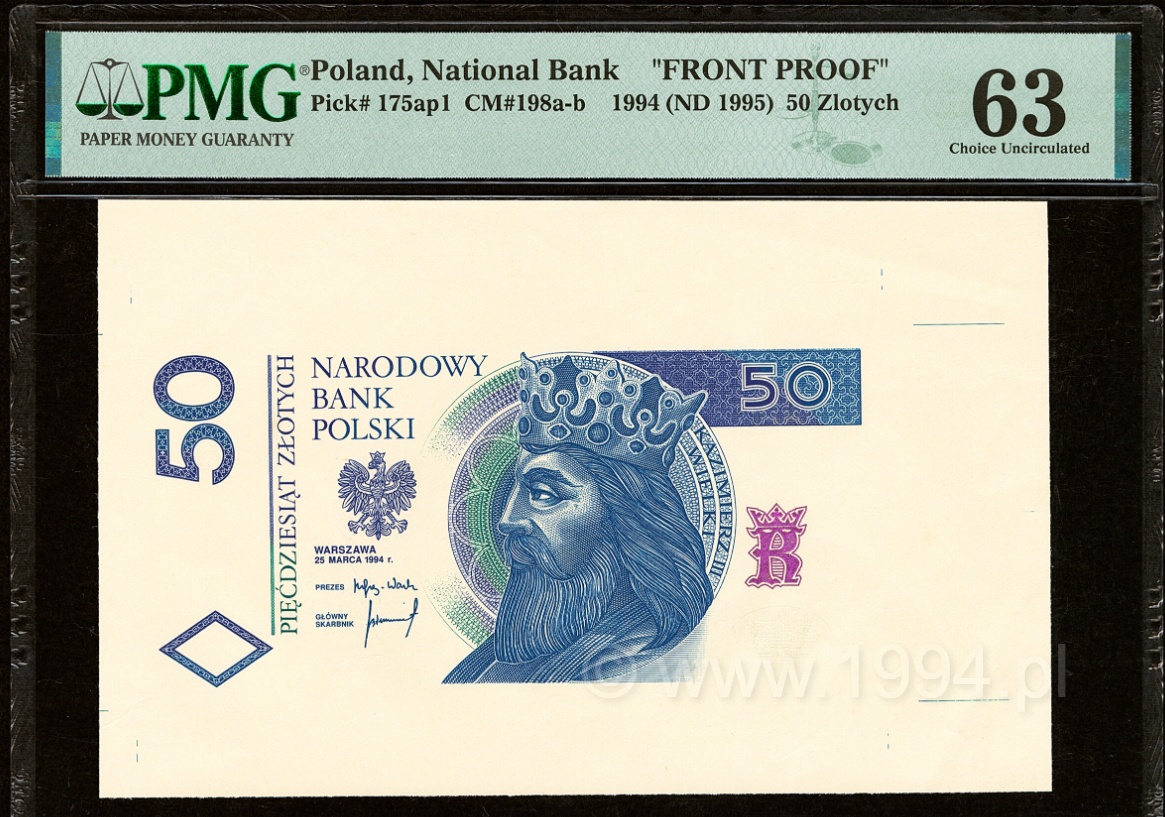
Poland 1994 50 Złotych front proof, Pick 175ap1, PMG 63 Choice Uncirculated, final approved obverse design by Thomas De La Rue

Poland 1994 - 50 Zlotych Front Proof (Pick 175ap1)

As a front proof, the sheet carries no reverse impression and no serials, confirming its role as an approval and archival reference rather than a circulation or presentation item. Such proofs were produced in extremely small numbers and retained within De La Rue’s internal archives as part of the printer–central bank approval workflow. Read more →

PolandFront Proof199450 ZłotychPMG 63 Choice Uncirculated (Front Proof, Top Pop 1/1) Front ProofPick 175ap1Thomas De La RueTDLRNarodowy Bank PolskiKazimierz WielkiCasimir the GreatModern Polish BanknotesRedenomination SeriesPoland1994PMG 63Top PopR9 Extremely RareUniqueMuseum Grade
Held
Australia 1877 Mercantile Bank of Sydney £1 specimen with red ONE overprint, Pick Unlisted, printed by Bradbury Wilkinson & Co., graded PMG 66 EPQ Gem Uncirculated Pop 1, only known example

Australia 1877 - Mercantile Bank of Sydney £1 Specimen (Pick Unlisted)

A superb Bradbury, Wilkinson & Co. specimen from the early colonial banking era, this £1 note for the Mercantile Bank of Sydney survives today as the only documented example of its type. Certified PMG 66 EPQ Gem Uncirculated and recorded as Pop 1, it represents a unique surviving specimen of a private Australian bank whose issues rarely appear in any form. The same piece is known to have appeared once in a past Christie’s sale prior to encapsulation, making this the sole confirmed survivor based on all available auction, census, and institutional research. Read more →

AustraliaSpecimen18771 PoundPMG 66 EPQ Gem Uncirculated (Pop 1) Specimen1 PoundPick UnlistedRed OverprintColonial Private BankBradbury WilkinsonBWCMercantile Bank of SydneyNew South Wales Banking History19th Century FinanceAustralian Private IssuesSecurity Printing HistoryColonial PeriodAustralia1877Only Known ExampleR9 Extremely RareUniquePop 1Top PopPMG 66 EPQGem UncirculatedMuseum Grade
Held
Australia Federal Bank of Australia Limited one pound Sydney specimen printed by Bradbury Wilkinson, annotated 1882, PMG 64 Choice Uncirculated

Australia 1879–1903 - Federal Bank of Australia, Limited £1 Sydney Specimen (Pick Unlisted)

A pencilled annotation reading “9 May 82” appears on the note. Such annotations are rarely preserved on specimen material and provide valuable documentary evidence of how reference notes were handled during the working life of a banknote design. Specimens were commonly retained in printer archives, banking offices, or presentation sets used during the approval and distribution process. Handwritten notes added during this process form part of the historical record of the object itself. In this case, the annotation confirms that the specimen was already in institutional reference use by 1882, within the earliest operational period of the Federal Bank of Australia. Read more →

AustraliaSpecimen18791 PoundPMG 64 Choice Uncirculated (Annotated, Top Population) Specimen Banknote1 PoundPrinter SpecimenAnnotated SpecimenExport Engraved NoteLarge Format BanknoteBradbury WilkinsonBWCBritish Security PrintingVictorian Era EngravingPrivate Banknote ProductionFederal Bank of Australia LimitedAustralian Private BanksPre Federation AustraliaSydney Banking HistoryVictorian Banking Crisis1893 Banking CollapseAustraliaSydney187919031879–1903Pick UnlistedTop PopMuseum GradeR9 Extremely RareUniqueAnnotationsHandwritten Annotations
Held
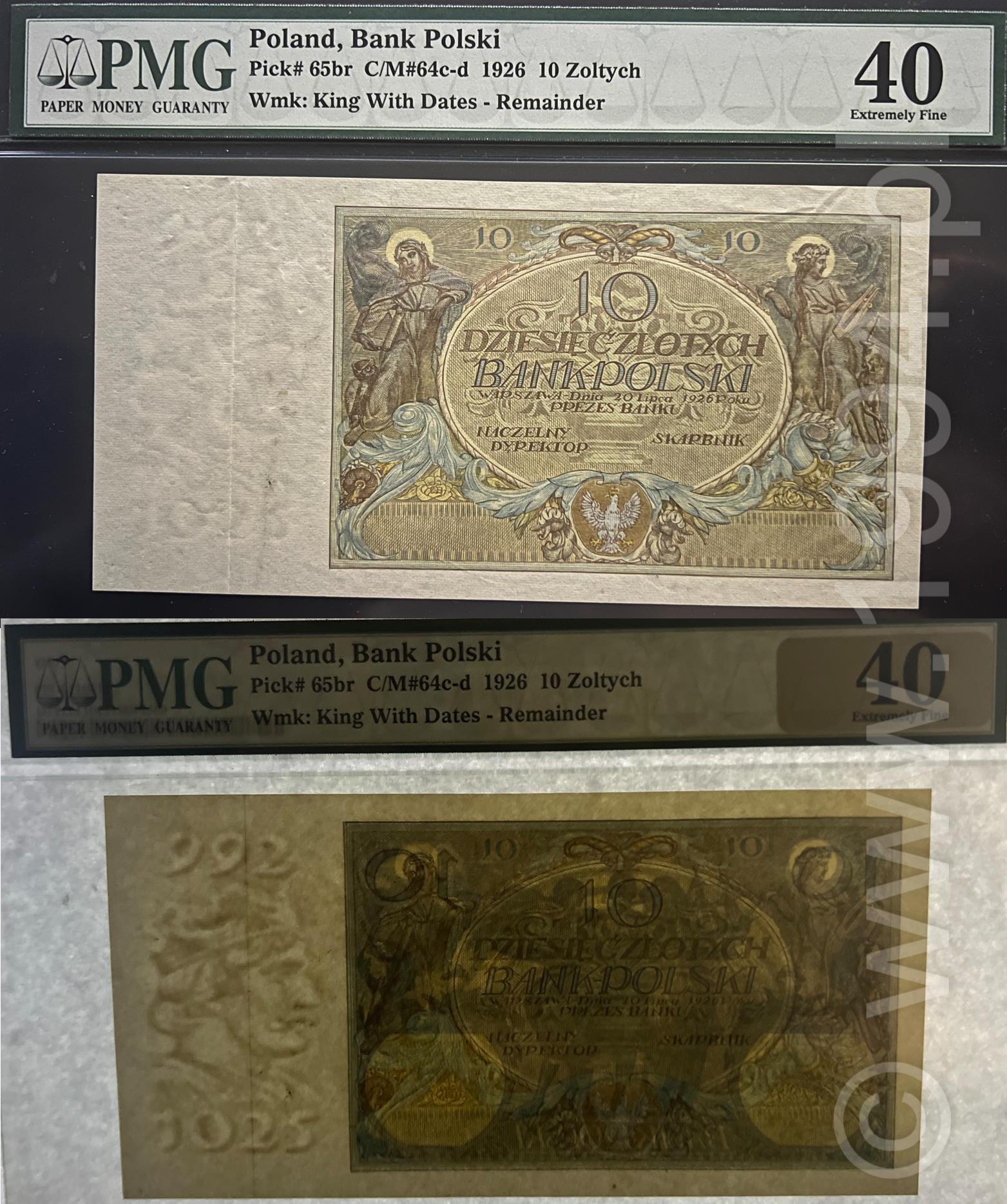
Poland 1926 10 Złotych remainder Pick 65br with Bolesław Chrobry 992–1025 portrait watermark, PMG 40 Extremely Fine

Poland 1926 - 10 Zlotych Remainder Bolesław Chrobry 992–1025 Watermark (Pick 65br)

Remainder material of this kind was therefore routinely scheduled for destruction shortly after printing ceased, in order to prevent uncontrolled use. Survival was incidental rather than deliberate and resulted only from isolated departures from standard disposal procedures. Read more →

PolandRemainder192610 złotychPMG 40 Extremely Fine RemainderBank Polski10 ZlotychPortrait WatermarkBoleslaw Chrobry992–10251926 Banknote IssueSecond Polish RepublicState SymbolismWatermark HistoryPoland1926Museum GradeR9 Extremely RareUniquePick 65brMilczak 64PMG 40
Held
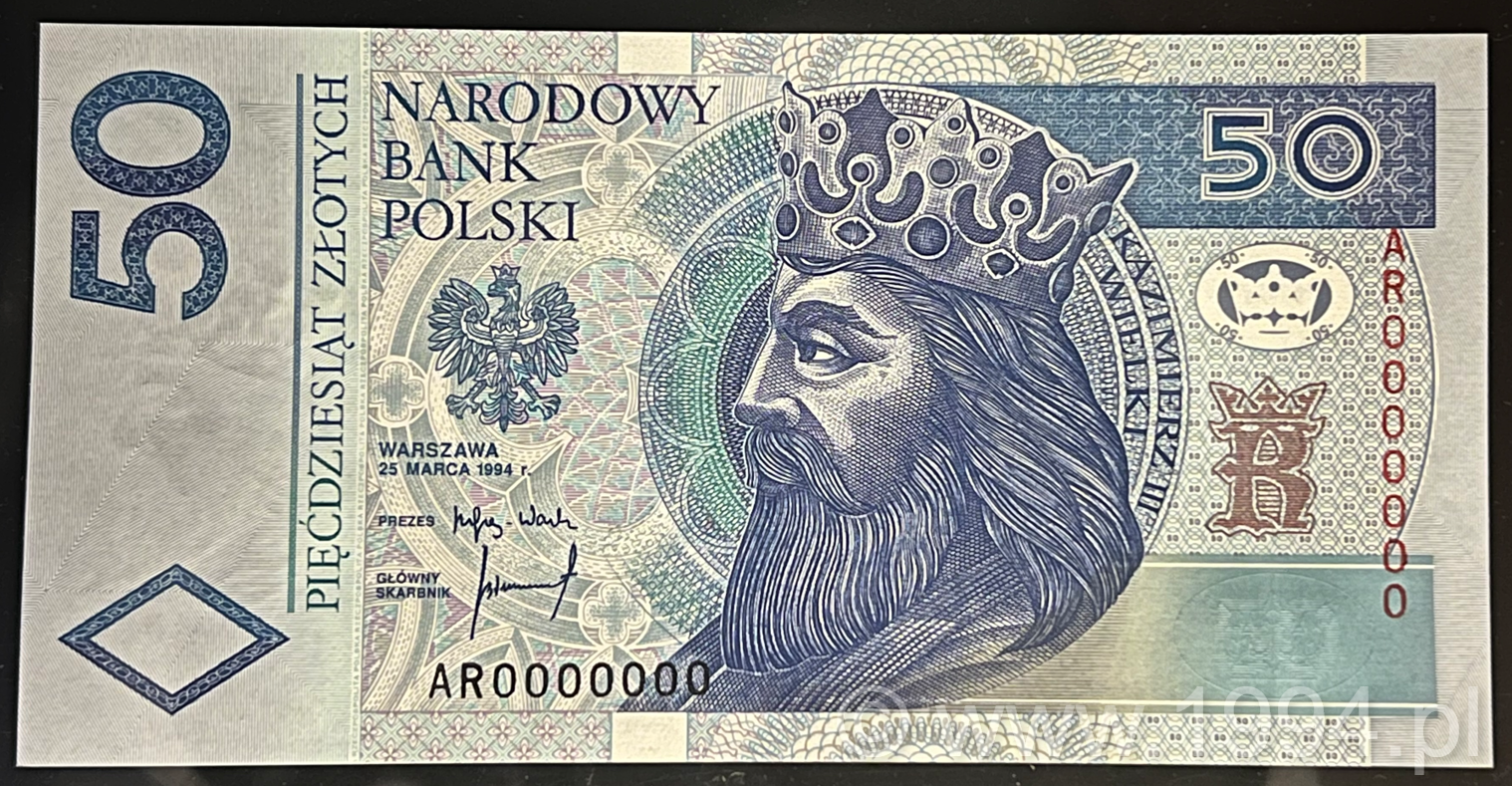
Poland 1994 50 Zlotych discovery AR prefix approval specimen without overprints, serial AR0000000, red vertical control numbering, final issued-style design, and Thomas De La Rue production origin.

Poland 1994 - 50 Zlotych Discovery AR Prefix Approval Specimen Without Overprints (Pick Unlisted)

Produced by Thomas De La Rue in London for the National Bank of Poland, the note carries Andrzej Heidrich's completed 1994 design with layered guilloche work, detailed denomination panels, ornamental security structures, and the King Casimir III the Great watermark in the left field. Read more →

PolandApproval Specimen Without Overprints199450 ZlotychUncirculated Approval SpecimenApproval Specimen Without OverprintsApproval-Stage SpecimenDiscovery AR PrefixDiscovery PrefixDiscovery MaterialProduction-Stage DiscoverySpecimenUncataloguedUnlisted Approval PrefixAR PrefixSerial AR0000000Zero Serial NumberRed Vertical Control NumberingThomas De La RueTDLRMilczak AA Listed Without ImageMilczak Unlisted AR PrefixPick UnlistedPreviously Undocumented AR PrefixApproval Prefix EvidencePhysical Approval SpecimenHidden Approval MaterialPoland Currency Redesign 1994National Bank of PolandNarodowy Bank PolskiModern Polish BanknotesSecurity Printing HistoryDesign Approval ProcessPre Issue Control NotePrinter Approval MaterialFinal Issued-Style DesignKing Casimir III the GreatKazimierz WielkiAndrzej HeidrichHanna Gronkiewicz-WaltzWieslaw BiernatowiczPolandPoland 1994199450 ZlotychMuseum GradeR9 Extremely RareUnique
Held
↑ Top