Description and research notes
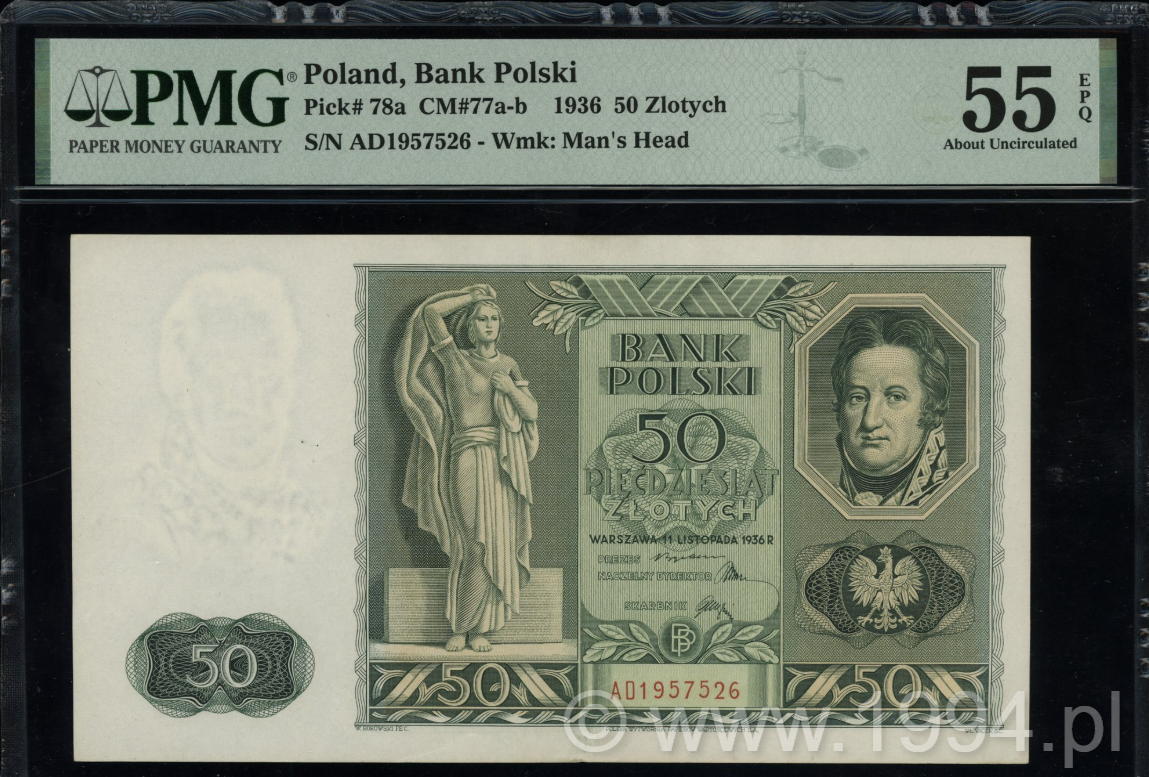
The 50 Zlotych note dated 11 November 1936 with the portrait of General Jan Henryk Dąbrowski represents the highest artistic and symbolic achievement of Polish interwar banknote design. Conceived as the flagship denomination of a fully modernized Bank Polski series, it was intended to embody state continuity, national identity, and technical excellence at a moment when the Second Polish Republic had reached institutional maturity.
The choice of date was deliberate. Issued on Independence Day, the note was designed to function not merely as currency but as a visual declaration of sovereignty. The obverse portrait depicts General Dąbrowski (1755–1818), founder of the Polish Legions in Italy and a central figure of Polish national memory, immortalized in the opening lines of the national anthem. His inclusion placed the banknote firmly within a narrative of military tradition, civic duty, and national perseverance.
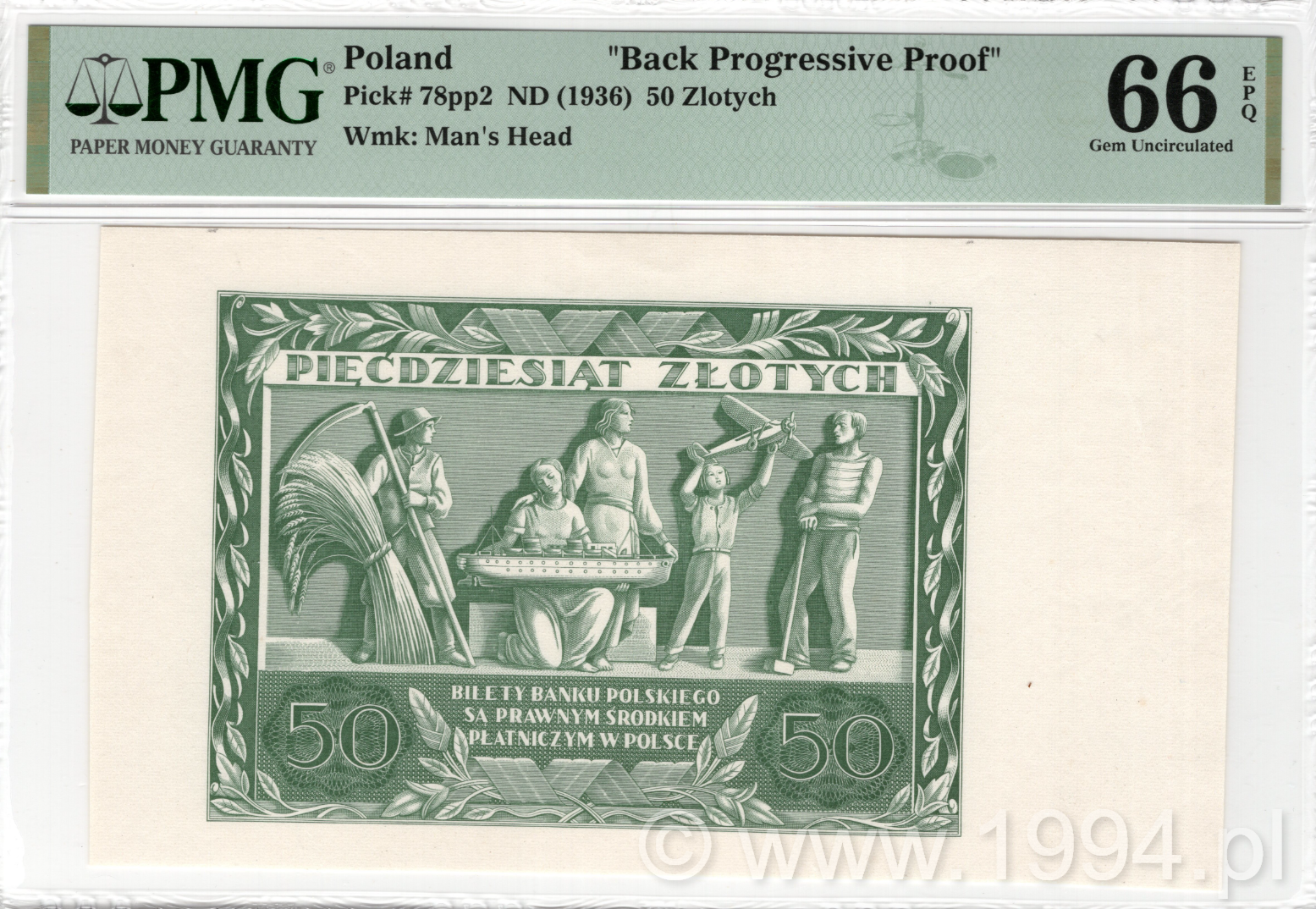
The reverse presents a complex allegorical composition uniting agriculture, industry, and culture. Rather than decorative excess, the imagery reflects a carefully balanced program of state symbolism: productive land, modern labor, and intellectual life integrated into a coherent vision of the Republic’s future. The overall composition is restrained, symmetrical, and distinctly European in its graphic philosophy.
Production was carried out at the Państwowa Wytwórnia Papierów Wartościowych in Warsaw. Technical direction was provided by Leon Barański, with artistic supervision by Wacław Borowski and engraving by Włodzimierz Vacek. The note combines offset printing with steel intaglio and features a multitone portrait watermark of Dąbrowski, regarded as one of the finest achievements of Polish papermaking in the interwar period.
Despite completion and delivery to Bank Polski, the note never entered regular peacetime circulation. Approximately two thousand examples were produced, but the outbreak of war in September 1939 halted the planned release. During the ensuing cash shortage, a limited quantity was reportedly issued under emergency conditions, primarily in northern Poland. Surviving examples from this episode often exhibit heavy wear consistent with field use.
Today, two distinct survivor groups are known: a very small number of uncirculated notes preserved from bank reserves, and a limited population of circulated examples reflecting wartime deployment. High-grade survivors are exceptional, underscoring the note’s dual identity as both an unrealized peacetime issue and an artifact of national collapse.
The Dąbrowski 50 Zlotych stands as one of the most historically charged banknotes of the Second Polish Republic - designed in confidence, released in crisis, and preserved as a tangible record of a state whose ambitions were cut short by war.