Description and research notes
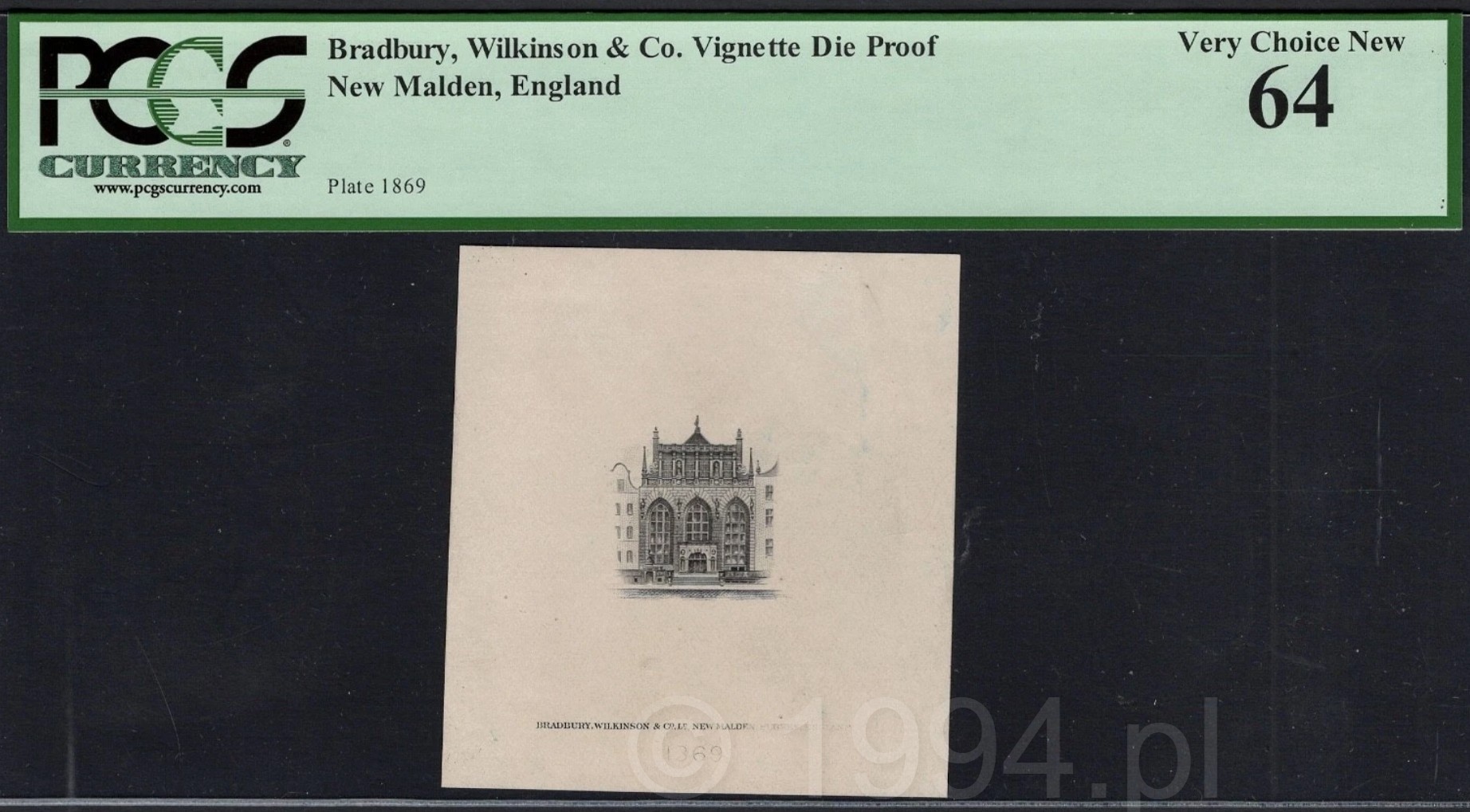
This engraved architectural vignette was produced by Bradbury Wilkinson and Company in New Malden, Surrey, as a direct design component for the 1937 Bank of Danzig 20 Gulden issue (Pick 63), issued under the authority of the Free City of Gdańsk. It is not a generic or stock engraving, but the exact central vignette incorporated into the final banknote design.
The engraving depicts a monumental civic structure rendered with precise architectural detail and controlled perspective. Within the completed banknote, this building occupies the central field beneath the issuing authority, functioning as both a visual anchor and a symbolic representation of institutional stability and civic identity.
The Free City of Gdańsk, established in 1920 under the Treaty of Versailles, operated as a semi-autonomous city-state with its own monetary system. Following the collapse of the German mark during hyperinflation, the gulden was introduced in late 1923 as a distinct currency divided into 100 pfennigs. The Bank of Danzig served as the issuing authority, producing banknotes that consistently incorporated local iconography, including architecture, heraldry, and sculptural elements tied to the city’s identity.
This architectural vignette reflects that design philosophy, embedding a representation of civic infrastructure directly into the currency. Such imagery reinforced the authority and credibility of the issuing institution during a period when trust in paper money depended heavily on both visual symbolism and printing quality.
As part of Bradbury Wilkinson’s production process, vignettes were engraved separately before integration into the master plate. This modular workflow allowed specialist engravers to refine line depth, tonal balance, and compositional clarity independently from the surrounding guilloché and denomination framework. The result is a highly controlled focal element within the final printed note.
The involvement of Bradbury Wilkinson and Company underscores the reliance on established British security printers for high-grade banknote production. Their work provided both technical security and international credibility, particularly for semi-autonomous issuing authorities such as the Free City of Gdańsk.
This vignette survives as a die proof, representing an internal stage of the engraving and approval process rather than a circulating object. Such proofs were retained within the production workflow and rarely preserved outside institutional contexts.
Its direct correspondence with the Bank of Danzig 20 Gulden 1937 issue establishes a complete production link between engraved design and finished banknote. As such, it stands as a primary artifact documenting the creation of one of the defining issues of the Free City of Gdańsk’s interwar monetary system.