Description and research notes
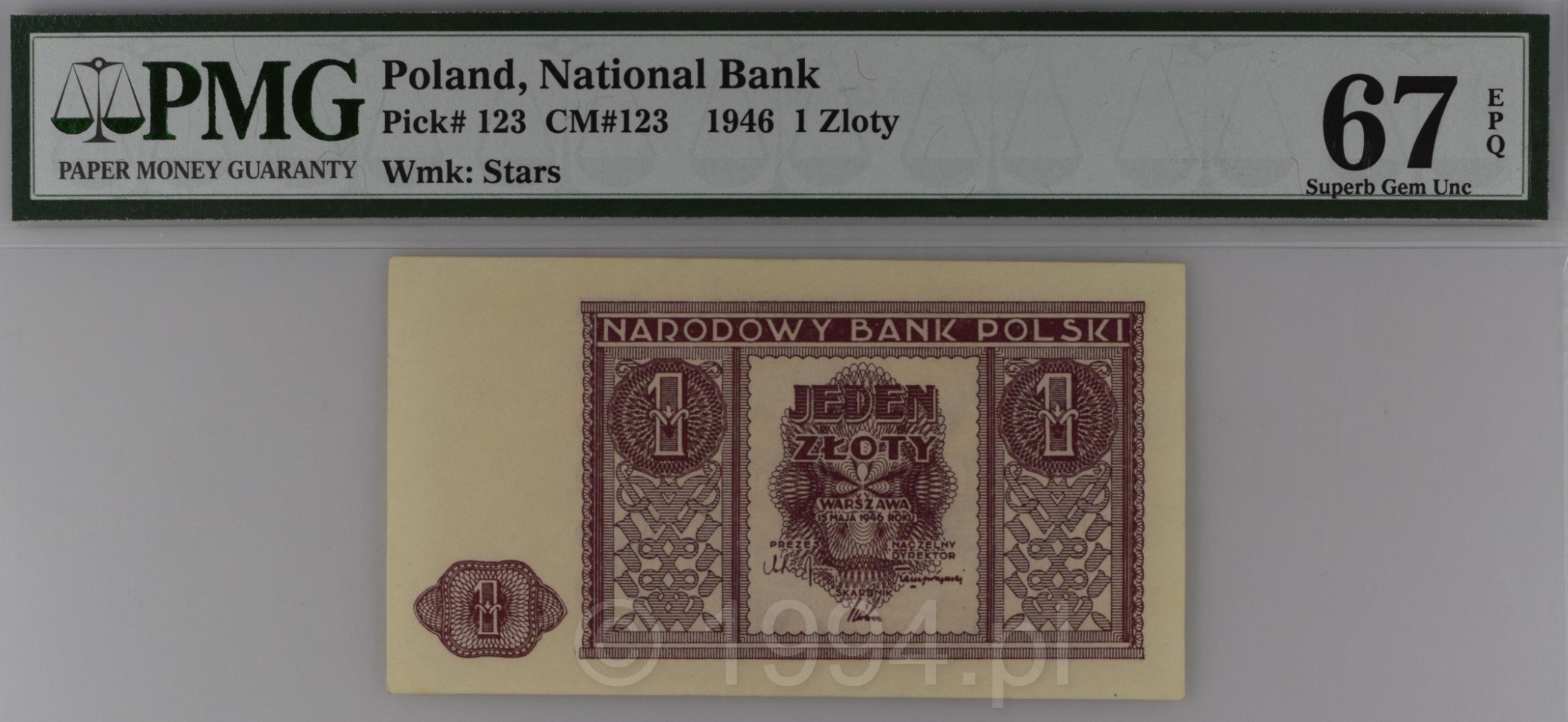
The 1 Zloty note dated 15 May 1946 formed part of the first post-war currency issued by Narodowy Bank Polski following the establishment of the new monetary system in Poland after the Second World War. As the lowest denomination of the series, it was intended for everyday transactions and circulated extensively between 1946 and 1950.
Unlike most contemporary Polish banknotes, this denomination was issued without a serial number or prefix. The paper incorporates a multi-tone watermark composed of repeating light and dark triangles across the full surface, providing an additional security feature despite the note's simple typographic design.
The obverse centres the written denomination within an ornate guilloche rosette surrounded by geometric ornamentation and the issuing clause declaring Narodowy Bank Polski notes to be legal tender in Poland. Printed signatures of President Edward Drożniak, Managing Director Witold Trąmpczyński, and Treasurer Karol Pustówka appear below. The reverse presents a matching guilloche composition featuring both the numeric and written denomination executed in the same amaranth typographic printing.
Designed by Ryszard Kleczewski and printed by the Polish Security Printing Works in Łódź, the note reflects the restrained yet functional security printing adopted during the immediate post-war reconstruction period. Although produced in a print run of approximately 152 million notes, surviving examples in exceptional condition are considerably less common due to the heavy circulation typical of low-denomination currency.
This collection example is preserved in outstanding condition, retaining sharp printing, original paper quality, and well-defined watermark details that illustrate the production standards of Poland's first post-war banknote series.