Description and research notes
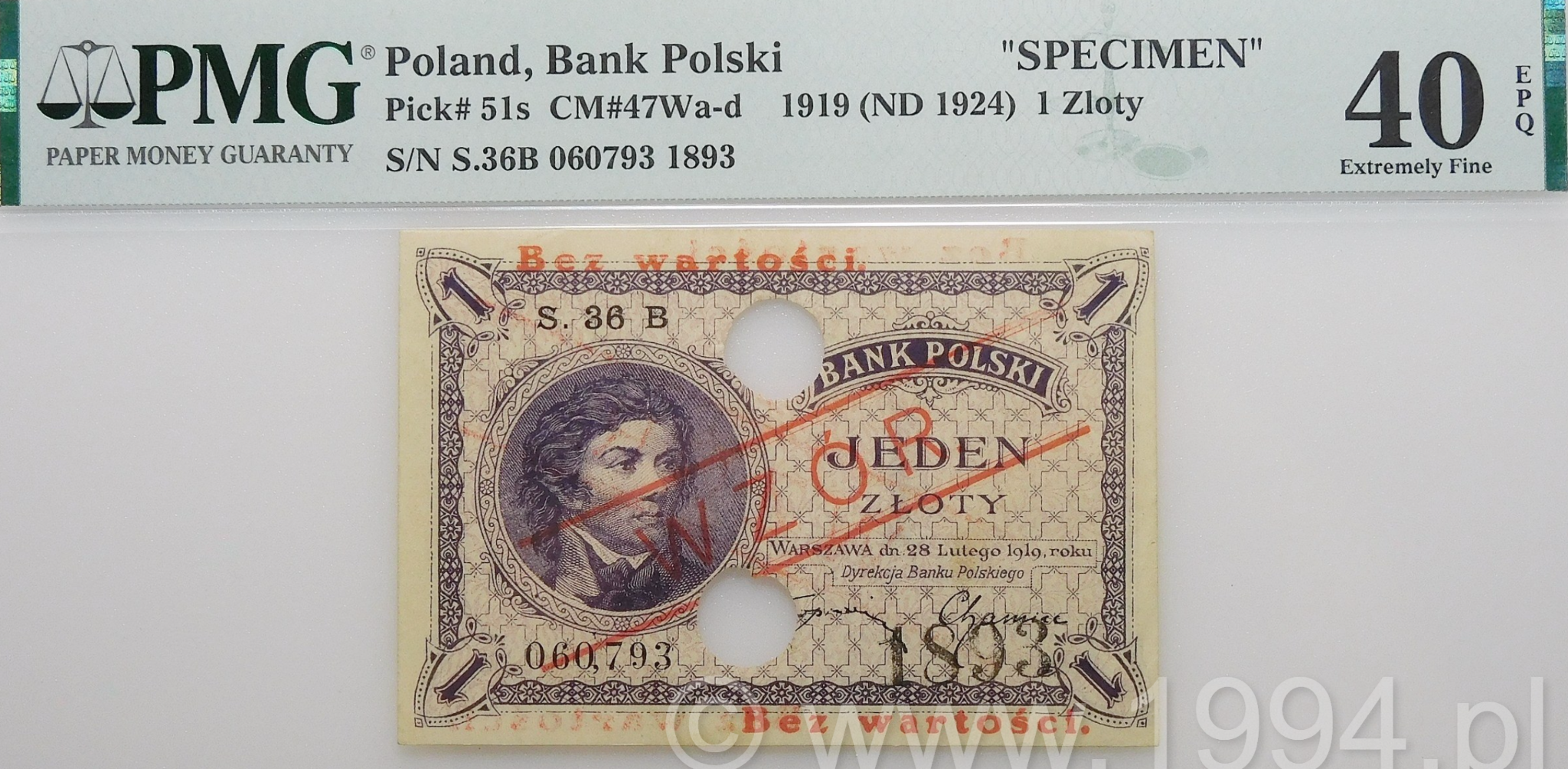
The Bank Polski 1 Zloty note dated 28 February 1919 formed part of the first zloty issue prepared for the restored Polish state shortly after independence was regained.
Designed, engraved, and printed in 1919, the issue was held in reserve while the Polish marka remained the circulating currency. The notes entered public circulation in 1924 during the monetary reform introduced under Prime Minister Wladyslaw Grabski. The new zloty replaced the inflation-damaged marka, and Bank Polski assumed its role as the central issuing institution.
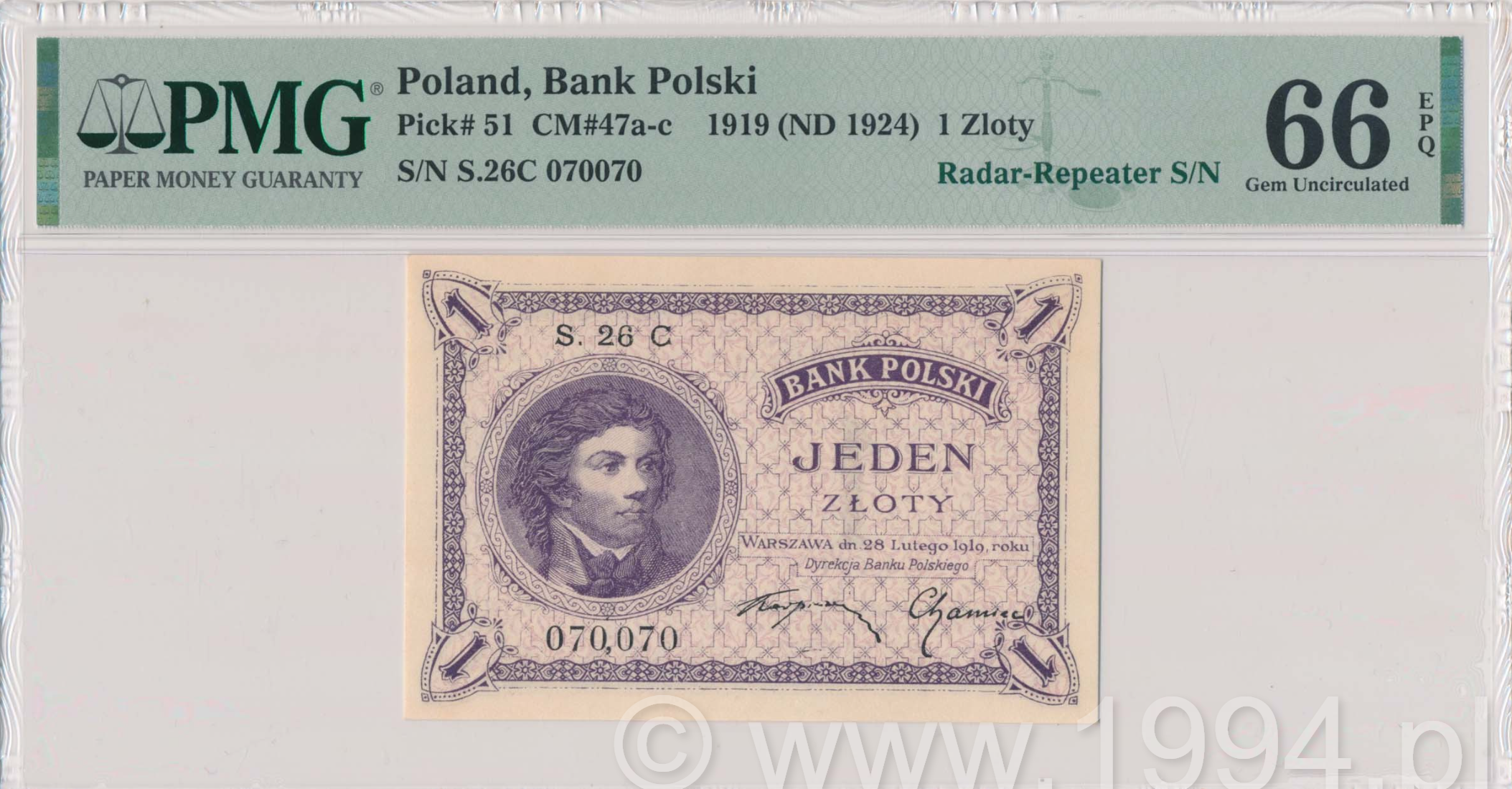
The face presents a portrait of Tadeusz Kosciuszko within a circular engraved medallion at left. The Bank Polski title appears prominently above the denomination, while the date and printed signatures occupy the lower central field. Dense geometric ornament, fine guilloche work, and repeated corner denominations create a compact design suited to the lowest value in the inaugural series.
The reverse continues the violet ornamental scheme around a large central numeral. Repeated value markings and closely arranged security patterns make the denomination immediately recognizable while giving the small-format note a balanced and highly structured appearance.
The note was printed by Imprimerie Benoit Arnaud in Lyon, France. Its engraved portraiture, fine-line borders, layered underprinting, and compact security design document the contribution of French security printing to the first paper-money series prepared for independent Poland.
The collection example carries series S.26C and radar-repeater serial number 070070. PMG 66 EPQ, Top Pop.
As the lowest denomination of the first Bank Polski zloty series, the note documents the preparation of a national currency in 1919 and its introduction during the Grabski reform of 1924. It is a material record of the restoration of Polish monetary sovereignty after independence.