Description and research notes
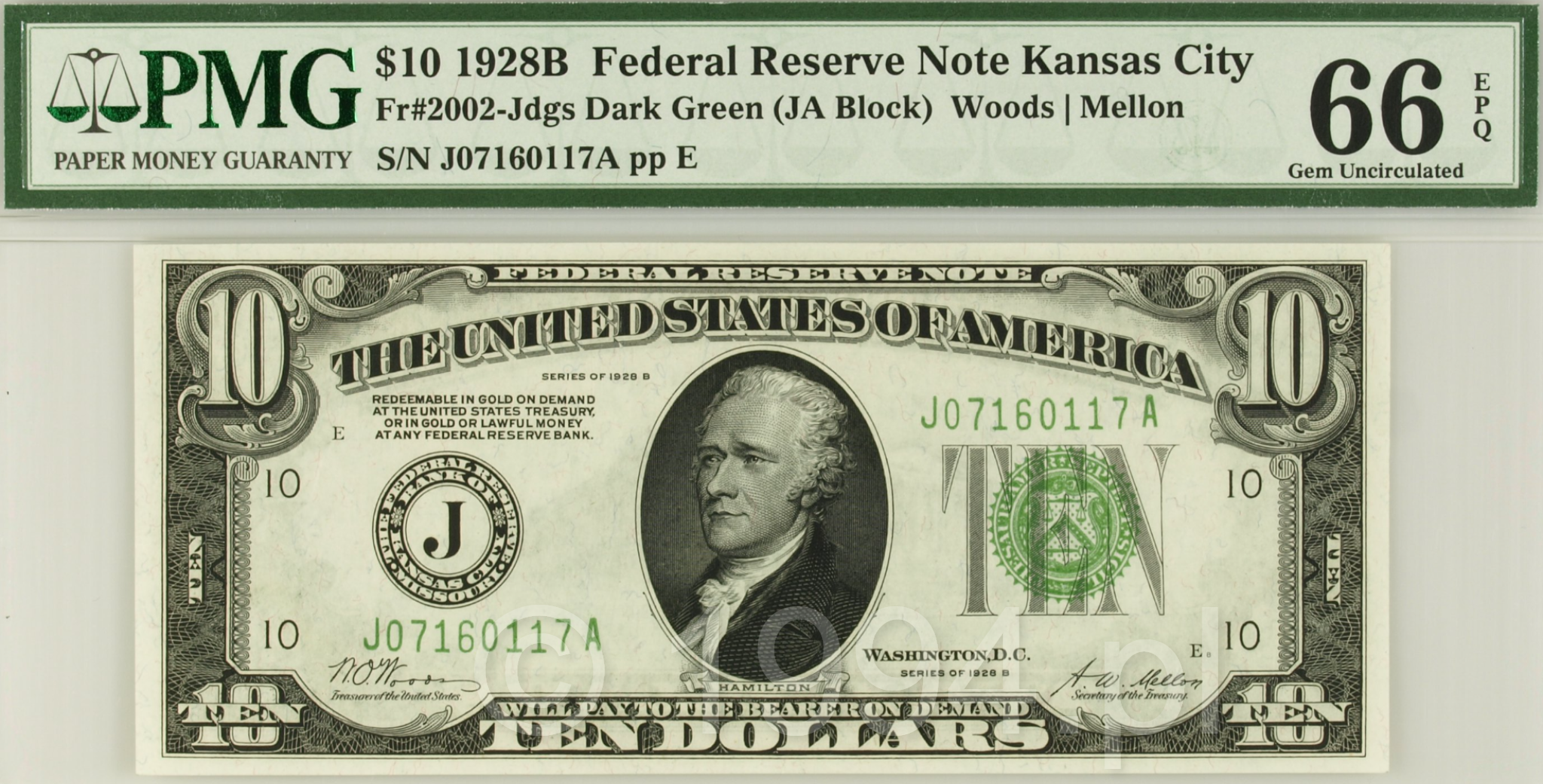
The Series 1928B 10 Dollars Federal Reserve Note from the Kansas City District, cataloged as Friedberg 2002-Jdgs, represents one of the early small-size Federal Reserve issues that defined modern United States currency. Bearing the signatures of Woods and Mellon, this example features the Dark Green Seal variety and belongs to the JA block, a detail of interest to specialists tracking early district production sequences.
The 1928 series marked the first issuance of standardized small-size Federal Reserve Notes, replacing the larger nineteenth-century format. These compact dimensions improved printing efficiency and storage while retaining the deeply engraved intaglio artistry characteristic of Bureau of Engraving and Printing production. The portrait of Alexander Hamilton anchors the obverse, framed by the classical ornamental border that became synonymous with early small-size ten-dollar notes.
The Dark Green Seal variety reflects the earliest printings within the 1928 Federal Reserve series. Subtle tonal distinctions in seal coloration distinguish these notes from later lighter green issues. The Kansas City Federal Reserve District is identified by the letter J within the black district seal and corresponding serial prefix.
Federal Reserve Notes of this era were redeemable in gold or lawful money prior to the suspension of gold redemption in 1933, a clause prominently stated on the face. As such, these notes straddle the transitional monetary environment of the late gold standard period and the reforms that followed during the early years of the Great Depression.
Graded PMG 66 EPQ Gem Uncirculated, this example sits within the upper tier of preservation for the type. Exceptional Paper Quality confirms fully original surfaces with intact embossing and undisturbed paper integrity. Strong centering, vivid seal color, and razor-sharp margins combine to present a premium representative of the 1928B Kansas City issue.
Within the broader framework of early small-size Federal Reserve Notes, the 1928B 10 Dollars Dark Green Seal variety occupies a foundational position. It embodies the technical refinement, monetary transition, and aesthetic continuity that defined United States paper money at the close of the gold redemption era.