Description and research notes
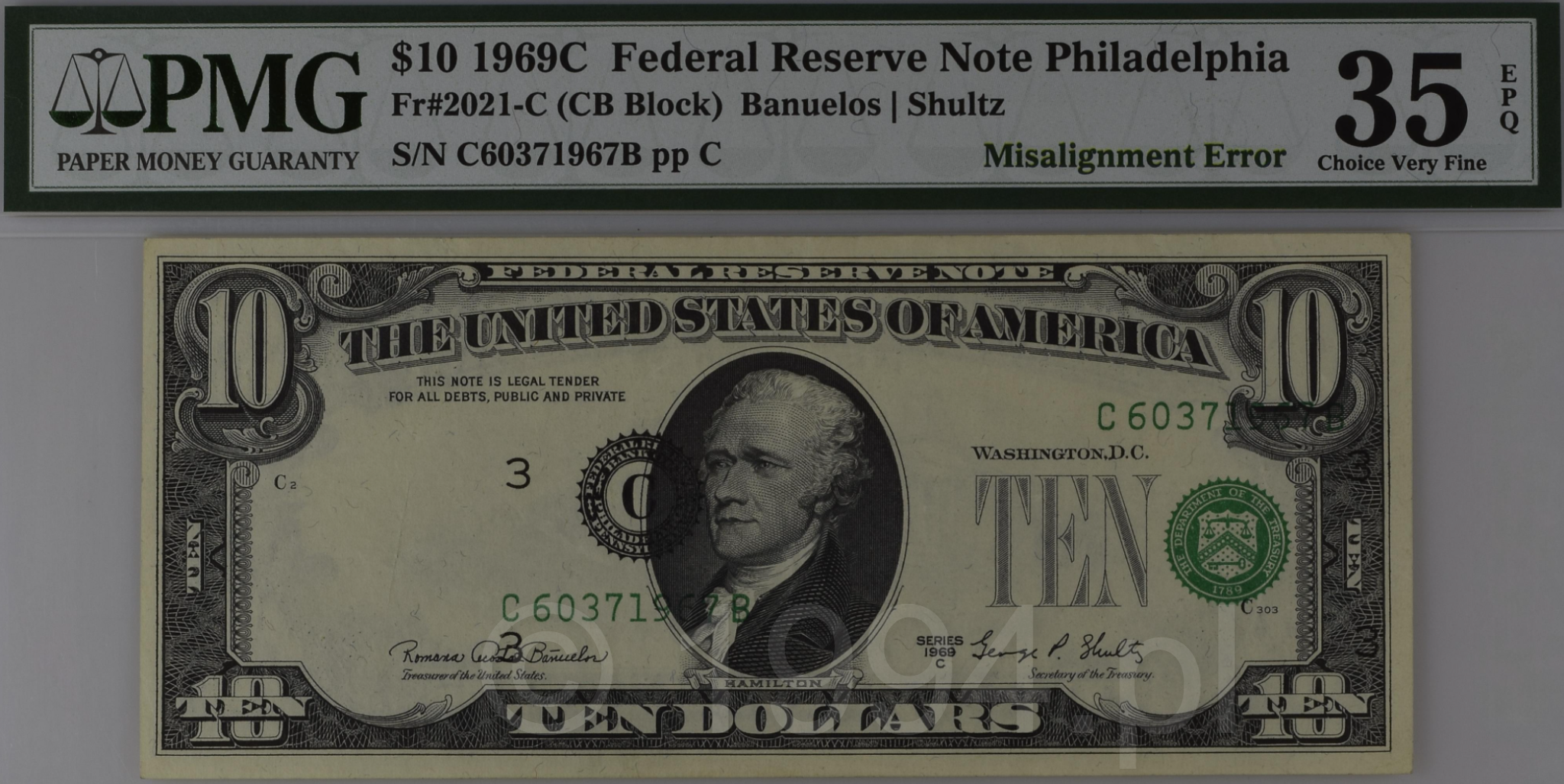
The Series 1969C 10 Dollars Federal Reserve Note from the Philadelphia District, cataloged as Friedberg 2021-C, presents a documented Overprint Misalignment Error affecting the green seal and serial number impressions. Signed by Treasurer Romana Acosta Banuelos and Secretary of the Treasury George P. Shultz, this issue belongs to the transitional era of late small-portrait Federal Reserve Notes prior to the design revisions of the 1990s.
Overprint misalignment errors occur during the final stage of currency production, when the Treasury seal and serial numbers are applied in a separate printing pass after the primary intaglio face and back impressions. A slight sheet shift during this stage results in displaced overprint elements, producing a visually dramatic offset relative to the engraved design. In this example, the misalignment is clearly visible in the green seal and serial number placement, confirming a genuine production anomaly rather than post-issue damage.
The obverse features the portrait of Alexander Hamilton, rendered in finely layered intaglio, while the reverse depicts the United States Treasury Building in Washington, D.C. The Philadelphia Federal Reserve District is identified by the letter C within the district seal and serial prefix. As a mid-century Federal Reserve issue, the note reflects the stabilized fiat monetary system established after the suspension of gold convertibility.
Graded PMG 35 EPQ Choice Very Fine, this example retains original paper quality as confirmed by the Exceptional Paper Quality designation. Despite moderate circulation consistent with its grade, the paper integrity and embossing remain intact. The misalignment error adds a layer of mechanical and production interest, elevating the note beyond a standard circulation example.
Overprint misalignment errors remain among the more accessible yet visually compelling categories within United States error note collecting. They provide tangible evidence of the multi-stage printing process used by the Bureau of Engraving and Printing and illustrate how minor positional variances can create collectible deviations within otherwise uniform production runs.