Description and research notes
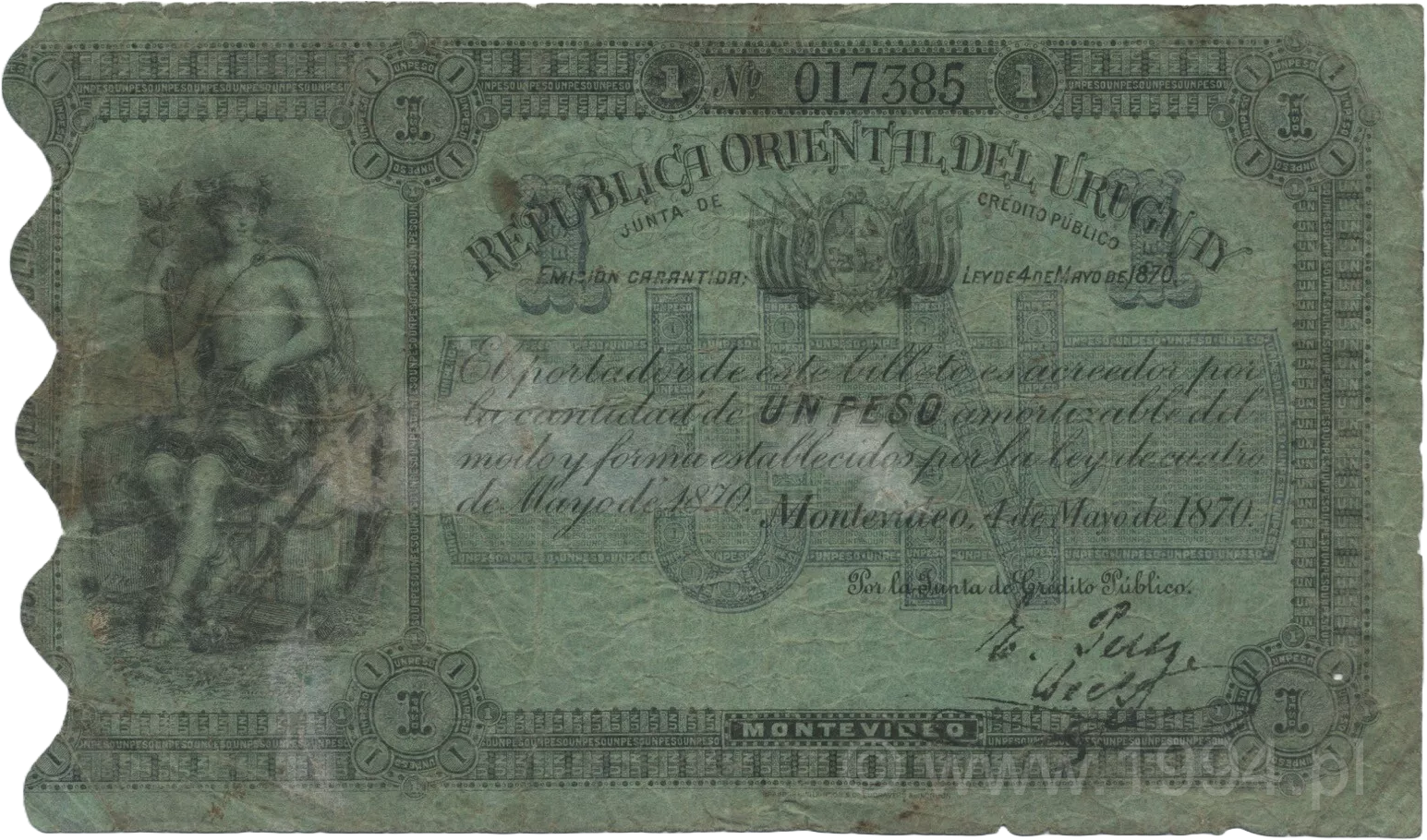
Issued by the Junta de Credito Publico under the Ley de 4 de Mayo de 1870, this 50 Centesimos note represents one of Uruguay’s earliest government-backed paper currencies. Locally printed in Montevideo by Litografía G. Mas & Cía., the design belongs to the same inaugural emission as the 1 Peso 'Mercury' note. Known to collectors as the 'Cow Head' type, its left vignette features a finely detailed depiction of Uruguay’s cattle, symbolizing the nation’s livestock wealth and agrarian economy.
The intricate intaglio work, produced entirely on native presses, is remarkable for its precision given the technical limits of the time. Each note was individually signed by members of the Junta, whose autographs authenticated the government guarantee before mechanical signatures were introduced later in the decade. The scalloped left edge, cut by a special press, served as an anti-counterfeiting device unique among South American issues of the nineteenth century.
Cataloged as Pick A109b / PMG A109b (Cincuenta Centesimos, 4 de Mayo de 1870), this variety is extremely scarce-only four examples appear in the PMG census, graded between 10 and 20. Serial 274594 demonstrates the note’s full border and clear signatures. Within the Uruguay early-issue series, it stands as the defining 'Cow Head' note, linking the locally produced 1870 currency experiment to the later industrial precision of the 1871 ABNC and 1887 Waterlow printings.