Description and research notes
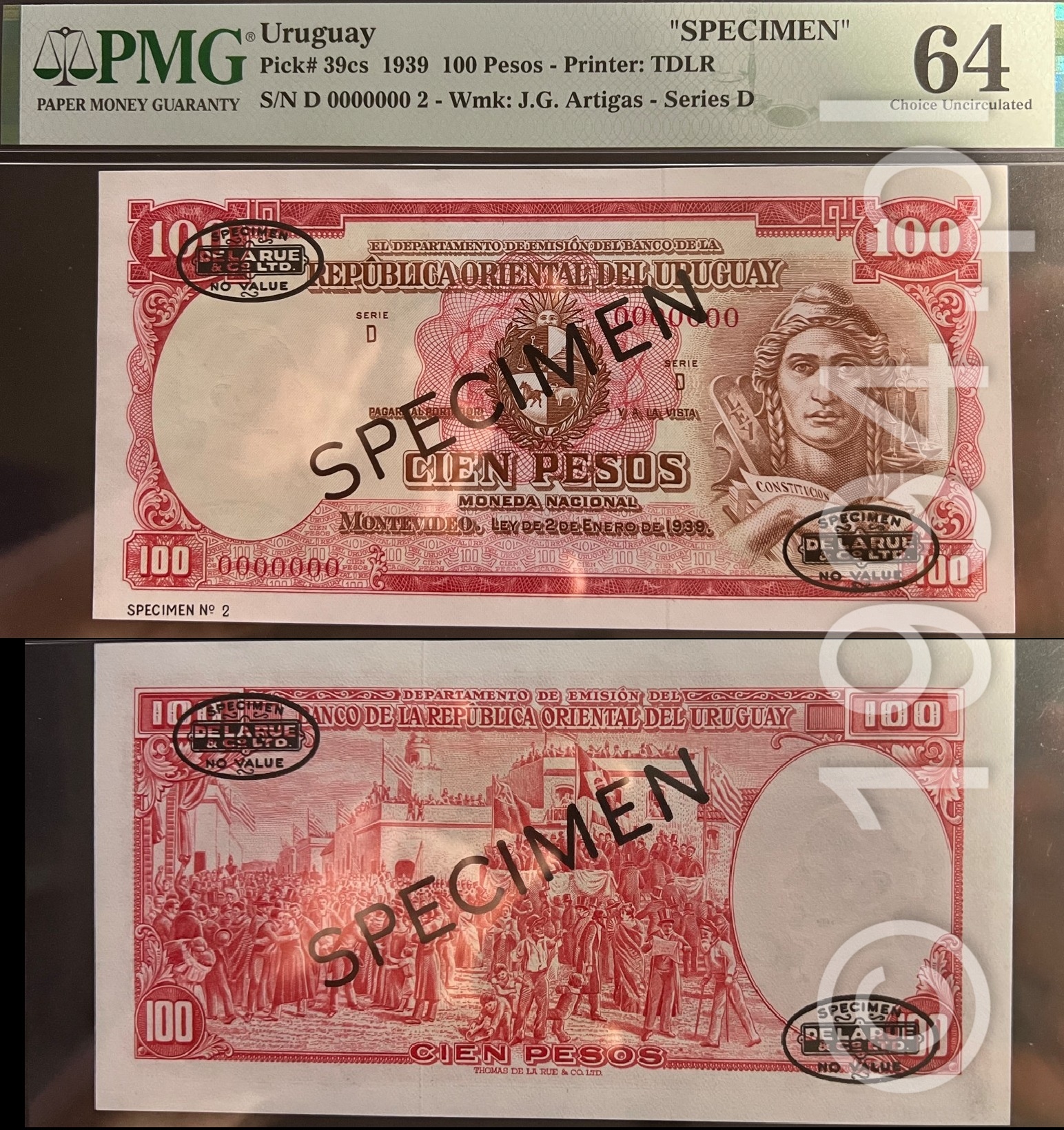
This Serie D one hundred pesos specimen of the Banco de la Republica Oriental del Uruguay is identified as Specimen No. 2 and represents the red-marked member of an exceptional matched specimen-control pair. Its companion carries the same Pick 39cs classification, the same Serie D designation, the same all-zero serial format, the same Specimen No. 2 assignment, and the same completed banknote design, but was prepared with black specimen markings. Together, the two notes preserve parallel printer-controlled presentations of the same reference position.
The repeated Specimen No. 2 designation is central to the significance of this piece. Because the identical number appears on both the red-marked and black-marked examples, the numbering evidently operated within separate control, distribution, or presentation groups rather than as one universal sequence covering every specimen format. The pair therefore documents more than a simple difference in ink color. It reveals that Thomas De La Rue and Company Limited maintained parallel specimen states for the same denomination, series, and numbered reference position.
The obverse presents the formal authority of the Republica Oriental del Uruguay above the central denomination CIEN PESOS and the statement MONEDA NACIONAL. The national arms occupy the center of an elaborate guilloche field, surrounded by engraved borders, repeating denomination devices, and finely structured security ornament. Serie D appears clearly on the face, accompanied by the prefix D and paired all-zero serial numbers.
At right, the allegorical female figure holds the Constitution, presenting republican law as the foundation of the monetary promise. Her classical form is combined with architectural and industrial imagery, linking constitutional authority with economic organization and national development. Fine intaglio linework creates depth across the face, garments, book, and surrounding symbolic elements.
The defining administrative layer is applied in red. A broad diagonal SPECIMEN inscription crosses the center of the obverse, while oval SPECIMEN DE LA RUE AND COMPANY LIMITED NO VALUE stamps appear at the upper left and lower right. Their placement makes the institutional status unmistakable while preserving the national arms, denomination, constitutional allegory, watermark field, and serial structure for examination.
The reverse presents a panoramic civic scene filled with assembled citizens, flags, and monumental architecture. The composition evokes public ceremony, republican identity, and collective national memory. Its dense engraved detail gives the crowd both narrative movement and historical weight, while the reserved watermark oval balances the scene at right.
Red specimen markings continue across the reverse, creating a complete two-sided cancellation state. The repeated diagonal inscription and oval control stamps bind both faces into a single documented reference format and distinguish this piece clearly from its black-marked companion.
Printed by Thomas De La Rue and Company Limited, this red Serie D, Specimen No. 2 example is most important when understood as one half of the surviving matched control pair. Its shared series, specimen number, serial format, design, and grade with the black-marked example provide direct material evidence of parallel specimen preparation within Uruguay's 1939 one hundred pesos issue.