Description and research notes
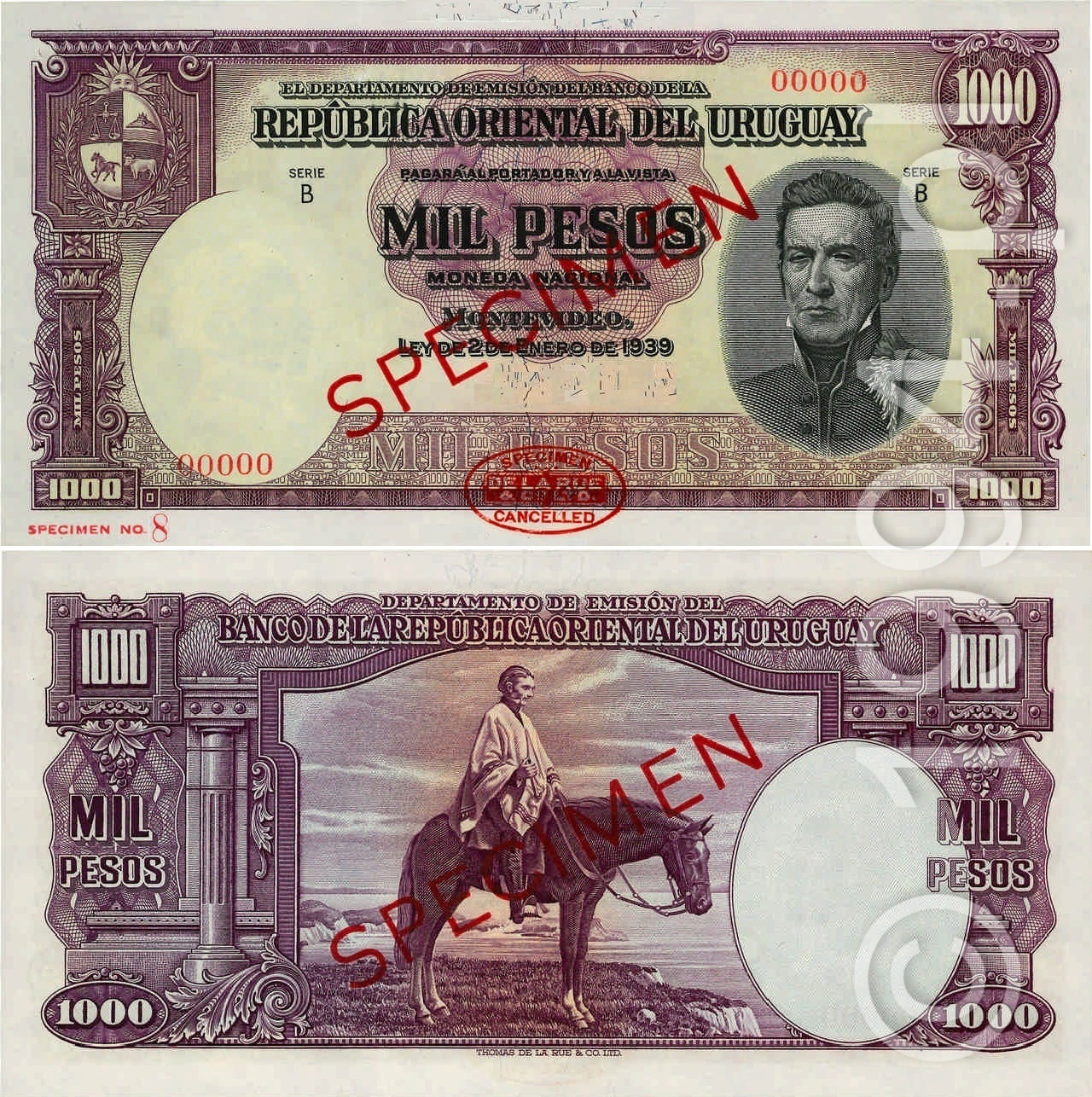
This specimen represents the one thousand pesos denomination of the Banco de la Republica Oriental del Uruguay issued under the monetary law of 2 January 1939. As a high-denomination reference impression, it was produced for institutional control, archival documentation, and regulated distribution rather than for circulation.
Within the 1939 emission, the one thousand pesos occupied the apex of the denomination hierarchy, associated with treasury settlement, interbank accounting, and large-scale financial operations. Specimen examples of this value document the administrative and production controls governing Uruguay’s late-interwar monetary system.
The note is printed as Serie B, as shown on the face of the instrument. It carries the standard all-zero serial format with prefix corresponding to the series, accompanied by the printed designation "SPECIMEN No. 8" at the lower margin, confirming its controlled specimen sequence within this specific series.
Cancellation is executed through a printed method combining a diagonal red SPECIMEN overprint across the central field with a red oval printer control stamp reading "SPECIMEN DE LA RUE & CO LTD – CANCELLED." No perforation or punch cancellation is present. This layered ink cancellation method represents De La Rue’s controlled specimen handling protocol for formally invalidating reference material while preserving full design clarity.
The obverse presents the formal engraved portrait and architectural composition characteristic of Thomas De La Rue’s late-interwar intaglio production, with MIL PESOS prominently integrated into an ornate security framework. The reverse displays the equestrian allegorical scene associated with the one thousand pesos type, rendered at full circulation engraving standard.
Printed by Thomas De La Rue and Company of London, this example documents the printed-cancel control variant of the highest denomination within the 1939 Uruguay series. It stands as institutional production evidence of the specimen management practices applied to top-tier currency issues during the consolidation of Uruguay’s modern state-directed banking system.