Description and research notes
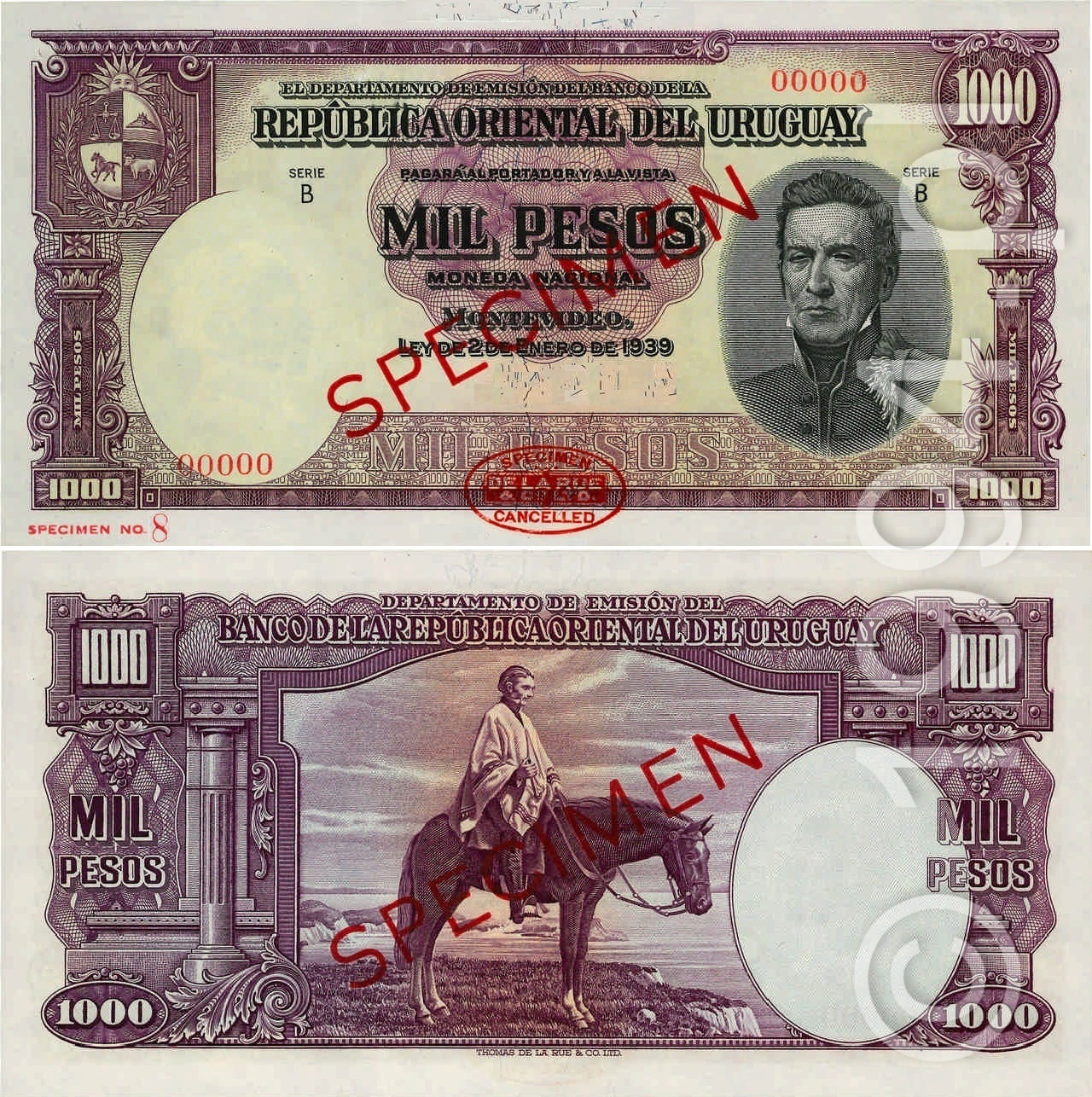
Issued under the authority of the Banco de la Republica Oriental del Uruguay, this 1939 one thousand pesos specimen is an official reference example from Serie D, numbered Specimen No. 23. It records the completed appearance of one of the most imposing denominations in Uruguay's prewar paper currency system, preserved in specimen form for controlled administrative, banking, and archival use.
The note belongs to the monetary framework established by the law of 2 January 1939, cited prominently across the center of the obverse. At this level of value, the one thousand pesos denomination represented substantial purchasing and accounting power. Its scale, elaborate engraving, and commanding visual structure were designed for an instrument associated with major banking transactions, institutional reserves, treasury operations, and high-value settlement rather than ordinary daily exchange.
The obverse is dominated by the full institutional title REPUBLICA ORIENTAL DEL URUGUAY, placed above the monumental denomination MIL PESOS. To the right appears a finely engraved portrait of Jose Gervasio Artigas, shown in military dress with a strong frontal expression. Artigas serves here as more than a commemorative portrait. His presence places the authority of the banknote within Uruguay's national foundation, linking the monetary promise of the state with the country's principal independence figure.
The surrounding framework is built from architectural columns, scrollwork, repeating denomination patterns, shields, wreaths, and carefully balanced guilloche fields. The open watermark area at left interrupts the dense ornamentation and creates a deliberate visual counterweight to the portrait. Within the paper is the watermark of Jose Gervasio Artigas, extending the national imagery beyond the printed surface and into the physical structure of the sheet itself.
This Serie D specimen carries paired all-zero serial numbers and the printed designation SPECIMEN No. 23 along the lower margin. A large diagonal red SPECIMEN overprint crosses the central obligation and denomination. Additional red oval specimen stamps appear over the upper-left emblematic panel and the lower-right portion of the note. Together, these cancellations establish the piece as a formally controlled specimen while leaving the principal engraved features fully visible for examination and reference.
The reverse presents a broad equestrian composition showing a mounted figure in traditional dress crossing an open landscape. The scene is framed by heavy architectural ornament, grape clusters, scrolls, columns, and large denomination panels. The rider gives the reverse a distinctly national character, evoking the rural landscape, mounted culture, and historical traditions associated with Uruguay and the wider Rio de la Plata region.
Red specimen markings are repeated across the reverse, including the diagonal SPECIMEN inscription and oval control stamps positioned at the left and lower right. Their placement creates a complete two-sided cancellation system, confirming that the entire finished note was retained and distributed as a specimen reference rather than merely represented by a single printed face.
The imprint of Thomas De La Rue and Company Limited appears at the lower center of the reverse. The London security printer combined portrait engraving, architectural framing, fine-line backgrounds, watermark integration, and repeated denomination devices into a design capable of expressing both high monetary value and official state authority.
Preserved in Paper Money Guaranty 65 Gem Uncirculated Exceptional Paper Quality condition, this Serie D, Specimen No. 23 example retains the sharp paper, strong color, clean margins, and engraving clarity required to study the design at its intended production standard. It is an important surviving document of Uruguay's 1939 monetary program, the specimen-control practices of Thomas De La Rue and Company Limited, and the visual language used for one of the country's highest-value banknote instruments.