Argentina’s paper-money history begins here before the later national banking structure, before the
1881 monetary reform, and before the cleaner peso system that followed. The earliest material in this
section reaches back to the 1844 Provincia de Buenos Ayres issues of the Rosas period,
when paper money was not just a financial instrument but also a political document. Notes of that era
carried provincial authority, manuscript signatures, local security features, and direct ideological language
from the Argentine Confederation period.
From that starting point, the collection follows Argentina through one of the most complex monetary
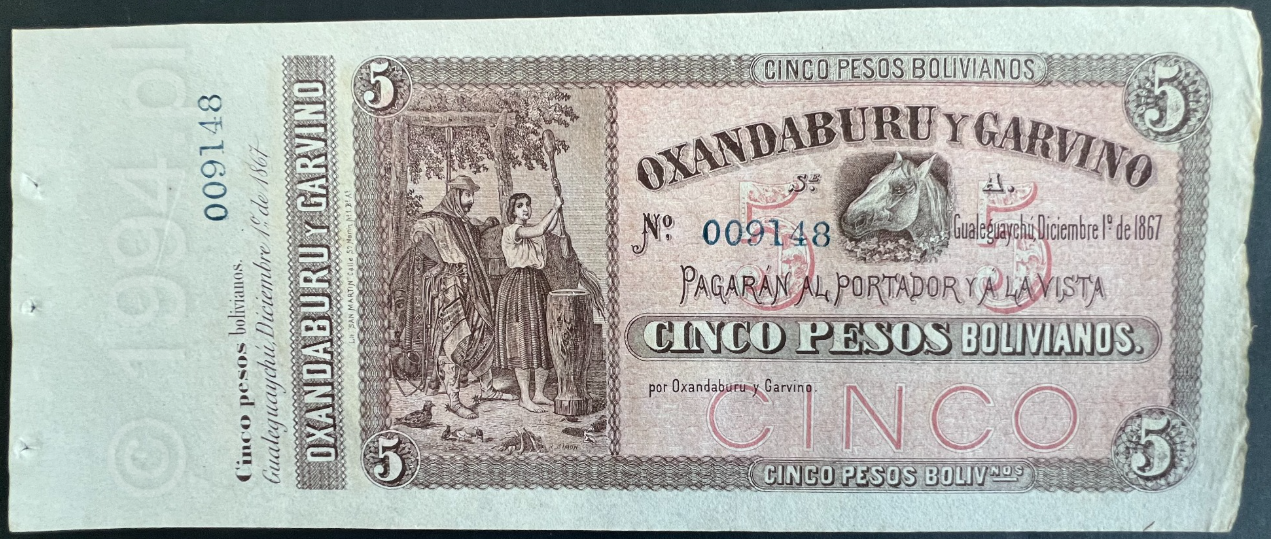
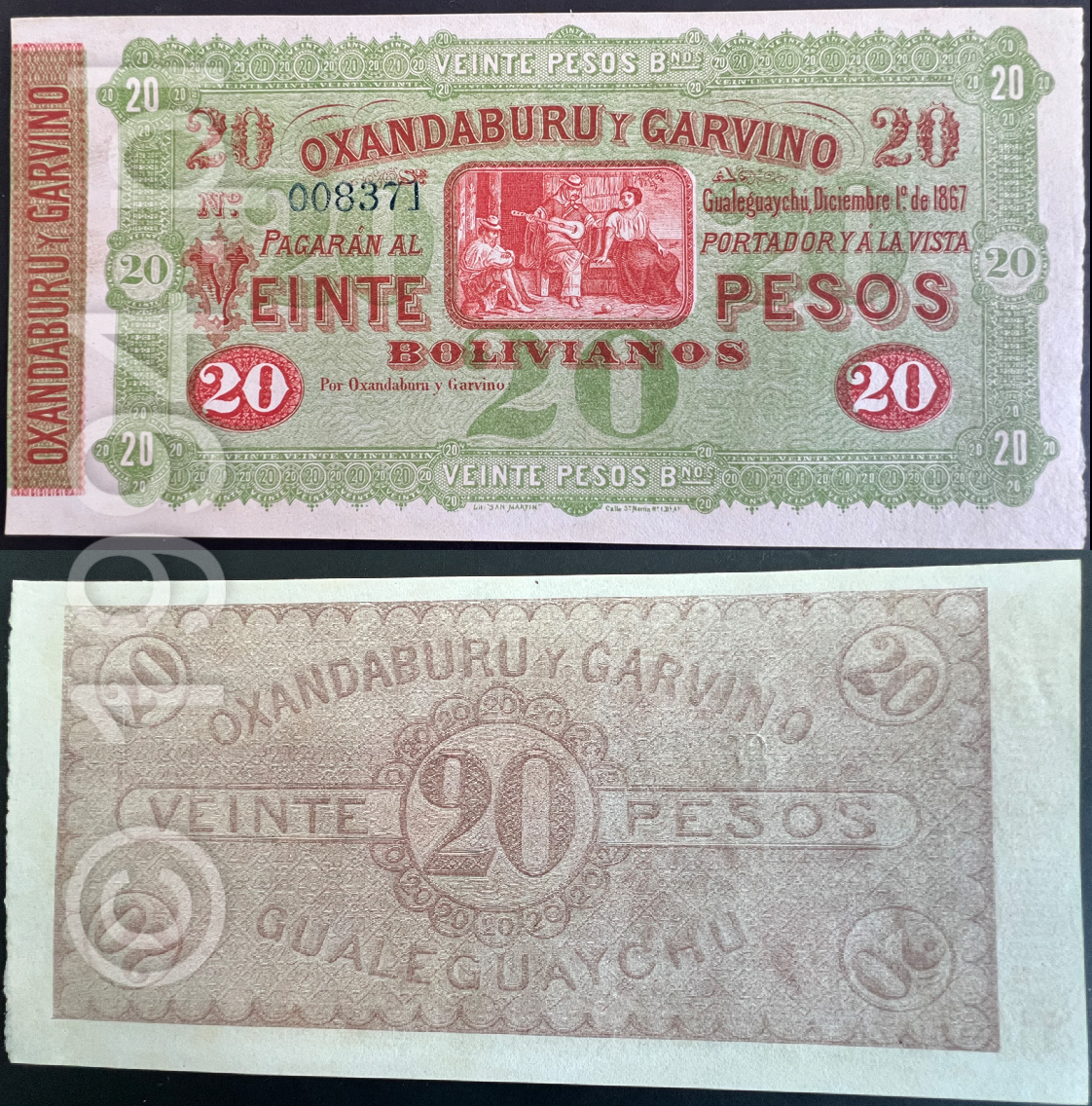
transitions in South America. Currency moved through Moneda Corriente, Reales,
Pesos Fuertes, Plata Boliviana, and later Moneda Nacional Oro.
This was not a simple change of denomination. It was a shift from provincial paper, private bank promises,
regional silver standards, frontier circulation, and foreign-backed credit toward a more organized national
monetary system.
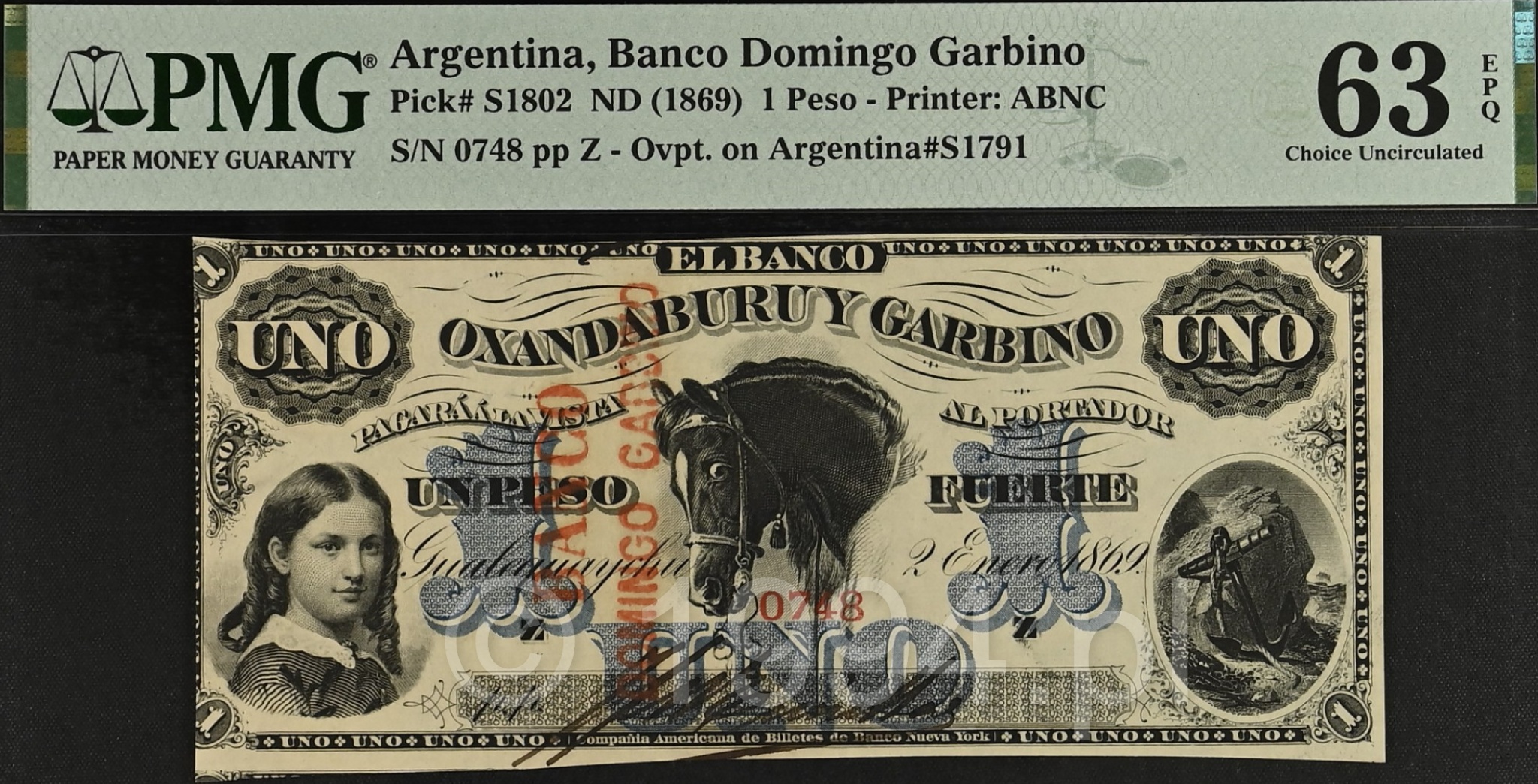
The banks represented here include the Provincia de Buenos Ayres,
Banco de Londres y Rio de la Plata, Banco Domingo Garbino,
Banco de San Juan, Banco del Chaco, and other issuers tied to Buenos Aires,
Rosario, San Juan, Santa Fe, the Chaco region, and the wider river trade economy. These notes show Argentina
as a country being financed from several directions at once: by provincial authority, private capital,
foreign banking houses, local commerce, and imported security printing.
The printing history is just as important as the banking history. Early typographic bank vales sit beside
engraved issues, specimens, remainders, overprinted notes, and printer-controlled archival material.
Bradbury, Wilkinson & Co. of London and the American Bank Note Company
of New York supplied many of the finest designs, bringing allegorical figures, condors, provincial arms,
guilloche engraving, portraiture, security borders, and anti-counterfeit technique into Argentine paper money.
Specimens and proofs are central to this section because they preserve parts of the story that issued notes
alone cannot. Some record designs prepared for banks whose circulating examples are now almost unknown.
Others document printer archives, approval pieces, overprint validation, and production evidence from notes
that survived only in tiny numbers. Together, these items show Argentina’s nineteenth-century money as a
layered system of politics, banking, regional identity, foreign printing, and economic expansion, from the
Rosas-era provincial emissions of 1844 to the gold-linked bank issues of the 1880s.