Description and research notes
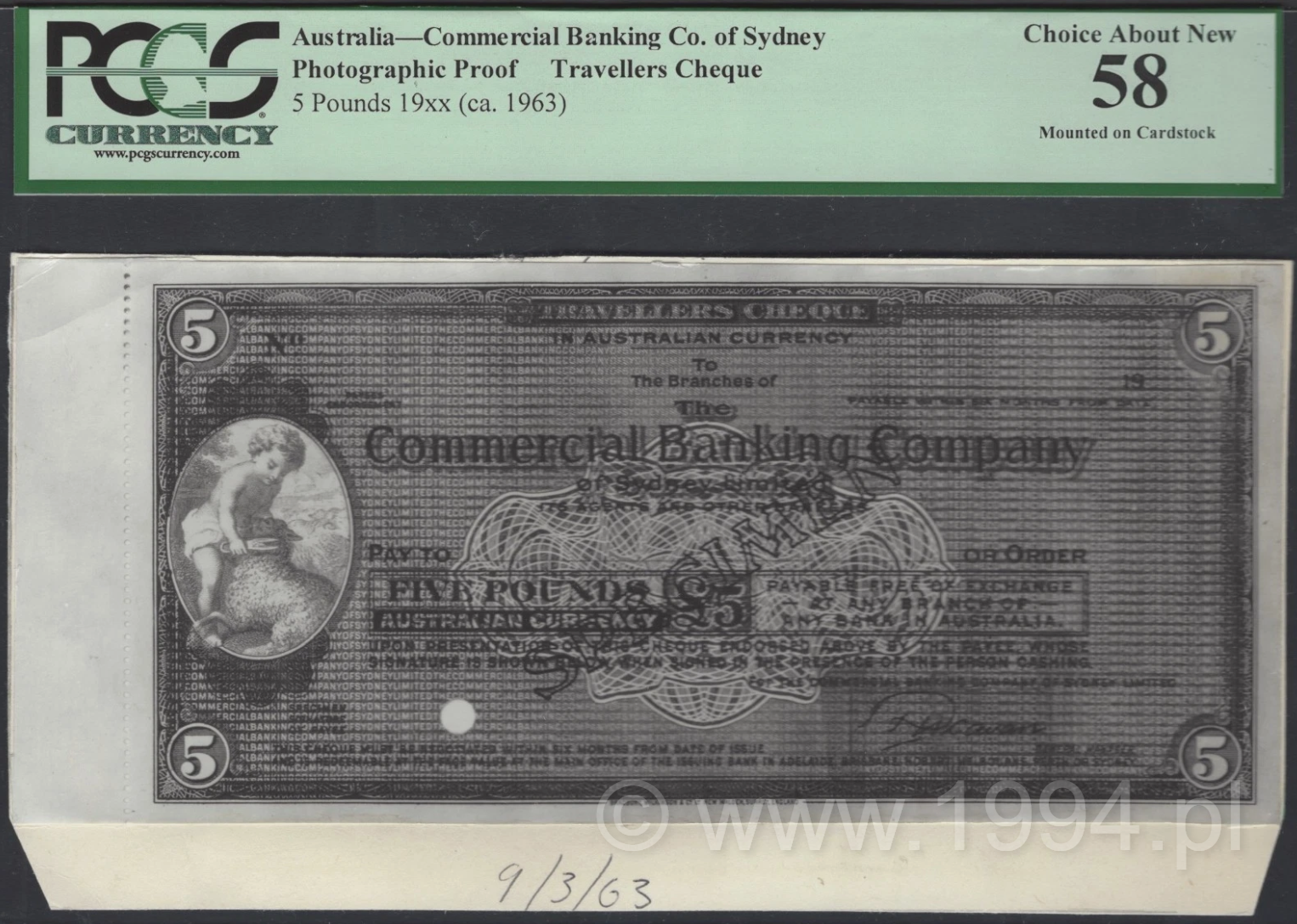
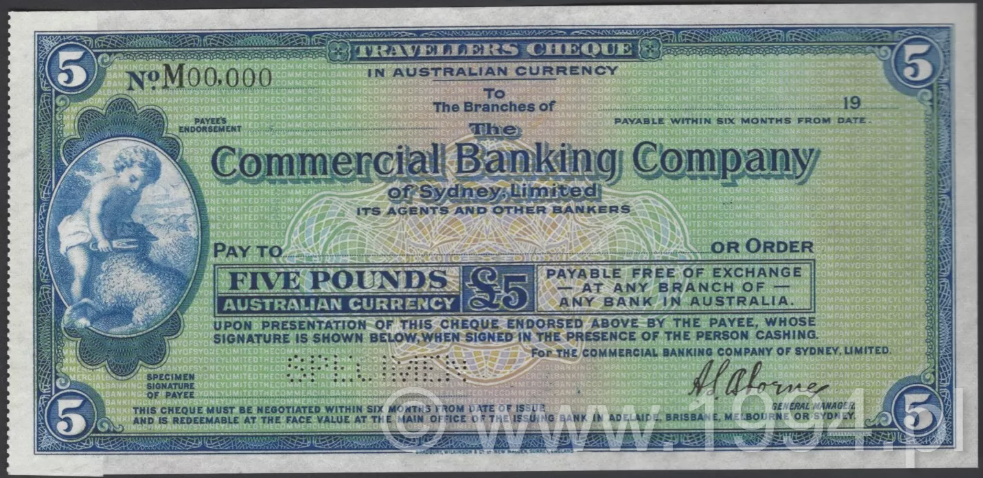
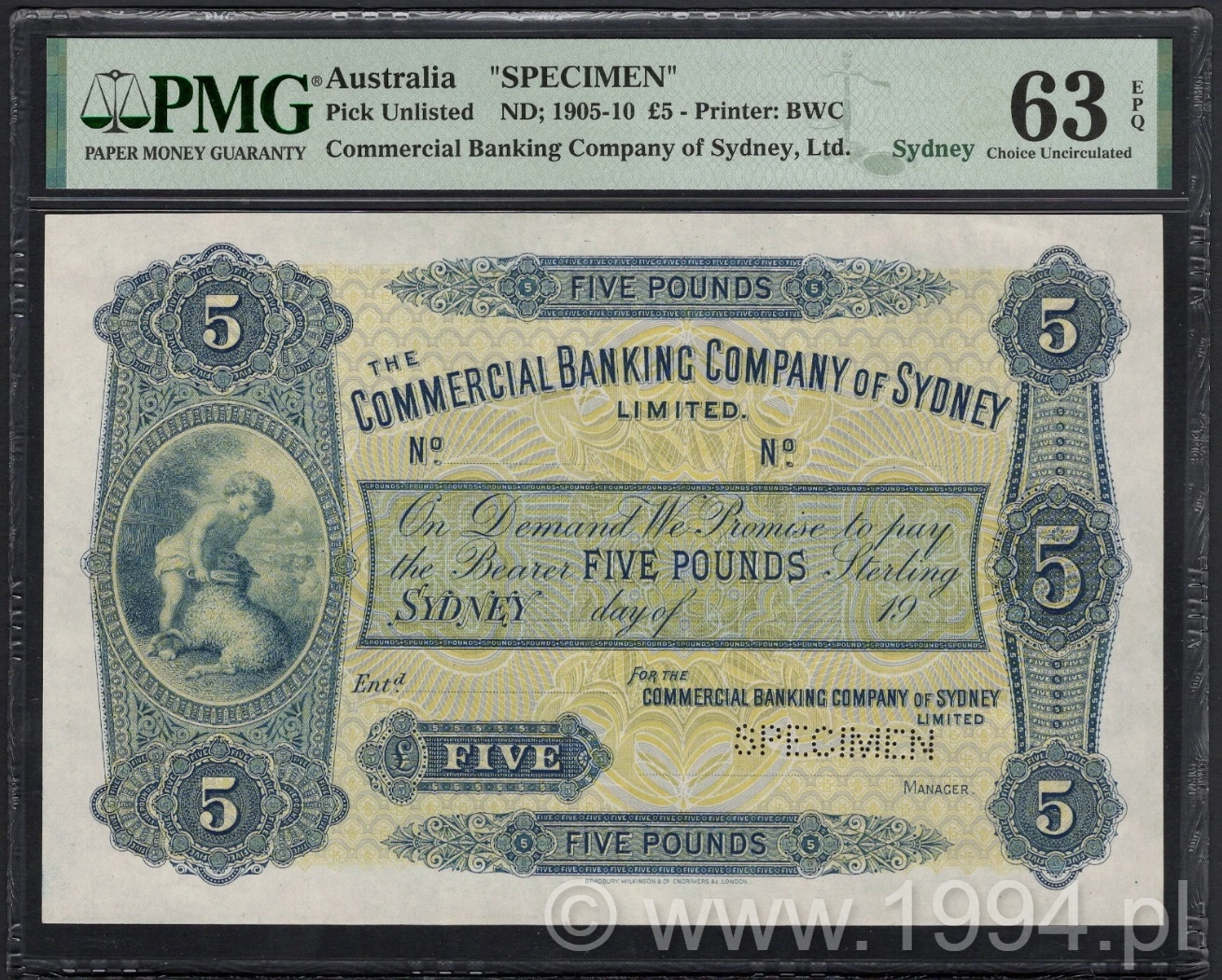
Proof specimen printed by Bradbury, Wilkinson & Co. between 1905 and 1910 for the Commercial Banking Company of Sydney LIMITED - one of Australia’s oldest and most respected private banks, founded in 1834. The CBC operated independently until its 1981 merger with the National Bank of Australasia, forming today’s NAB.
The note’s design captures the late-Edwardian peak of Bradbury, Wilkinson craftsmanship: elaborate guilloché, multicolour underprint, and symbolic vignettes including a cherub with a ram’s head representing commerce and abundance. Its heavy perforations and broad margins identify it as a proof rather than a circulation specimen, created to demonstrate design and engraving quality before full production.
Unlisted in Pick and graded PMG 63 EPQ Choice Uncirculated (Top Pop), this specimen marks the transition from private colonial issues to the newly centralised Commonwealth currency introduced after 1910. It reflects both the confidence of early-twentieth-century Australian banking and the enduring partnership between London engravers and Australian financial institutions.
This proof connects directly to the artistic lineage of earlier Bradbury Wilkinson work for Victoria’s private banks, such as the City of Melbourne and Federal Bank series, underscoring the continuity of engraving excellence and the global reach of London’s security printers at the dawn of Australia’s national currency era.
Beyond its immediate visual appeal, the note documents the final years of Australian private-banknote autonomy. Prior to the 1910 Australian Notes Act, private banks like the CBC were empowered to issue their own circulating currency. Large denominations such as this £5 were central to interbank settlement, bullion purchases, commercial clearing, and the financial infrastructure of Sydney’s rapidly expanding economy.
Bradbury Wilkinson’s master plates reflect the mature internationalisation of security printing. By 1905–1910, Australian banks increasingly relied on London engravers for their highest-grade notes, as BWC offered complex tint-stone methods, deep intaglio capability, and anti-counterfeiting technologies unattainable in most colonial print shops. These proof specimens were the pinnacle of that relationship, produced in tiny numbers for board approval, archival retention, or printer-client authentication.
Educationally, this piece illustrates the shift from ornate Victorian detail to a more controlled, geometry-driven Edwardian design language. The delicate layering of yellow, blue, and grey tints marks Bradbury Wilkinson’s late-colonial multicolour phase - a direct precursor to early Commonwealth notes and one of the last expressions of private-bank artistry before nationalisation.
As a proof with cancelled perforations, broad margins, and fully preserved plate detail, this example stands among the finest surviving artifacts of early-twentieth-century Australian paper money. Its PMG 63 EPQ Top Pop status further elevates it as a benchmark for scholars and advanced collectors studying the final private-bank issues of the Australian continent.