Description and research notes
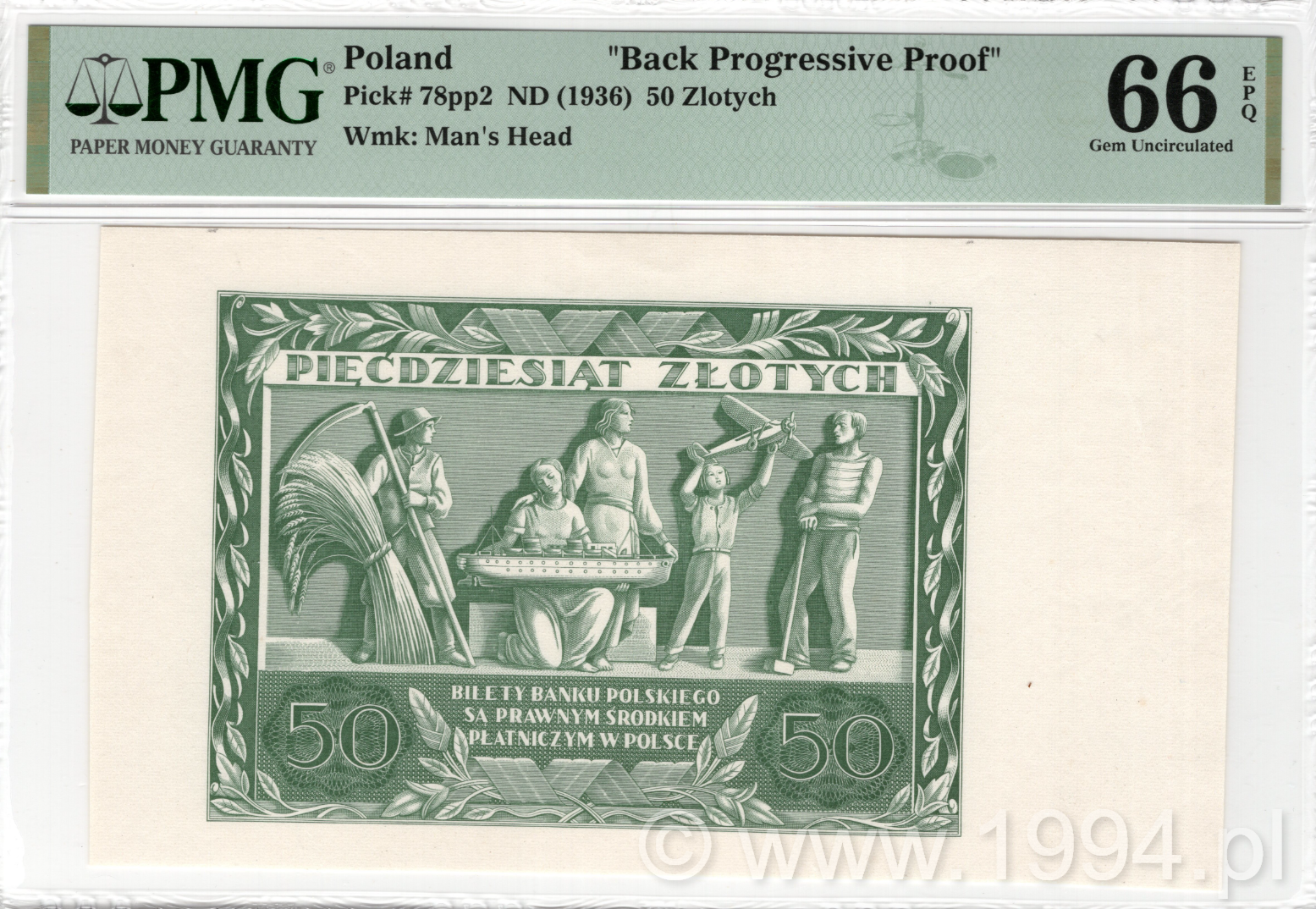
Progressive proof of the reverse design for the unissued 1936 50 Zlotych - one of the most advanced and visually ambitious notes ever conceived by the Second Polish Republic. Printed by the Państwowa Wytwórnia Papierów Wartościowych (PWPW) in Warsaw, this sheet captures a transitional stage in the birth of a masterpiece.
The reverse artwork was executed under the artistic supervision of Wacław Borowski and engraved by Włodzimierz Vacek, two of the most accomplished figures in pre-war Polish graphic arts. It portrays an allegorical composition symbolizing the productive power of the nation - agriculture, industry, and the arts united under the newly reborn Republic. In the full design, this imagery was intended to balance the classical portrait of General Jan Henryk Dąbrowski on the face of the note, expressing the connection between patriotic tradition and modern progress.
At this stage of production, only the reverse imagery was printed, using the offset process in pale orange and light-green tones - the same colors later used for the final issue. The PWPW’s documentation and surviving trial sheets show that each printing form measured roughly 557 × 515 mm and contained twelve notes arranged in three rows of four. Serial numbers were impressed before intaglio printing, a practice unique to PWPW at the time, ensuring registration precision. Proofs like this one were pulled to inspect ink density, alignment, and tonal layering prior to the application of engraving and security features.
Certified PMG 66 EPQ Gem Uncirculated and recorded as the single finest known (Top Pop), this impression displays an extraordinary clarity of line and untouched color balance - qualities seldom seen even in surviving production materials. Under magnification, one can study the early offset texture, faint guide marks, and micro-registration cues later eliminated from the master plates.
Progressive proofs are seldom encountered outside official archives. They were never intended for collectors, and their survival provides a rare, forensic view of how the Bank Polski and PWPW approached design refinement during Poland’s 1930s modernization campaign. Together with the finished Dąbrowski note, this proof completes the narrative - from concept to currency, from artistic ideal to national symbol. It stands today as a pristine artifact of Poland’s pre-war technical ingenuity and aesthetic ambition.