Description and research notes
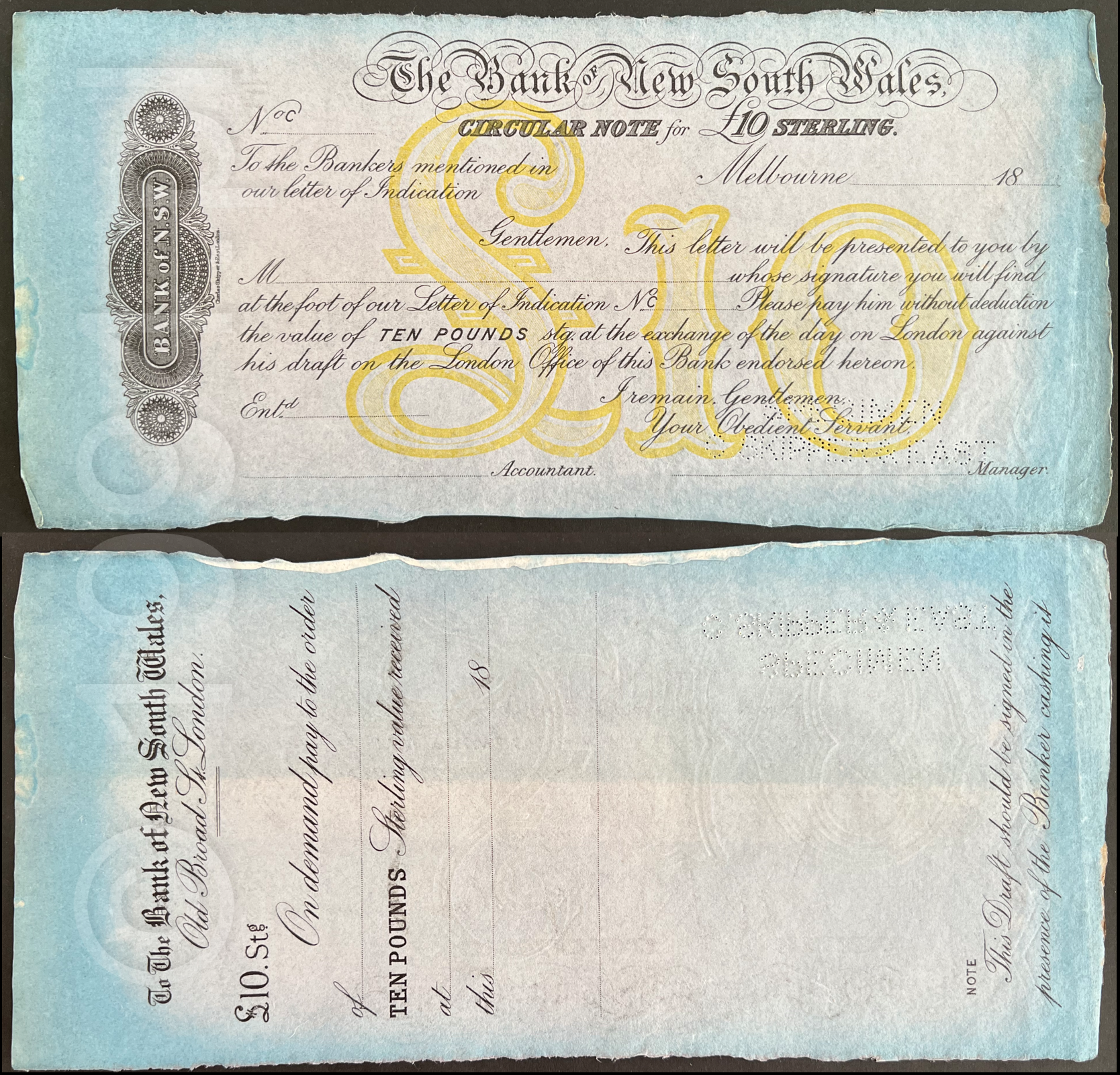
This proof represents a pre-issue banknote of the Bank of Australasia, denominated Ten Pounds and prepared for the Melbourne office during the institution early period of operation. It was produced as part of the bank internal approval and presentation process and was not intended for circulation.
The Bank of Australasia was incorporated by Royal Charter in 1835 and operated as one of the earliest British joint-stock banks active in Australia. From its inception, the bank relied on engraved paper currency to support commercial expansion in the Australian colonies, issuing notes payable in sterling on demand at its offices.
This proof displays the fully engraved face design, including the royal arms at center, denomination roundels, and the promise to pay the bearer on demand. The word SPECIMEN is printed prominently on the face, clearly identifying the note as a non-circulating proof prepared for reference, approval, or institutional record rather than public use.
The layout reflects early Victorian security printing practice, with heavy border engraving, balanced symmetry, and restrained ornamentation intended to convey authority and trust. The absence of serial numbering and signatures is consistent with proof status and confirms that the note represents a design-stage artifact rather than an issued instrument.
The Melbourne imprint anchors the note to the colonial financial center of Victoria during a period of rapid economic development. Notes of this denomination were used for large commercial settlements and institutional transactions, making the Ten Pounds value the highest tier of everyday banking paper in the colonial economy.
Proof material from the Bank of Australasia is exceptionally scarce due to the bank early date, limited production runs, and the routine destruction of non-circulating material once designs were approved. Surviving proofs provide direct evidence of how British banking institutions introduced formal paper money systems into Australia prior to Federation.
This example serves as a primary documentary artifact of early Australian banking practice, British export engraving, and the institutional mechanics behind the first generation of colonial banknotes.