Description and research notes
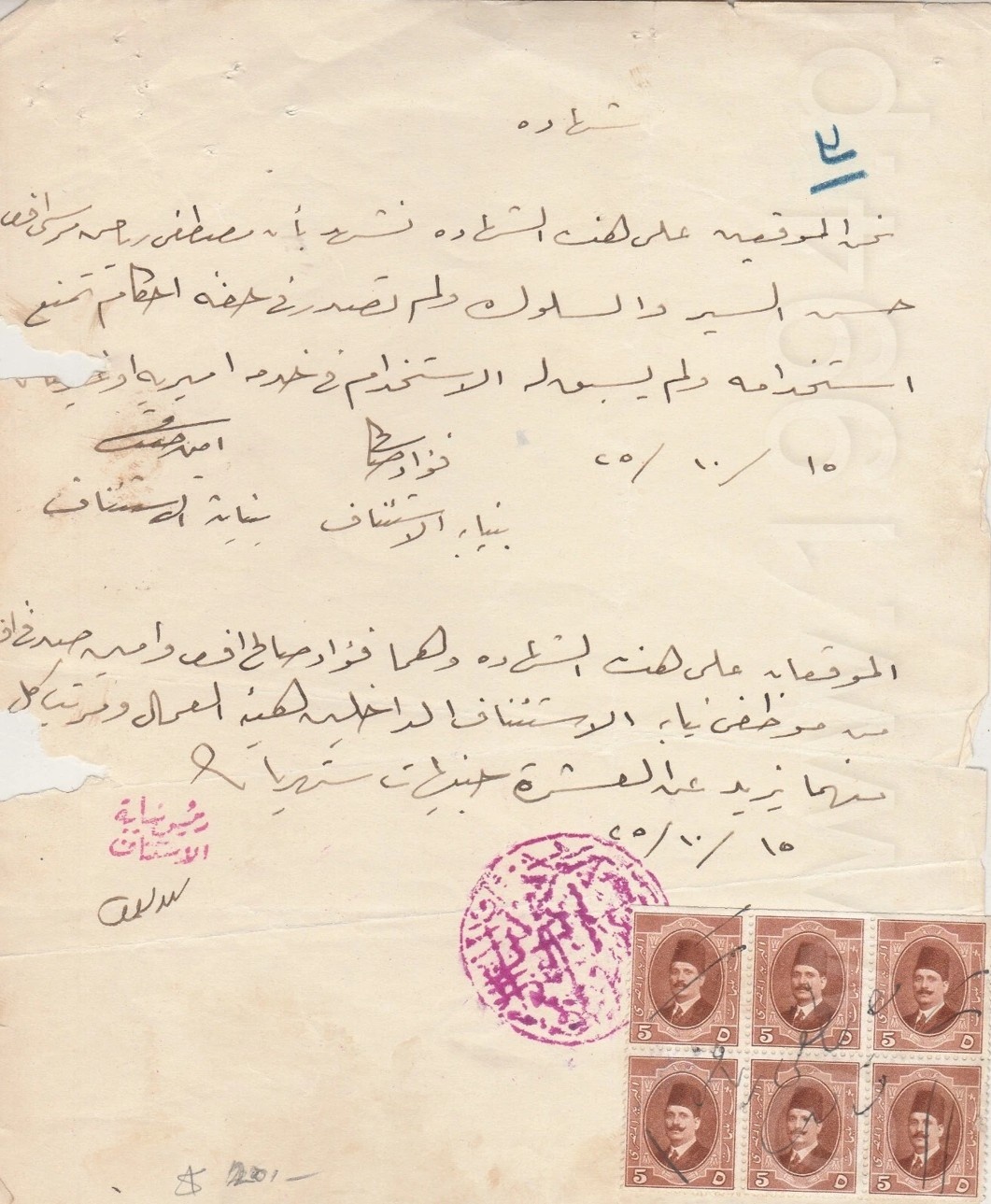
Original 1925 internal government certificate issued within an Egyptian ministry to document an irregularity or attempted fraud in an internal administrative process. The document is fully handwritten in period script with dated entries, clerk annotations, and formal internal case wording, including the 15 October 1925 date written directly into the manuscript text. The paper displays natural toning, corner folds, and routine office wear consistent with everyday administrative handling during the Fouad era.
Its most striking feature is the complete booklet pane of six 5-millieme King Fouad revenue stamps affixed together, fully intact and without separation. Government offices almost always detached individual stamps for fee payment, making the survival of a full booklet pane on a working document exceptionally rare. The pane remains in its original 2-by-3 configuration with uniform perforations and complete margins, showing that it was removed as a single unit from a revenue booklet rather than assembled from loose singles. All six stamps bear full manuscript cancellation across their surfaces, and the entire pane is additionally tied by a large circular ministry seal in violet, overlapping both the adhesives and the underlying paper.
The manuscript text describes an internal verification or disciplinary matter, likely involving the correction of an administrative oversight or the reporting of a suspected misuse of internal documentation. Fouad-era ministries produced such certificates to establish responsibility, certify internal findings, or document irregularities for filing in personnel or procedural records. These internal certifications were rarely intended for external circulation and were almost always destroyed during later consolidation or administrative cleanouts.
This document provides direct insight into the bureaucratic culture of 1920s Egypt. Under King Fouad I, ministries operated through highly formalized internal paperwork flows in which handwritten notes, certification stamps, and revenue adhesives played essential roles in validating processes and establishing audit trails. Before the creation of unified accounting offices and standardized printed forms, handwritten internal memoranda like this one formed the backbone of procedural oversight in education, taxation, customs, police, and civil-service departments. The affixed revenue pane represents not only the payment of a fee but also the ministry's adherence to internal financial controls, where fiscal adhesives served as a receipt mechanism for services, certifications, or case-handling steps.
The administrative seal, the complete booklet pane, and the unmistakably authentic period handwriting collectively preserve a snapshot of Fouad-era civil-service mechanics at a time when Egypt was modernizing internal recordkeeping while still relying heavily on Ottoman-inherited formats and manual verification systems. Such documents were routinely purged as ministries streamlined archives in the 1930s–1950s, making surviving internal certificates exceptionally scarce.
Combined with its intact pane of revenues, original clerk annotations, and full circular ministry cancellation, this certificate stands as one of the strongest surviving Egyptian fiscal artifacts from the mid-1920s. It is a museum-grade example of internal administrative practice during the reign of King Fouad I and an extraordinarily rare instance of a complete booklet pane used on an active government file rather than preserved in philatelic hands.