Description and research notes
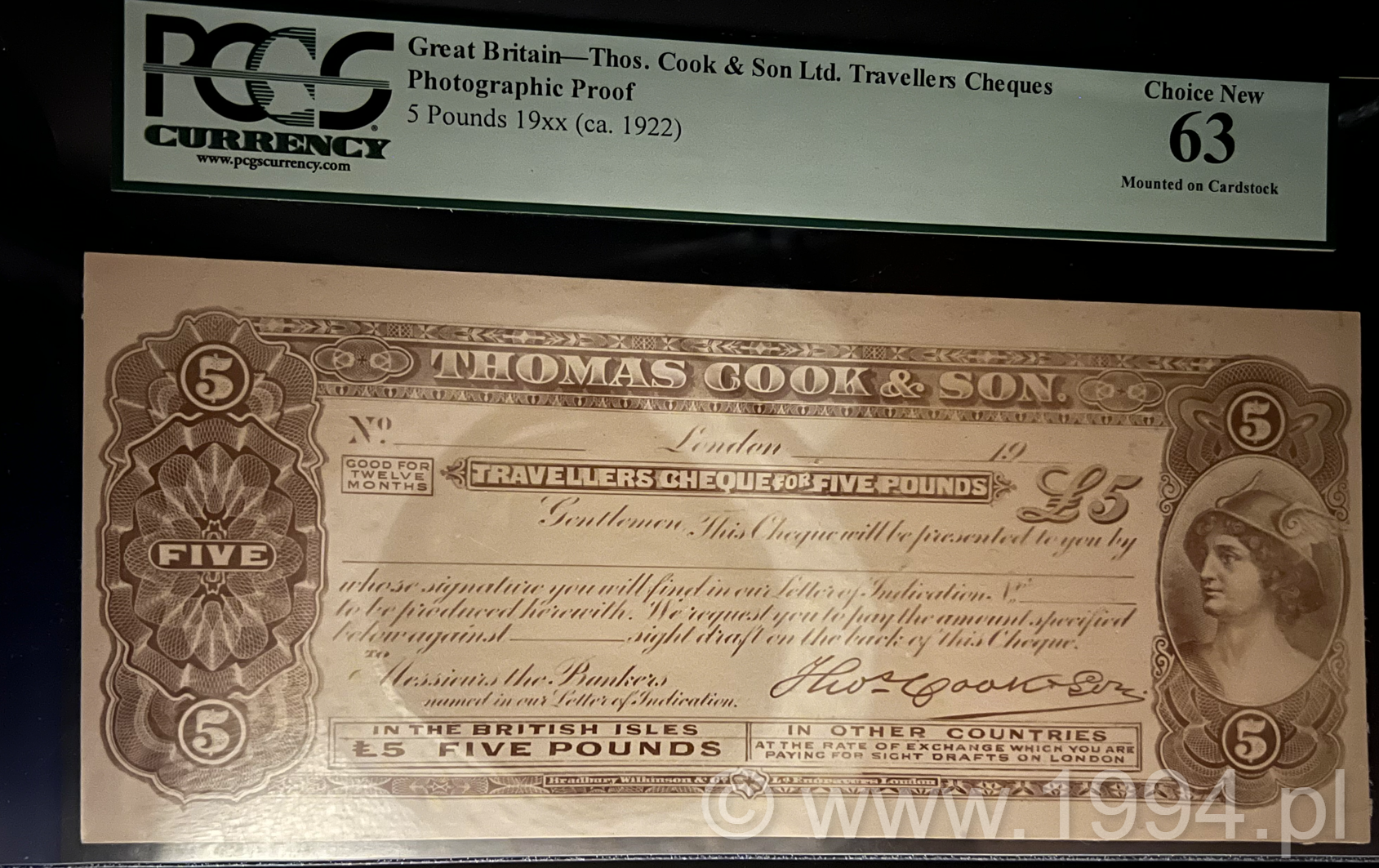
Photographic proof of the 5 Pounds Travellers Cheque prepared for Thomas Cook and Son in the early 1920s, produced during the post First World War consolidation phase of the firm's international payment system. Mounted on cardstock and preserved as a production-stage reference image, this proof records the engraved face before the finalized specimen form was printed for presentation and control use.
By the early 1920s, Thomas Cook and Son had established one of the most extensive private financial networks in the world. Travellers Cheques had evolved into a standardized, globally accepted instrument that allowed holders to obtain funds securely across the British Isles, Europe, and overseas destinations through Cook's offices and affiliated banks. The 5 Pounds denomination functioned as a core unit within this system, balancing portability with sufficient purchasing power for extended travel.
This example is a photographic proof, a distinct proofing format used to capture and evaluate the engraved face before commitment to full production printing. Photographic proofs were employed to assess engraving clarity, ornamental balance, typographic hierarchy, denomination placement, portrait treatment, and the overall visual integrity of the design. The sepia-toned image preserves the Thomas Cook and Son title banner, large denomination devices, dense geometric background, portrait vignette, payment wording, and signature areas in a clean production-review state.
The proof connects directly with the corresponding Thomas Cook and Son 5 Pounds Travellers Cheque specimen, allowing the proof-stage design record and the finalized specimen-stage cheque to be studied together. The photographic proof preserves the design as a mounted production review image, while the specimen preserves the printed cheque format with red specimen and cancellation markings, reverse payment wording, and the full issued-style presentation structure.
Mounted on original cardstock, the proof reflects internal handling practice for design review, presentation, and archival retention. The design projects institutional trust and financial authority through heavy ornamental framing, repeated value devices, and a formal Thomas Cook and Son banner. Its visual language belongs to the mature period of private traveller-payment instruments, when security printing, signature verification, and international correspondent networks combined into a practical global payment system.
At present, no other photographic proofs of the 5 Pounds Thomas Cook and Son Travellers Cheque from this period are documented in grading census records, auction archives, institutional collections, or published references. This establishes the piece as a unique visible example of its specific type and a primary reference artifact for the study of early twentieth-century private travel finance.
As a production-stage artifact, this photographic proof occupies a reference-level position in the study of private finance, security printing, and the evolution of traveller-based monetary instruments. Its connection to the matching specimen strengthens the archival value of both pieces, preserving the movement from photographic design verification to specimen-stage presentation within one of the most influential travel-payment systems of the twentieth century.