Description and research notes
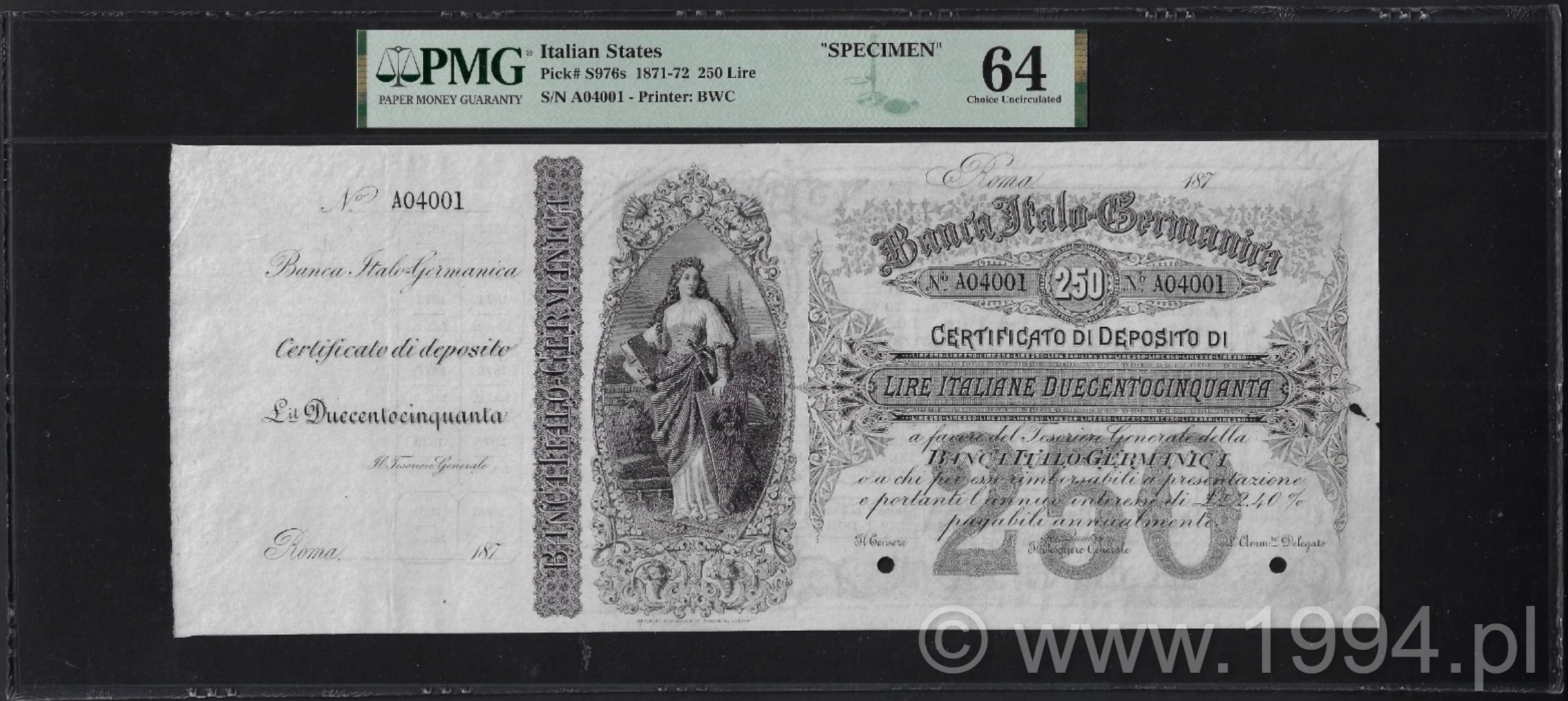
This engraved Standing Italia vignette die proof was produced by Bradbury, Wilkinson & Co., London, and is directly connected to the Banca Italo-Germanica 250 Lire specimen of 1871-72, Pick S976, where the same engraving appears as the principal pictorial element within the left-side ornamental panel. The proof preserves the complete vignette as a stand-alone engraved component before its integration into the finished banknote design.
The composition depicts a standing female personification of Italia within an elaborate vertical frame. She holds a book or document in one hand and rests the other beside a heraldic shield bearing the Italian arms. Architectural forms rise in the background, while inscriptions and symbolic details are incorporated into the surrounding landscape and ornamental structure. The figure combines classical allegorical imagery with contemporary references to the newly unified Italian state.
The engraving is executed in dense, finely controlled linework, with extensive cross-hatching used to model the figure, clothing, shield, architectural background and decorative frame. The large vertical format allowed the vignette to function as a substantial independent design element while retaining sufficient detail for later incorporation into a complex security-printed composition.
Bradbury Wilkinson developed banknote designs from separately engraved components, including allegorical figures, portraits, heraldic devices, landscapes, architectural views, borders and denomination elements. This proof documents that component stage directly, preserving the complete Standing Italia engraving apart from the lettering, counters, serial fields and financial text of the finished note.
On the 250 Lire specimen, the vignette occupies the prominent vertical panel near the center-left of the note, immediately beside the principal Banca Italo-Germanica text and denomination structure. Its scale and placement make it one of the dominant visual elements of the completed design and provide a direct production link between the independent engraving and the finished 1871-72 banknote.
The imagery belongs closely to the political setting of the period. Italian unification had been completed only shortly before, with Rome incorporated into the Kingdom of Italy in 1870 and established as the national capital in 1871. The personification of Italia therefore carried immediate national meaning, combining classical allegory, heraldry and contemporary state identity within a commercial banking design.
As a surviving stand-alone die proof, the piece documents Bradbury Wilkinson's engraving practice at the individual component level and preserves the principal allegorical vignette used on the Banca Italo-Germanica 250 Lire specimen before its incorporation into the complete security-printed composition.