Collection PL

About 1994.pl
Results for “bwc”
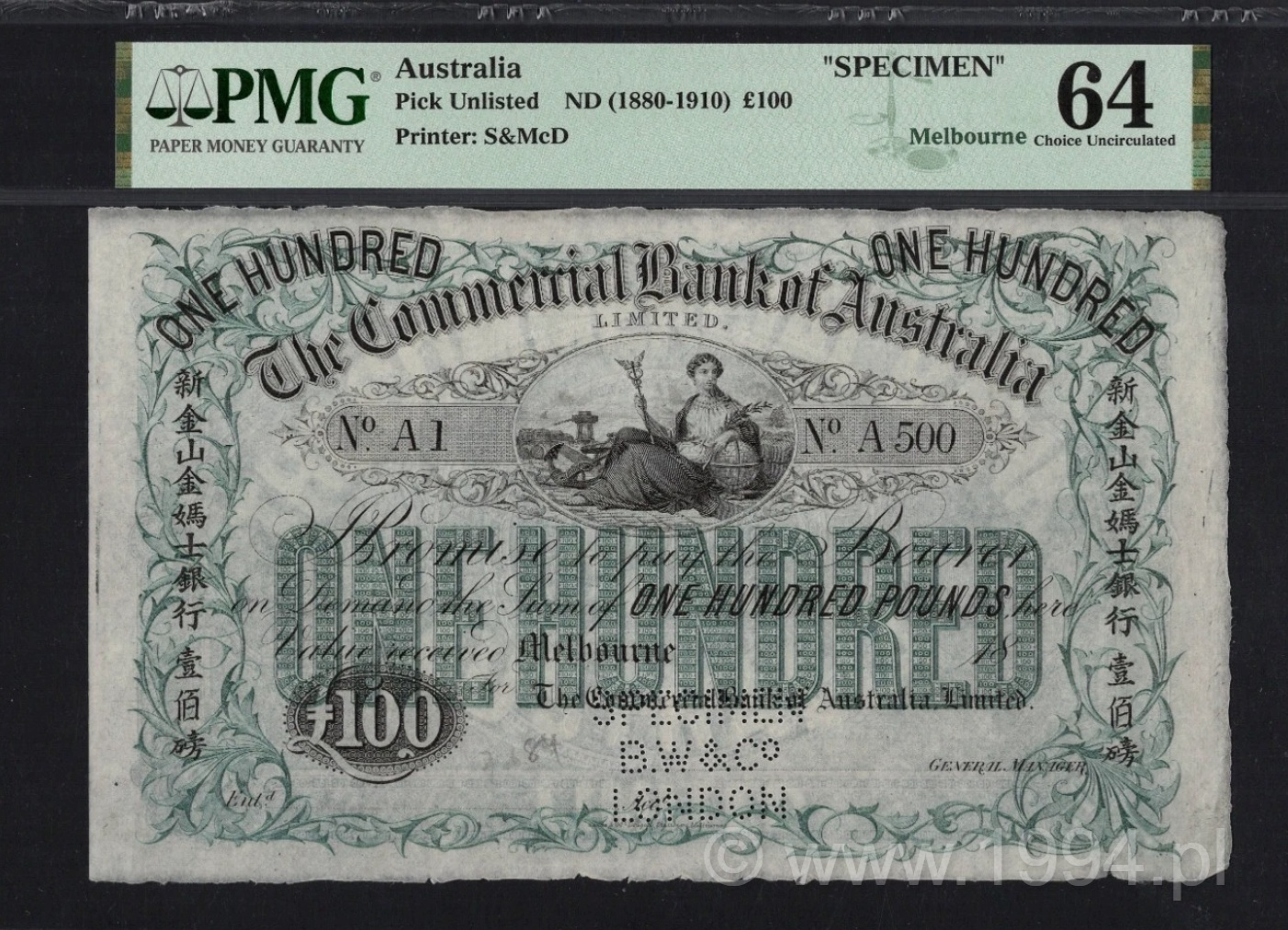
Australia 1880–1910 Commercial Bank of Australia £100 specimen, PMG 64 Choice Uncirculated

Australia 1880–1910 - Commercial Bank of Australia £100 Specimen (Pick Unlisted)

Pick Unlisted and absent from major catalogues, this note represents the intersection of rarity, artistry, cultural history, and financial significance. As a design artifact, a Chinese-Australian commercial document, a surviving record of deliberate 19th-century financial localization, and a financial relic from the end of Australia’s private-banknote era, this piece is an educational cornerstone for advanced Commonwealth collections and a critical reference in the study of pre-federation monetary history. Read more →

AustraliaSpecimen1880100 PoundsPMG 64 Choice Uncirculated Specimen100 PoundsHigh DenominationCommercial Bank of AustraliaBradbury WilkinsonBWCSands & McDougallColonial SpecimenBilingualChinese-EnglishPick UnlistedColonial Banking HistoryAustralian Private BanknotesPre-Notes Act Era19th Century BankingMulticultural Trade NetworksSecurity Printing HistoryBritish Engraving InfluenceAustralian Monetary HistoryAustralia188019101880–1910PMG 64Museum GradeR9 Extremely RareUniqueAnnotationsHandwritten Annotations
Held
New Zealand 1907–1926 Bank of New Zealand £20 Blue audit-range serial-prefix specimen with dual control numbers, Bradbury Wilkinson & Co., PMG 55 AU, Pop 1/1, R9 Extremely Rare

New Zealand 1907–1926 - Bank of New Zealand £20 Blue Serial-Prefix Audit Specimen (Pick S194s)

The PMG 55 About Uncirculated grade is exceptionally high for a large-format, soft-paper audit specimen. With Pop 1/1 status and no evidence of any additional audit-range examples in institutional or private holdings, this piece stands as the definitive reference for the BNZ £20 issue and a cornerstone artifact of New Zealand’s pre–Reserve Bank monetary history. Read more →

New ZealandSpecimen190720 PoundsPMG 55 About Uncirculated (Pop 1/1) Specimen20 PoundsBlueBNZ Color LineageHigh Denomination Color TierHigh DenominationAudit-Range SpecimenSerial PrefixDual Serial NumbersPerforated SpecimenBradbury WilkinsonBWCPick S194sBank of New ZealandPrivate Banknote EraPre-Reserve BankNew Zealand Banking HistoryBritish Engraved NotesMāori Portrait VignettesSecurity Printing HistoryHigh-Value NotesAudit Control SheetNew Zealand190719261907–1926PMG 58Pop 1Top PopMuseum GradeR9 Extremely RareUnique
Held
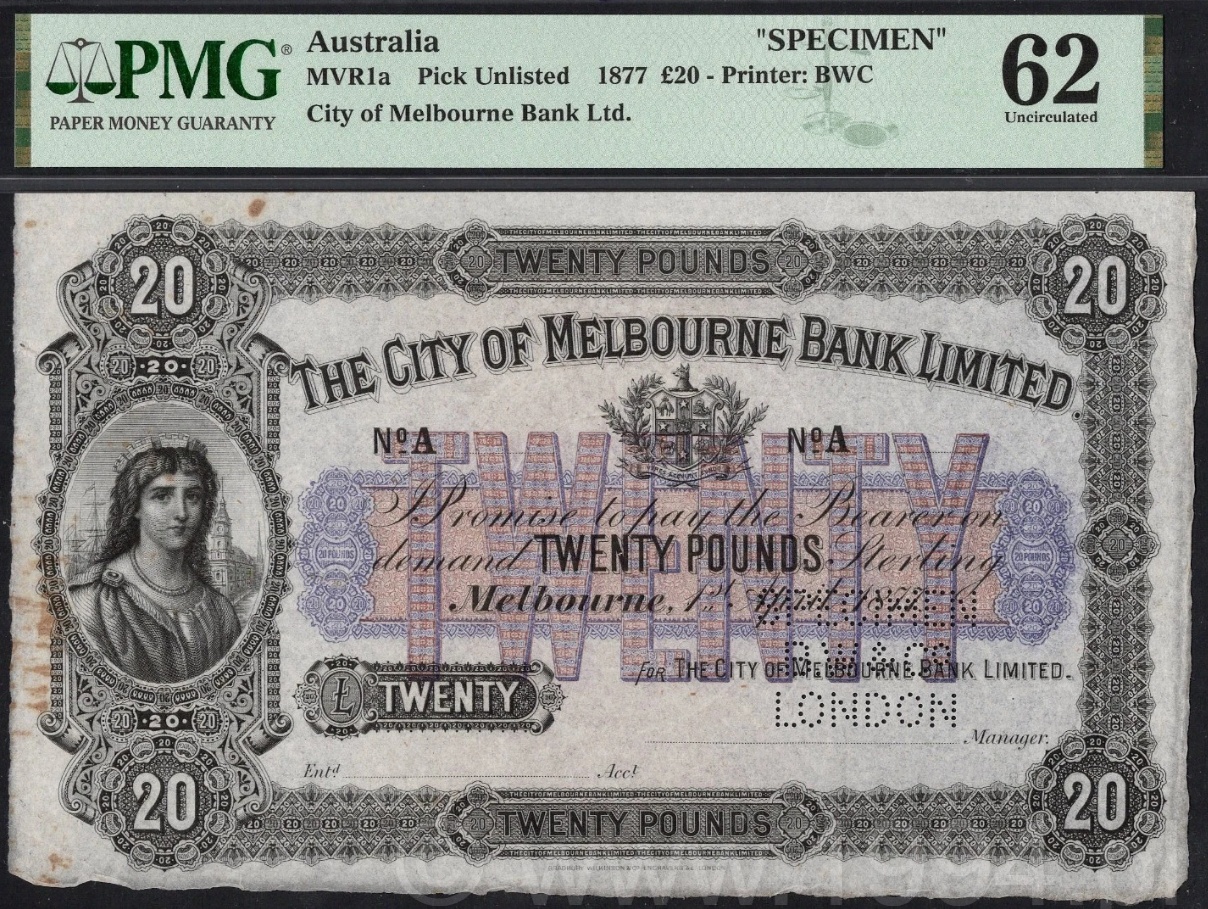
Australia 1877 City of Melbourne Bank Limited £20 specimen engraved by Bradbury Wilkinson, PMG 62 Uncirculated, unique surviving example

Australia 1877 - City of Melbourne Bank Limited £20 Specimen (Pick Unlisted)

High-denomination private banknotes such as £20 circulated exclusively within institutional and wholesale channels. They were used for interbank settlement, bullion transactions, and large commercial payments rather than everyday commerce. As a result, survival rates were exceptionally poor even during their own period of use. Following Federation and the Australian Notes Act of 1910, issued examples were recalled and destroyed, leaving specimens as the sole documentary record for many denominations. Read more →

AustraliaSpecimen187720 PoundsPMG 62 Uncirculated Specimen20 PoundsCity of Melbourne Bank LimitedBradbury WilkinsonBWCPick UnlistedColonial SpecimenEngraved Security PrintingAustralian Private BanknotesVictoria Banking HistoryPre-Federation FinanceGold Rush Era BankingSecurity Printing History19th Century BankingAustralian Monetary HistoryAustraliaVictoria1877PMG 62Museum GradeR9 Extremely RareUnique
Held
Australia 1877 Mercantile Bank of Sydney £1 specimen with red ONE overprint, Pick Unlisted, printed by Bradbury Wilkinson & Co., graded PMG 66 EPQ Gem Uncirculated Pop 1, only known example

Australia 1877 - Mercantile Bank of Sydney £1 Specimen (Pick Unlisted)

Produced in London by Bradbury, Wilkinson & Co., the note displays the firm’s finely controlled intaglio characteristic of the 1870s: geometric borders, elaborate guilloches, and a bold typographic layout. The large red overprint “ONE” identifies it as an internal specimen, intended for reference or approval rather than circulation. Its pristine surfaces, confirmed by PMG’s Exceptional Paper Quality designation, reflect its archival preservation and the superior paper stock used for BWC’s specimen and proof work. Read more →

AustraliaSpecimen18771 PoundPMG 66 EPQ Gem Uncirculated (Pop 1) Specimen1 PoundPick UnlistedRed OverprintColonial Private BankBradbury WilkinsonBWCMercantile Bank of SydneyNew South Wales Banking History19th Century FinanceAustralian Private IssuesSecurity Printing HistoryColonial PeriodAustralia1877Only Known ExampleR9 Extremely RareUniquePop 1Top PopPMG 66 EPQGem UncirculatedMuseum Grade
Held
Australia Federal Bank of Australia Limited one pound Sydney specimen printed by Bradbury Wilkinson, annotated 1882, PMG 64 Choice Uncirculated

Australia 1879–1903 - Federal Bank of Australia, Limited £1 Sydney Specimen (Pick Unlisted)

Graded PMG 64 Choice Uncirculated and recorded as the finest known example, this specimen stands as a unique surviving artifact of the Federal Bank of Australia’s brief existence. Its significance lies not only in its rarity but also in its documentation of Sydney’s role as a major colonial financial center during Australia’s private banknote era prior to Federation. Read more →

AustraliaSpecimen18791 PoundPMG 64 Choice Uncirculated (Annotated, Top Population) Specimen Banknote1 PoundPrinter SpecimenAnnotated SpecimenExport Engraved NoteLarge Format BanknoteBradbury WilkinsonBWCBritish Security PrintingVictorian Era EngravingPrivate Banknote ProductionFederal Bank of Australia LimitedAustralian Private BanksPre Federation AustraliaSydney Banking HistoryVictorian Banking Crisis1893 Banking CollapseAustraliaSydney187919031879–1903Pick UnlistedTop PopMuseum GradeR9 Extremely RareUniqueAnnotationsHandwritten Annotations
Held
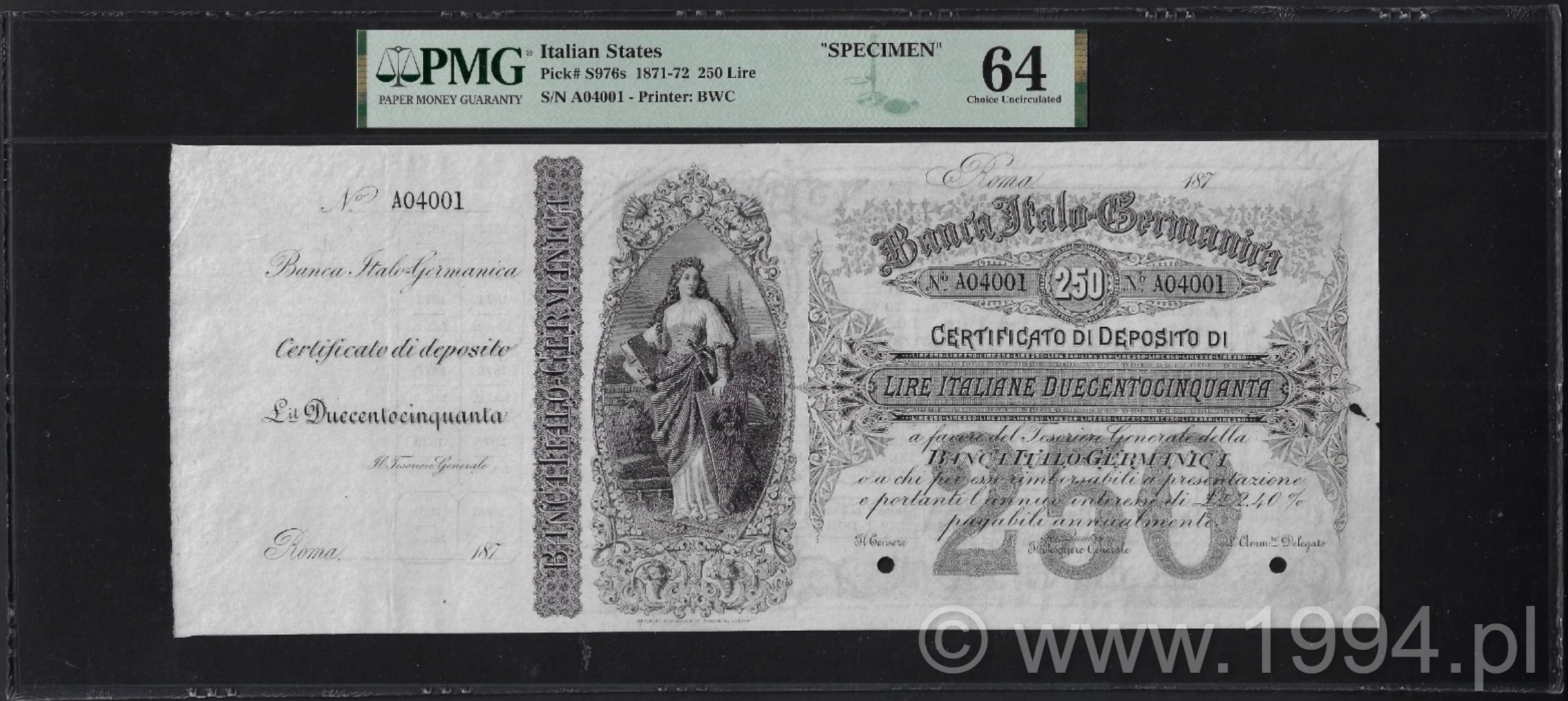
Italy 1871–1872 Banca Italo-Germanica 250 Lire specimen, Pick S976s, Bradbury Wilkinson & Co., PMG 64 Top Pop

Italy 1871–1872 - Banca Italo-Germanica 250 Lire Specimen (Pick S976s)

Produced by Bradbury, Wilkinson & Co. in London during the early stages of their European expansion, the engraving reflects a transitional moment in BWC’s development from commercial engravers into one of the world’s premier security printers. The deeply cut guilloches, vast empty margins, and sculptural allegory of Standing Italia exhibit a sophistication rarely seen on private Italian issues of the period. BWC’s design language of the 1870s-ornate, aspirational, and technically ambitious-foreshadows the company’s later dominance in colonial and European banknote engraving. As an artifact of design history alone, this note marks one of the earliest intersections between British engraving expertise and the newly unified Italian state. Read more →

ItalySpecimen1871250 LirePMG 64 (Top Pop) Private BankOversizedSpecimenDouble Punch HolePunch Cancelled250 LireEngraved Security PaperProof and Archive PieceBradbury WilkinsonBWCPick S976sItalian StatesPost Unification ItalyItalian Banking HistoryFailed Banknote IssuesGerman Capital in Italy19th Century FinanceNational AllegorySecurity Printing HistoryRome Banking ExperimentsUnissued Banknote ProjectItaly1871PMG 64Top PopR9 Extremely RareUniqueMuseum Grade
Held
Italy 1871 Germania with shield and spear vignette die proof engraved by Bradbury Wilkinson for the Banca Italo-Germanica 250 Lire (Pick PS976)

Italy 1871 - Standing Italia Vignette Die Proof used on Banca Italo-Germanica 250 Lire

Bradbury Wilkinson developed banknote designs from separately engraved components, including allegorical figures, portraits, heraldic devices, landscapes, architectural views, borders and denomination elements. This proof documents that component stage directly, preserving the complete Standing Italia engraving apart from the lettering, counters, serial fields and financial text of the finished note. Read more →

ItalyVignette1871-Uncirculated Italia AllegoryDie ProofBanca Italo-Germanica250 LireItalian StatesBradbury WilkinsonBWCItaly1871
Held
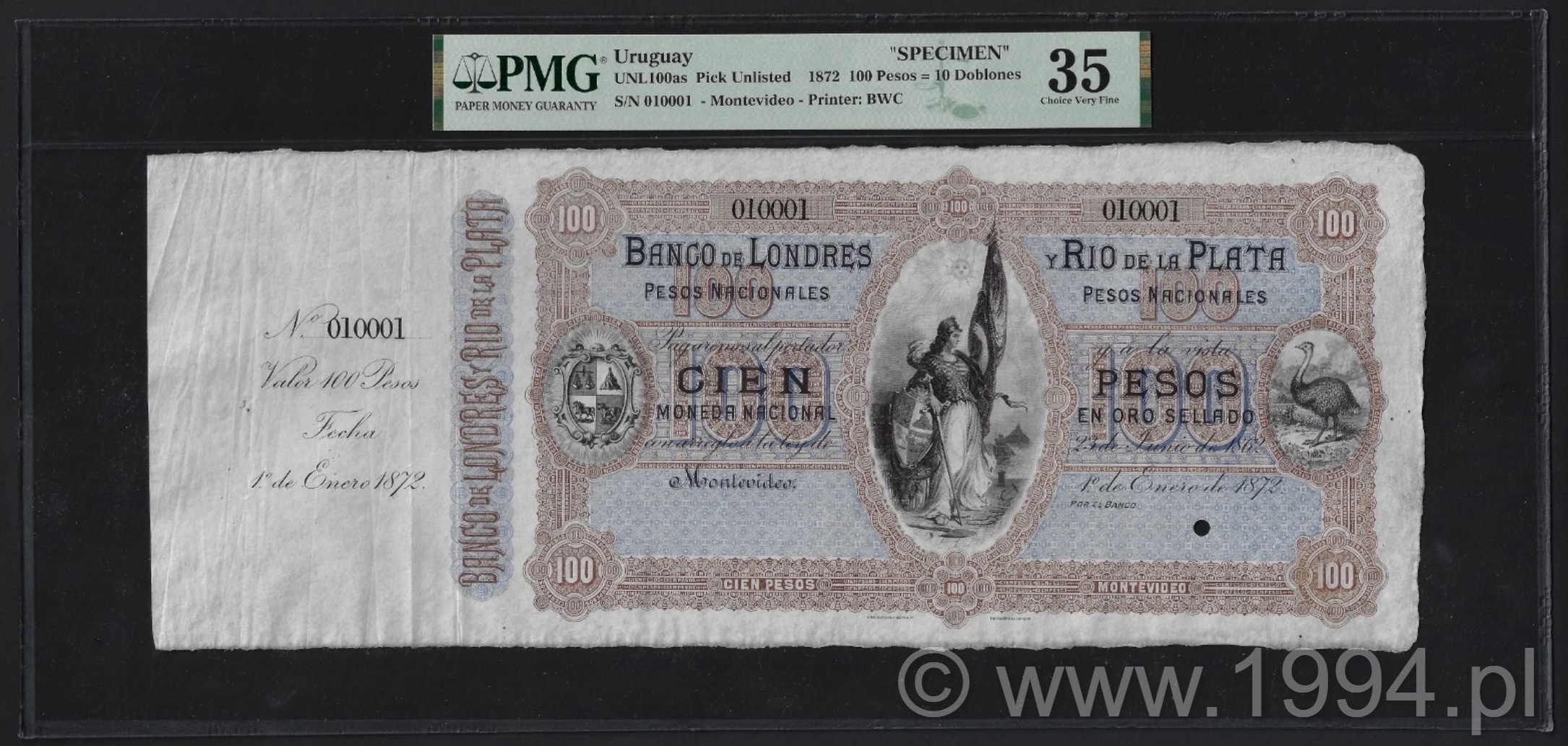
Uruguay 1872 100 Pesos equals 10 Doblones printer archival specimen, early serial number 010001, printed by Bradbury Wilkinson

Uruguay 1872 - Banco de Londres y Rio de la Plata 100 Pesos = 10 Doblones Specimen (Pick Unlisted)

A printer’s archival specimen of the 1872 issue of the Banco de Londres y Rio de la Plata, denominated 100 Pesos Nacionales with an explicit equivalence to 10 Doblones in gold. This dual-denomination construction represents one of the most ambitious monetary experiments undertaken in nineteenth-century Uruguay, attempting to anchor paper currency directly to a fixed gold value at a time of persistent instability and public distrust in fiduciary issues. Read more →

UruguaySpecimen1872100 Pesos = 10 DoblonesPMG 35 Choice Very Fine SpecimenPrinter Archival SpecimenDual DenominationGold EquivalenceEarly Pull Serial 010001Oversized FormatBradbury WilkinsonBWCLondon Security PrintingNineteenth Century EngravingArchival Reference NoteGold Standard ExperimentPeso Doblone ParityBanco de Londres y Rio de la PlataLatin American Monetary HistoryNineteenth Century State FinanceUruguayMontevideo1872Pick UnlistedMuseum GradeR9 Extremely RareUnique
Held
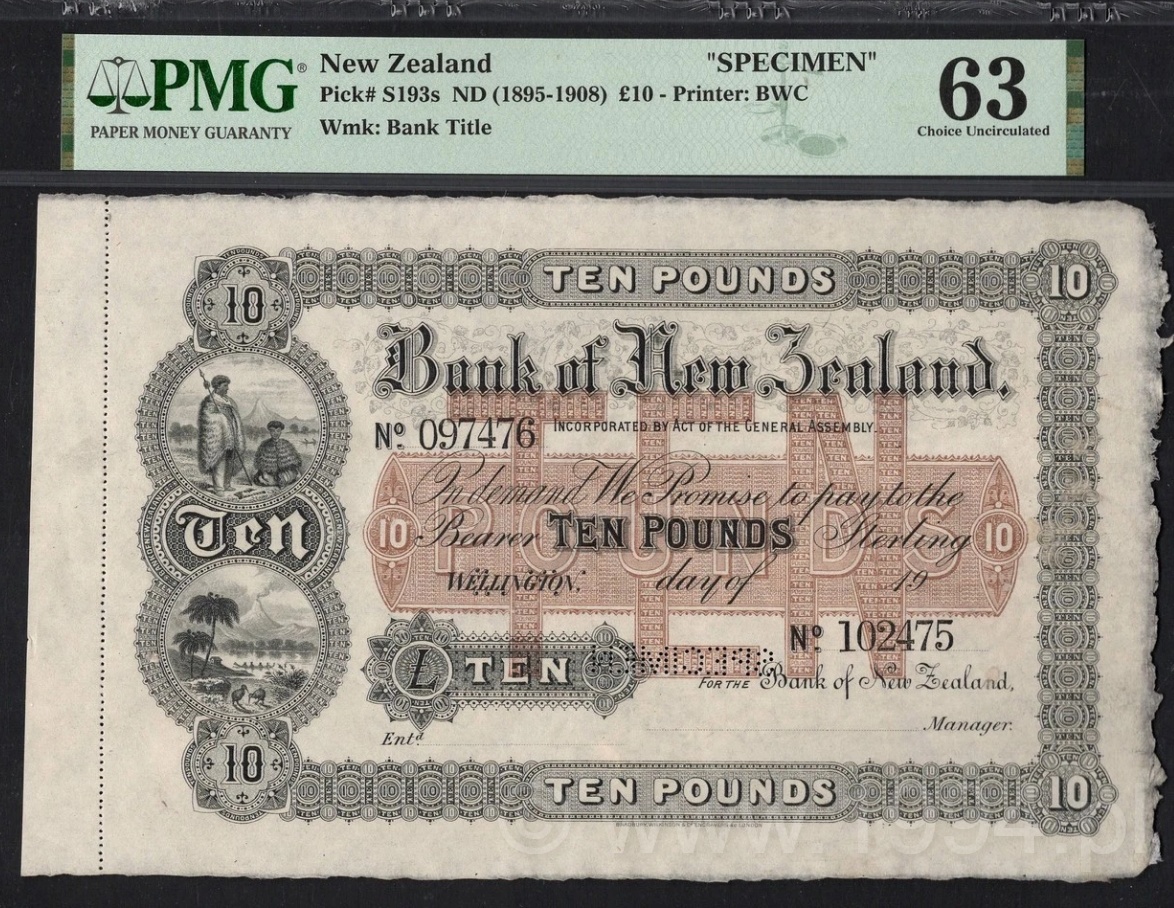
New Zealand 1895–1908 Bank of New Zealand 10 Pounds Brown specimen with dual serial numbers 097476 and 102475, perforated SPECIMEN, Bradbury Wilkinson printing, PMG 63 Choice Uncirculated

New Zealand 1895–1908 - Bank of New Zealand £10 Brown Specimen with Serial Number Prefix (Pick S193bs)

The specimen carries a perforation reading 'SPECIMEN' applied across the central design, executed through pin-perforation rather than ink overprint. This perforation functions as a printer-applied specimen designation. A wide vertical audit margin at left remains intact, consistent with printer file copies retained for internal reference and documentation. Read more →

New ZealandSpecimen with Serial Number Prefix189510 PoundsPMG 63 Choice Uncirculated Specimen10 PoundsBrownBNZ Color LineageSerial Prefix Specimen097476102475Perforated SPECIMENBradbury WilkinsonBWCPick S193bsBank of New ZealandPrivate Banknote EraPre-Reserve BankNew Zealand Banking HistoryMāori Portrait SeriesVictorian Edwardian TransitionSecurity Printing HistoryOceania NumismaticsHistoryNew Zealand189519081895-1908PMG 63Choice UncirculatedMuseum GradeR8 Extremely Rare
Held
New Zealand 1916–1920 Bank of New Zealand £5 Red-Rose wartime specimen from the BNZ orange lineage, Pick S227s, serial prefix 7/180001–7/220000, PMG 65 EPQ Top Pop

New Zealand 1916–1920 - Bank of New Zealand £5 Red-Rose (Orange Lineage) Specimen with Serial Number Prefix (Pick S227s)

The obverse reflects Bradbury Wilkinson’s mature colonial engraving style, with a Māori chieftain and youth vignette, coastal landscape, and dense guilloche structures printed in saturated wartime tint. The reverse is executed in blue-green interlace characteristic of BWC production of the period. Read more →

New ZealandSpecimen with Serial Number Prefix19165 PoundsPMG 65 EPQ Gem Uncirculated (Top Pop) Specimen5 PoundsRed-RoseBNZ Color LineageOrange LineageWith Serial PrefixPrinter AnnotationCANCELLED PerforationHigh DenominationBradbury WilkinsonBWCPick S227sBank of New ZealandPrivate Banknote EraPre-Reserve BankWartime IssueNew Zealand Banking HistoryMāori Portrait SeriesMaritime Economy NotesSecurity Printing HistoryNew Zealand191619201916–1920Top PopPMG 65 EPQMuseum GradeR8 Extremely RareAnnotationsHandwritten Annotations
Held
New Zealand 1913 Bank of New Zealand £5 Orange multi-serial approval specimen Pick S192ms with serials 286901 and 296900, Bradbury Wilkinson & Co., PMG 63 Choice Uncirculated

New Zealand 1913 - Bank of New Zealand £5 Orange Multi-Serial Approval Specimen (Pick S192ms)

Within the BNZ color lineage, the £5 Orange occupies the central position between the £1 Green and the higher-denomination £10 Brown. This warm-toned middle tier served as a long-standing visual identifier for the denomination across decades of private-bank issuance. The continued use of orange into the 1910s demonstrates Bradbury Wilkinson’s commitment to chromatic continuity even as engraving practices evolved. Read more →

New ZealandSpecimen19135 PoundsPMG 63 Choice Uncirculated (Top Pop) SpecimenApproval Specimen5 PoundsOrangeBNZ Color LineageMulti-Serial ApprovalBradbury WilkinsonBWCPick S192msBank of New ZealandPrivate Banknote EraPre-Reserve BankNew Zealand Banking HistoryWWI-Era ProductionVictorian-Edwardian TransitionMāori Portrait SeriesMaritime Economy NotesSecurity Printing HistoryOceania NumismaticsNew Zealand1913PMG 63Museum GradeR8 Extremely Rare
Held
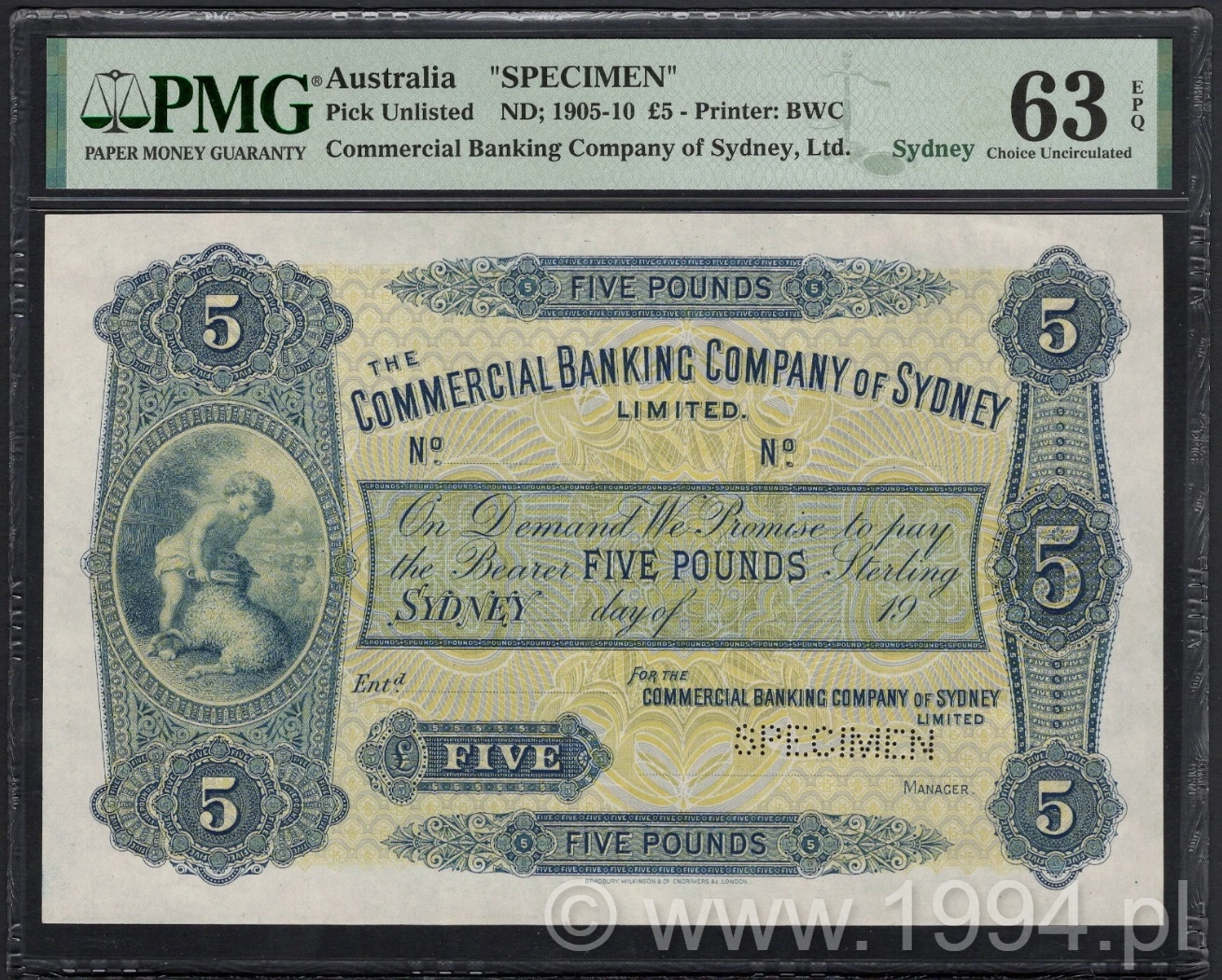
Commercial Banking Company of Sydney LIMITED £5 proof, circa 1905–1910, PMG 63 EPQ

Australia 1905–1910 - Commercial Banking Company of Sydney LIMITED £5 Specimen Proof (Pick Unlisted)

Bradbury Wilkinson’s master plates reflect the mature internationalisation of security printing. By 1905–1910, Australian banks increasingly relied on London engravers for their highest-grade notes, as BWC offered complex tint-stone methods, deep intaglio capability, and anti-counterfeiting technologies unattainable in most colonial print shops. These proof specimens were the pinnacle of that relationship, produced in tiny numbers for board approval, archival retention, or printer-client authentication. Read more →

AustraliaSpecimen Proof19055 PoundsPMG 63 EPQ (Top Pop) Specimen5 PoundsSpecimen ProofProofPick UnlistedCommercial Banking Company of Sydney LimitedBradbury WilkinsonBWCLarge SizePre-FederationColonial SpecimenEngraved Security PrintingAustralian Private BanknotesSydney Banking HistorySecurity Printing HistoryEdwardian DesignBritish Engraving InfluenceTransition to Commonwealth CurrencyEarly 20th Century BankingAustralian Monetary HistoryAustraliaSydney190519101905–1910PMG 63 EPQTop PopMuseum GradeR8 Extremely Rare
Held
↑ Top