Description and research notes
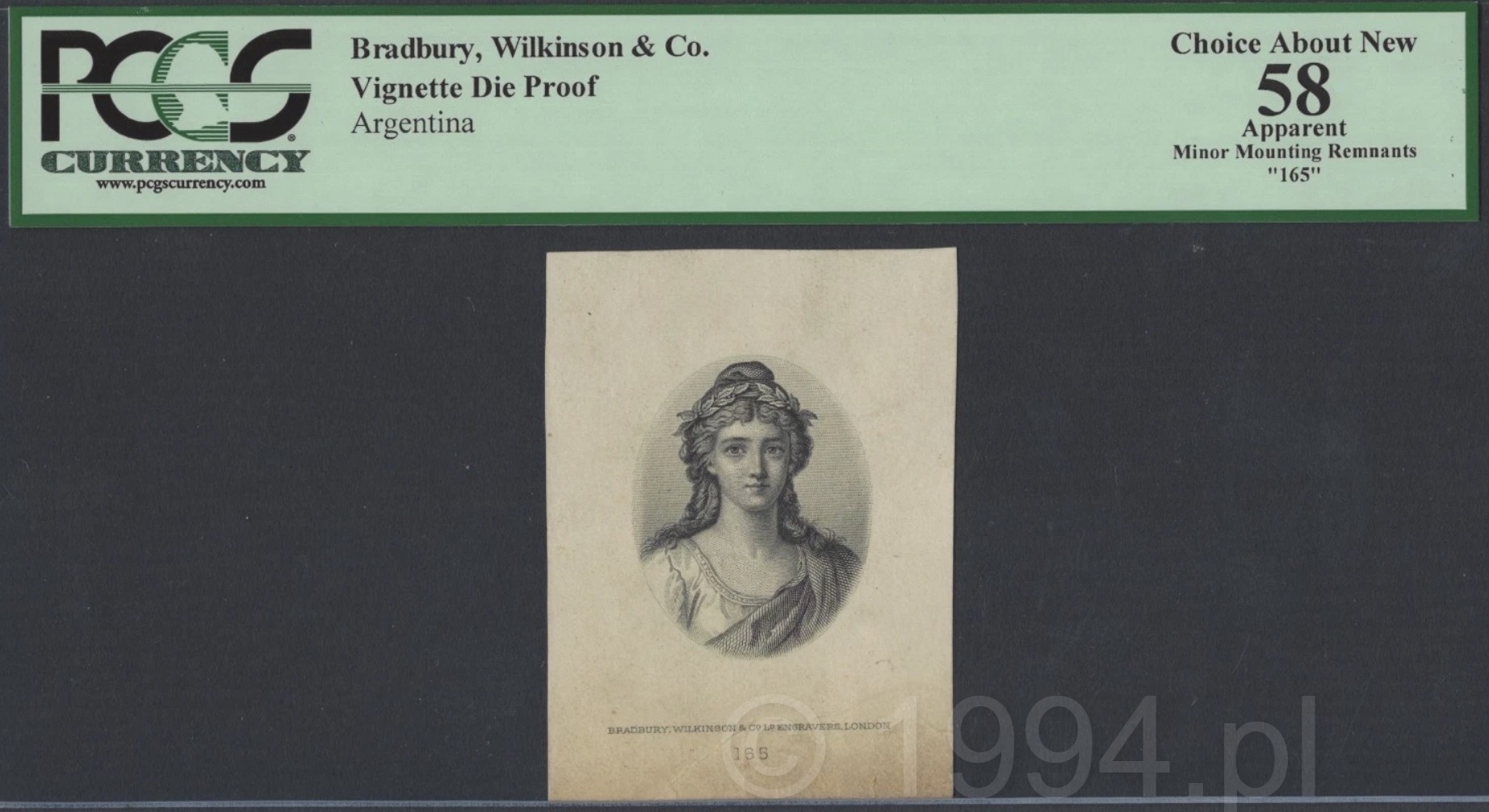
This intaglio vignette proof represents the master engraved portrait of Omar al-Mukhtar prepared for the Central Bank of Libya’s post-monarchy currency redesign introduced in 1971. The vignette constitutes a standalone production artifact, engraved independently of any completed banknote and intended for transfer into the face plate of the new 10 Dinars issue following final approval.
In modern banknote production, vignette proofs occupy a foundational position within the engraving workflow. They are executed before the assembly of complete face plates and serve as the visual and symbolic anchor around which the remainder of the design is constructed. Unlike color trials or issued notes, vignette proofs document the engraver’s original artistic intent at maximum fidelity, unconstrained by later compromises required for mass production.
The portrait depicts Omar al-Mukhtar, the Libyan resistance leader executed by Italian colonial authorities in 1931 and later elevated as a central national symbol following the 1969 revolution. His selection for Libya’s republican currency marked a decisive ideological shift away from royal imagery toward revolutionary legitimacy and anti-colonial identity. This vignette therefore carries political as well as technical significance, embodying the narrative the new regime sought to project through its monetary system.
The engraving displays classic high-grade intaglio technique, characterized by dense cross-hatching, controlled line tapering, and deep relief intended to carry substantial ink volume. Facial modeling is especially pronounced in the cheek, temple, and beard areas, where layered line work creates depth and texture exceeding that of the final issued note. Such intensity is typical of master vignettes, which are later softened through retouching and plate integration to ensure durability and consistency during high-speed printing.
Comparative examination against the issued 10 Dinars portrait reveals subtle but intentional modifications made at later stages of production. Line weights were moderated, highlights broadened, and transitions simplified to reduce plate wear and prevent tonal closure in circulation printing. This vignette thus preserves engraving detail that was deliberately reduced before final release, making it the most complete visual record of the portrait as originally conceived.
This proof was never intended for circulation and was not part of any issued, remaindered, or specimen banknote stock. It exists independently as a production-stage artifact, retained outside normal destruction protocols applied once plate preparation was completed.
At the time of cataloging, this is the only certified intaglio vignette proof of Omar al-Mukhtar recorded for the Central Bank of Libya 1971 series. No additional examples are documented in grading census data, auction archives, institutional collections, or reference literature. Its rarity derives from production-stage uniqueness rather than condition scarcity.
As such, this vignette stands as a museum-grade reference object documenting both the technical engraving process and the ideological transformation of Libyan currency in the early republican period. It represents the point at which political symbolism, artistic execution, and monetary authority converged into a finalized national image.