Description and research notes
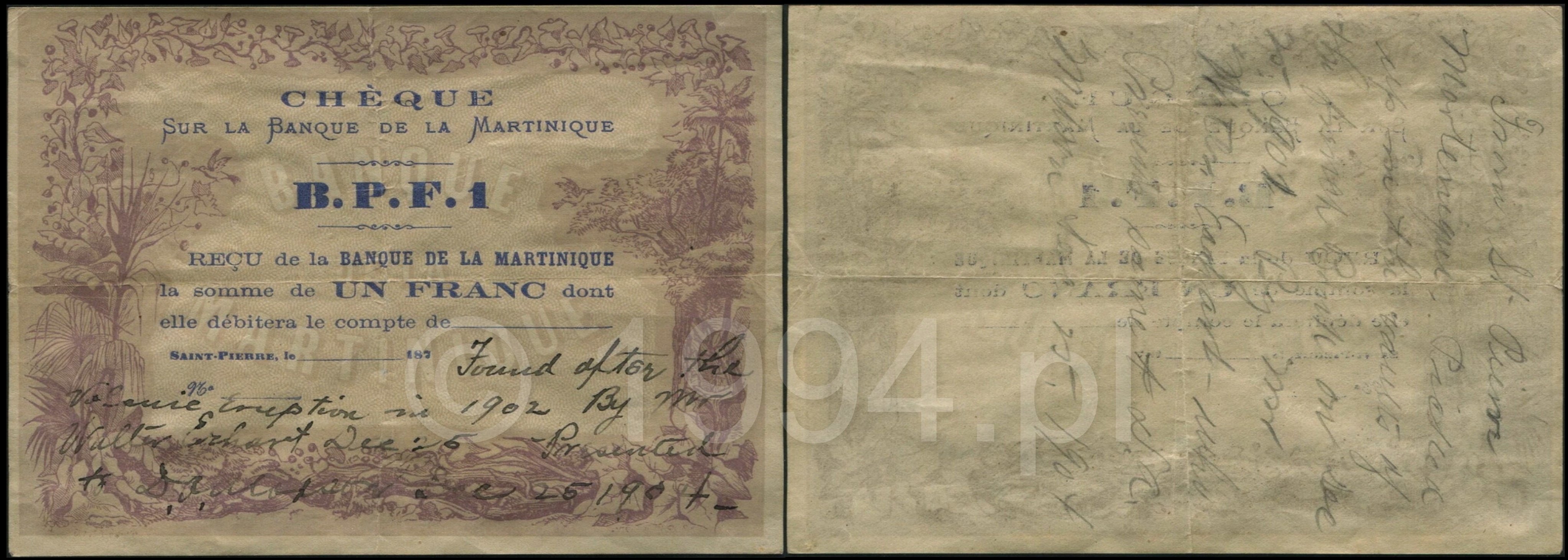
A Banque de la Martinique one franc cheque form, Pick P.5A, originally printed for use at Saint-Pierre during the late nineteenth century and later recovered from the ruins of the city following the catastrophic eruption of Mount Pelée on 8 May 1902. Although printed decades earlier as part of the bank’s standardized cheque issue, this surviving example was never negotiated as a financial instrument and instead entered history as a disaster-recovery relic, explicitly identified as such by contemporary handwritten annotations.
The printed face follows the established Banque de la Martinique cheque format, bearing the heading “Chèque sur la Banque de la Martinique,” internal control marking “B.P.F. 1,” and a printed acknowledgment of receipt for the sum of one franc, to be debited from the account of a named holder. The place of issue is Saint-Pierre, with a printed year line left incomplete, consistent with cheque forms intended to be dated at the time of use. Ornamental engraved borders composed of tropical flora frame the document, reflecting French metropolitan engraving conventions adapted for colonial financial instruments. Printer imprints at the lower margins attribute production to Claverie et Fils, with engraved elements credited to Reschérer.
Crucially, this cheque bears multiple handwritten annotations in period ink on both the face and reverse, transforming it from a dormant banking form into a documented historical artifact. On the face, contemporary handwriting states that the cheque was “Found after the eruption in 1902,” directly linking the object to the destruction of Saint-Pierre. Additional manuscript notes reference the event and date, confirming that the writing was applied shortly after the catastrophe and not as a later retrospective addition.
The reverse carries a clearer and more explicit inscription reading “Souvenir of St. Pierre” and “Found in the wreck of the Colonial Bank,” followed by a specific date: May 13, 1902. This date falls only five days after the eruption, during the brief window when access to the ruins was still possible and before systematic clearing or restriction of the site. The reference to the Colonial Bank situates the recovery location within the destroyed banking district of Saint-Pierre, an area completely annihilated by pyroclastic flows and fires.
The handwriting style, ink saturation, and integration with the paper fibers are consistent with early twentieth century iron gall ink usage. The manuscript text shows natural fading and absorption commensurate with age and environmental exposure, with no visual indicators of modern writing instruments or later alteration. The annotations do not exaggerate or dramatize the event but instead record it in plain, factual language, characteristic of personal field notes rather than commercial or exhibition labeling.
The physical condition of the cheque further supports its recovery narrative. The paper exhibits uniform toning, softened fibers, and surface wear consistent with exposure to heat, ash, moisture, and handling in a post-disaster environment. Folding patterns and overall texture differ markedly from pristine unissued examples, aligning instead with an object that survived a catastrophic event rather than archival storage.
Saint-Pierre, prior to its destruction, was the economic and administrative heart of Martinique and a central node in the island’s banking network. The annihilation of the city in 1902 resulted in the near-total loss of financial records, currency, and instruments held within its institutions. Paper banking artifacts that can be conclusively tied to the eruption are extraordinarily rare, and those bearing explicit contemporary inscriptions identifying their recovery context are rarer still.
This cheque therefore occupies a dual identity: it is both a nineteenth-century colonial banking instrument and a primary disaster relic from one of the deadliest volcanic eruptions in recorded history. Its significance lies not in monetary function but in documentary survival, direct event association, and contemporaneous human testimony preserved in ink. Within French colonial numismatics and disaster-related financial ephemera, this example stands as a museum-grade reference piece whose historical value is inseparable from its catastrophic provenance.