Description and research notes
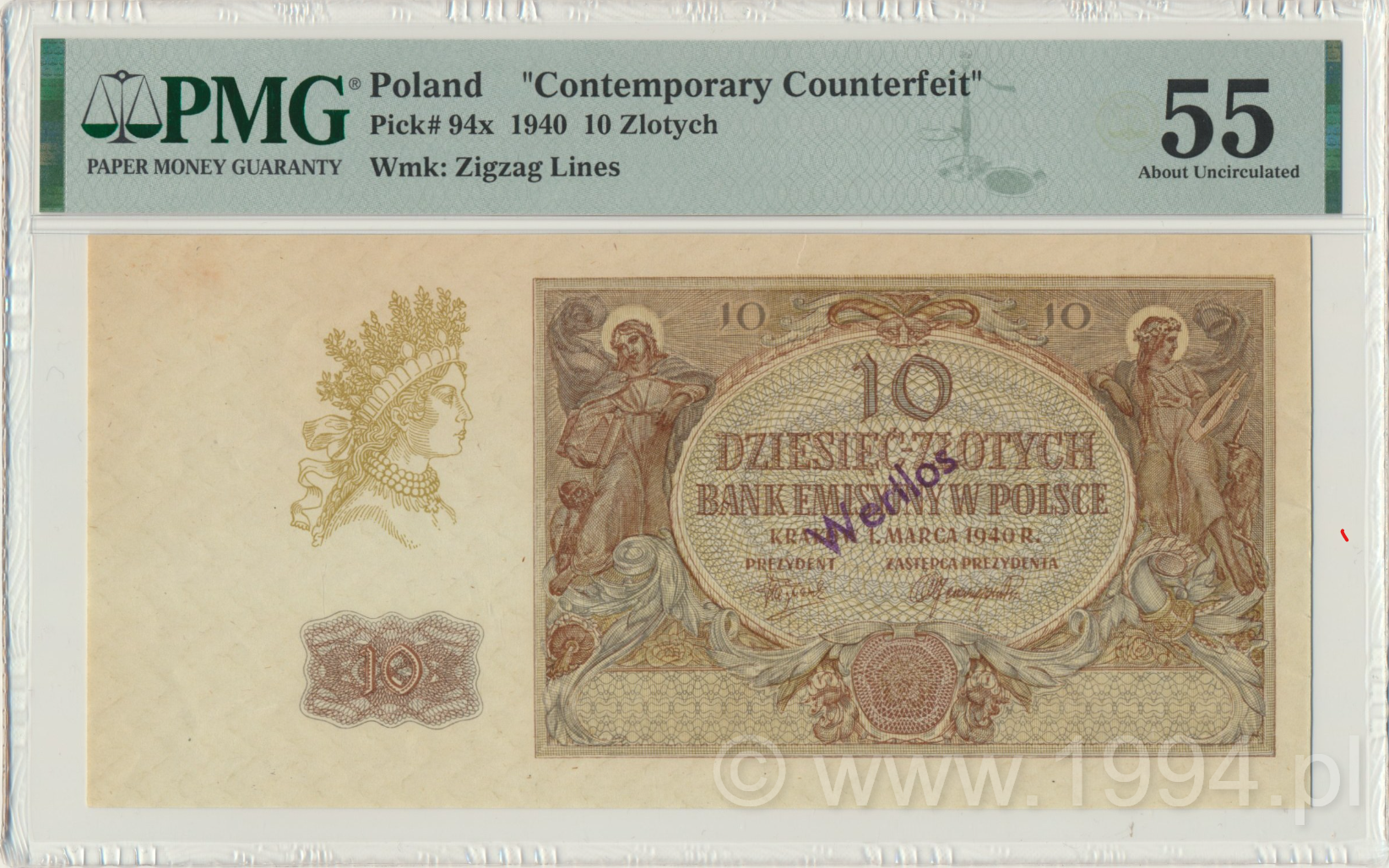
This Prefix C approval specimen of the 10 Złotych issue documents the formal authorization stage of one of the core denominations of the 1940 General Government banknote series. Dated Kraków, 1 March 1940, the note represents the fully approved production standard used to initiate circulation printing by Bank Emisyjny w Polsce.
The specimen is fully engraved and signed, corresponding in design, layout, and security structure to the issued banknote. The serial field contains a seven-digit zero control number, a standard internal identifier used at the approval stage to anchor the sheet within the production and validation workflow. Its function is institutional rather than monetary.
The obverse follows established Polish banknote conventions developed during the late interwar period. Allegorical female figures, symmetrical composition, and restrained ornamentation reflect a conscious continuation of pre-1939 visual language. This continuity was intentional: for a denomination intended for frequent everyday use, recognizability and formal stability took precedence over stylistic innovation.
The reverse design is anchored by the engraved portrait of Fryderyk Chopin, one of the most recognizable figures in Polish cultural history. His presence on the 10 Złotych was not incidental. In the context of occupation, retaining Chopin on a widely used denomination reinforced a familiar intellectual and emotional reference point in daily economic life.
The confirmation of Chopin’s portrait at the approval stage is structurally significant. By finalizing his image within the authorized design, the issuing authority embedded a cultural reference directly into the framework of the new monetary system without overt political signaling.
Engraving was executed according to pre-war Polish standards under the direction of Leonard Sowiński. Dense guilloche networks, controlled line work, and carefully balanced typography demonstrate disciplined security printing rather than improvisation. Printing was carried out with the involvement of Giesecke & Devrient, with subsequent production phases handled by Zakłady Graficzne "Sztuka" in Kraków as wartime logistics evolved.
Kraków’s designation as the place of issue reflects the reorganization of administrative authority following the removal of Warsaw from its pre-war financial role. Approval specimens bearing the Kraków imprint belong to the earliest stabilized phase of occupation-era monetary administration, when institutional systems were being formalized.
As an approval specimen, this note records a decision rather than circulation. It preserves the moment at which the form, imagery, signatures, and security features of the 10 Złotych were accepted for public use, providing a direct archival insight into how one of the most familiar denominations of the 1940 system was defined and authorized.