Description and research notes
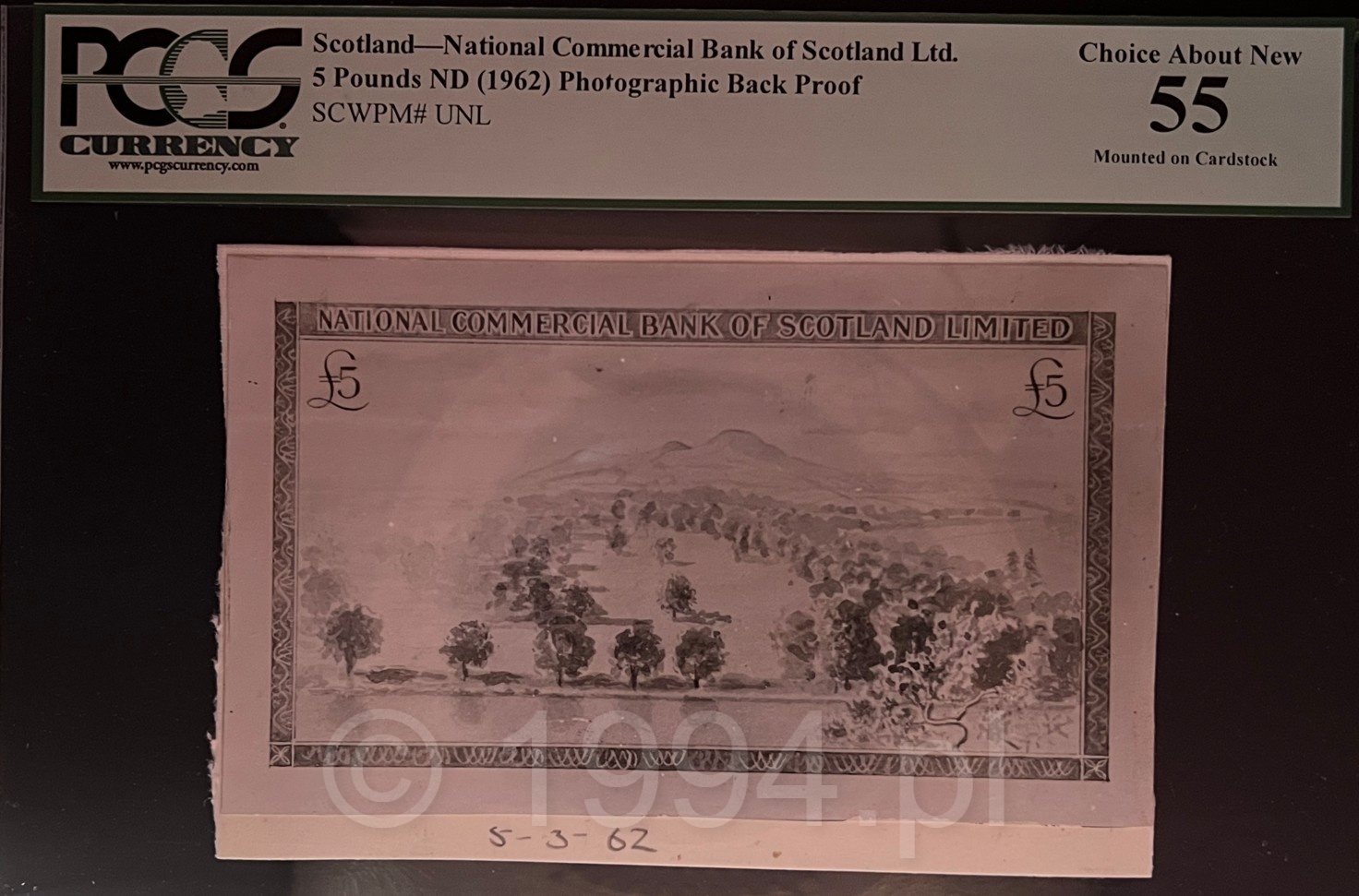
This 1962 National Commercial Bank of Scotland Limited 5 Pounds photographic back proof preserves a separate landscape reverse concept from the same design period. Cataloged here as Pick Unlisted, it records a proposed scenic direction for the bank's 5 Pounds reverse, with the design organized around countryside, water, trees, distant hills, and open Scottish terrain.
The image has a very different character from the Edinburgh Castle reverse. Instead of using the capital city as the central symbol, this design turns toward landscape and atmosphere. The river, clustered trees, low horizon, and distant hills create a softer national image, closer to Scotland as countryside and natural setting than Scotland as civic monument or financial capital.
That difference is what gives the proof its importance. It shows that the reverse program for the National Commercial Bank of Scotland Limited 5 Pounds note was not limited to a single finished image from the beginning. The bank and printer were working through visual alternatives, testing how a Scottish identity could be expressed on the back of the note: one route through Edinburgh and institutional architecture, another through landscape and regional atmosphere.
The proof also shows how the reverse had to function as a banknote design, not just as a picture. The landscape sits inside a controlled frame with denomination counters, bank title, side borders, and lower ornamental structure. The scene had to carry national character while leaving the note readable, balanced, and suitable for security printing. In that sense, the piece records the practical design problem behind every banknote reverse: image, denomination, identity, and production discipline all had to work together.
Placed beside the Edinburgh Castle photographic proof and the issued 1966 Pick 272a note, this landscape proof becomes the alternate branch of the group. The issued note shows the final direction. The Edinburgh Castle proof shows the chosen reverse as a separate production study. This landscape proof preserves the path that remained in the design archive, making the three pieces together a compact record of selection, comparison, and completion.
The piece is mounted on card stock, consistent with proof handling for review or archival preservation. PCGS grades it 55 Choice About New. Its Pick Unlisted status and alternate-design character make it a rare museum-grade witness to Scottish banknote design development, preserving a reverse concept that would otherwise be invisible from the issued-note record alone.