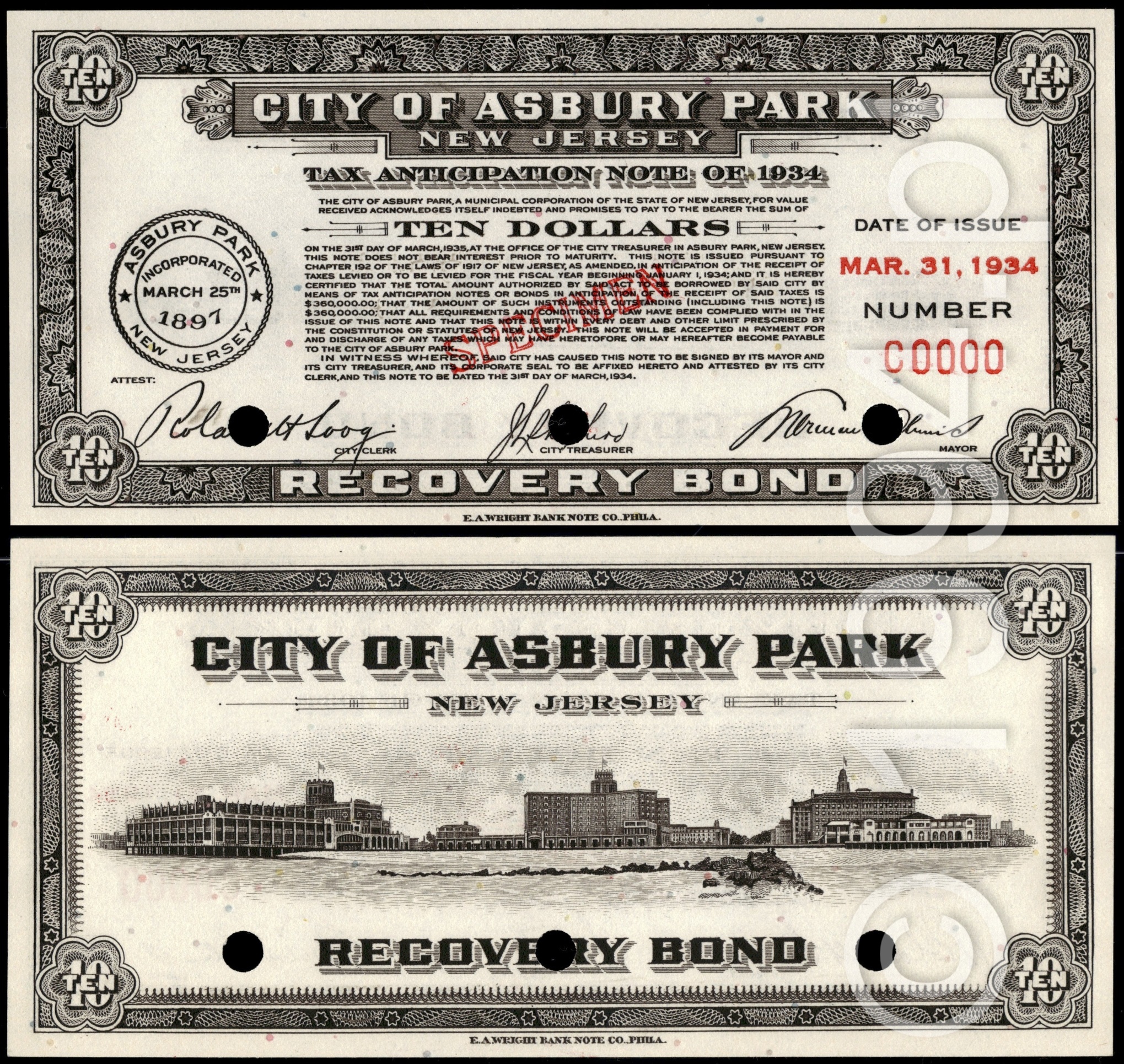
Description and research notes
This specimen represents an official municipal scrip issued by the Borough of Palmyra, Burlington County, New Jersey, Series of 1933, and denominated Five Dollars. It originates from the most acute phase of the Great Depression, when local governments faced severe liquidity shortages and were compelled to issue interest-bearing scrip to meet ordinary municipal obligations in the absence of sufficient circulating cash.
Municipal scrip functioned as a direct acknowledgment of indebtedness by the issuing authority, intended for local circulation or settlement rather than long-term financing. In Palmyra’s case, the scrip was structured as a general obligation of the borough, transferable by delivery and bearing interest at the rate of three percent per annum from the date of issue. It was expressly acceptable in payment of taxes or other indebtedness to the borough, with redemption to be fixed by the Borough Council, integrating it directly into the municipality’s fiscal system.
The engraved legal text contains no reference to schools, utilities, or earmarked purposes. Instead, it defines a broad municipal obligation, reflecting the need for flexible instruments capable of addressing payroll, vendor payments, and routine civic expenses during a period when conventional credit access was constrained and tax collections were delayed.
The obverse is executed in dense brown engraved security printing by E. A. Wright Bank Note Company of Philadelphia, a major American printer of municipal and financial instruments. The design features wave-pattern lathe engraving, dual ornamental SCRIP cartouches, and a recessed central denomination panel reading FIVE DOLLARS. The issuer is clearly identified as the Borough of Palmyra, Burlington County, New Jersey, leaving no ambiguity as to municipal responsibility.
This example is a true printer-issued specimen, identified by the serial number V 0000 and the overprinted word SPECIMEN. It was not intended for circulation and was produced solely for authorization, approval, or archival reference during the establishment of the issue. The reverse is dominated by a large and highly complex radial guilloche medallion, a professional anti-counterfeiting feature consistent with established security printing standards.
Within the Palmyra scrip series, the Five Dollar denomination represents a higher-value instrument intended for larger municipal disbursements or tax offsets, complementing lower denominations designed for everyday transactions. Its existence illustrates a tiered local response to financial disruption, balancing practicality with fiscal necessity.
In normal use, municipal scrip of this type circulated locally, was redeemed against taxes or obligations, and was ultimately cancelled or destroyed once fiscal stability returned. Specimen material, by contrast, had no operational role and was typically discarded once authorization was complete.
No other specimen example of this Borough of Palmyra Five Dollars municipal scrip issue is documented in institutional collections, auction records, certification census data, or standard reference literature. Based strictly on observed and recorded evidence, this piece stands as a unique surviving specimen and serves as a definitive documentary artifact of small-town municipal finance during the height of the Great Depression.