Description and research notes
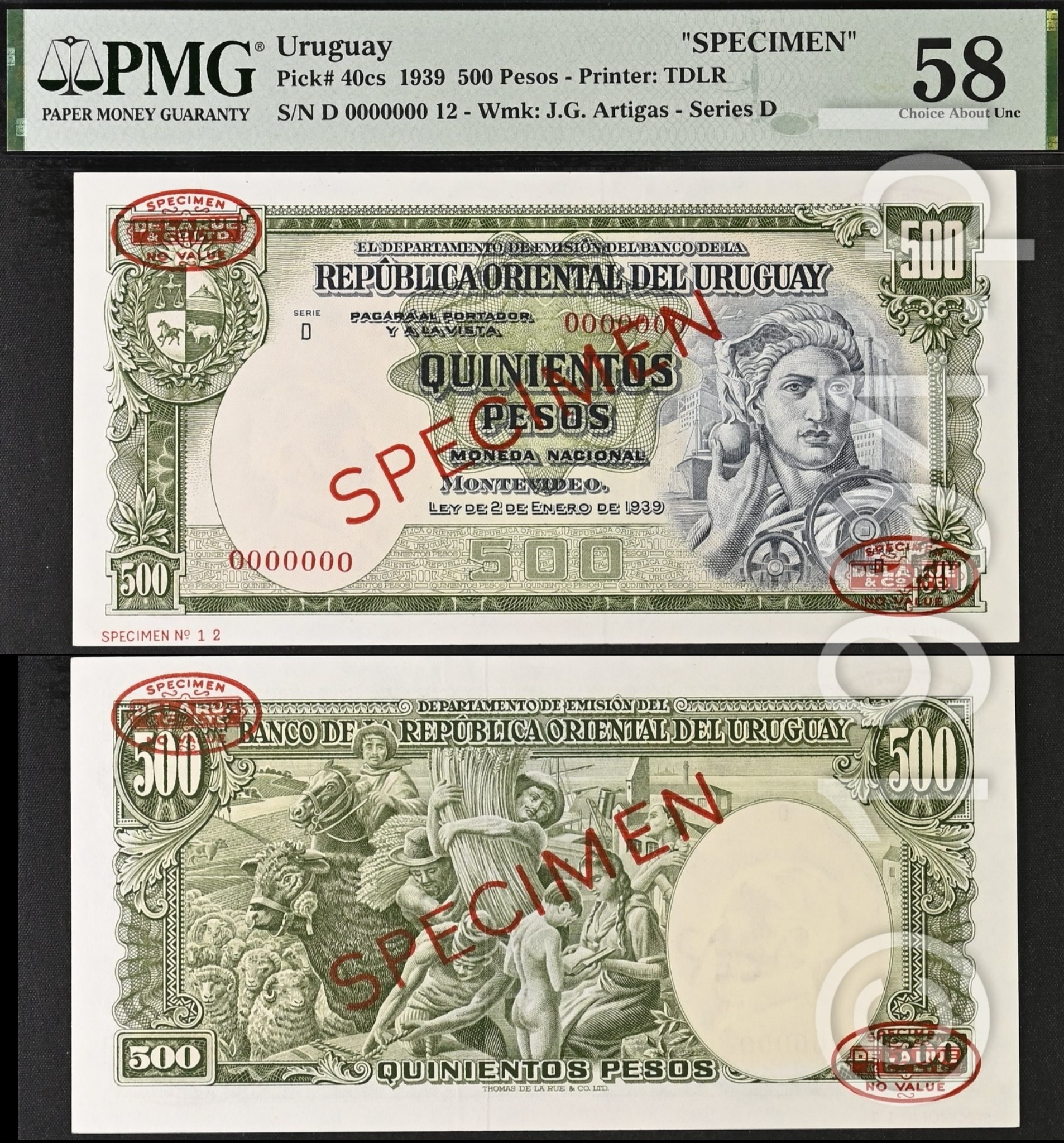
This Serie D five hundred pesos specimen, numbered 12, preserves one of the most fully developed cancellation formats used for the Banco de la Republica Oriental del Uruguay issue of 1939. Both sides carry bold red specimen markings, creating a complete reference instrument whose status is declared across the portrait, denomination, landscape, and surrounding security design.
The printed designation Specimen No. 12 gives the note a precise place within its controlled sequence. Combined with the Serie D identification and paired all-zero serial numbers, it records an individually accountable example prepared under institutional procedures. The number is therefore part of the note's archival identity, not merely an additional printed marking.
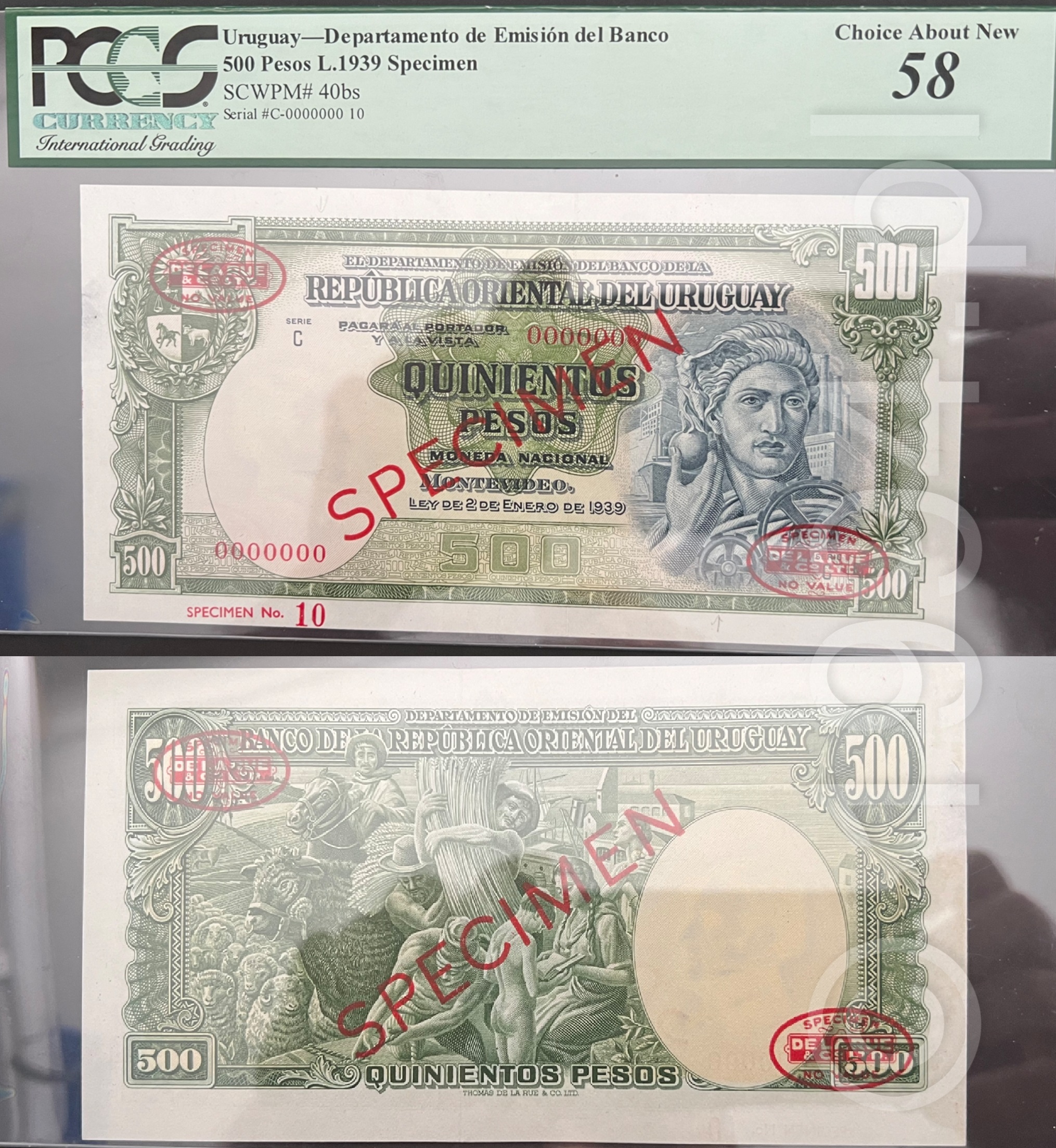
The obverse is dominated by the formal name of the Republica Oriental del Uruguay and the central QUINIENTOS PESOS denomination. The design draws its authority from scale and structure: monumental lettering, engraved architectural frames, repeated numerals, fine geometric fields, and a carefully balanced division between the watermark area at left and the portrait vignette at right.
The portrait is surrounded by imagery of industrial activity and modernization. Through dense intaglio engraving, the human figure, machinery, buildings, and patterned backgrounds are joined into a single statement of productive national strength. This industrial language complements the agricultural subject of the reverse and allows the two sides to present different but interconnected foundations of Uruguay's economy.
A broad diagonal red SPECIMEN overprint crosses the obverse, supplemented by oval SPECIMEN DE LA RUE CANCELLED stamps. Their placement establishes the note as a formally controlled printer specimen without preventing examination of the portrait, serial fields, watermark area, or central denomination. The repeated use of more than one control device reflects a specimen protocol intended to make the note's administrative status unmistakable.
The reverse expands the economic narrative through a detailed agricultural composition. Harvest workers, livestock, cultivated land, and distant structures are arranged within an elaborate engraved frame, presenting the countryside as a source of production, continuity, and national prosperity. Large denomination panels and ornamental architecture give the rural scene the same visual authority as the institutional face.
Red specimen markings are repeated across the reverse, extending the cancellation process to the entire printed object. This two-sided treatment separates the Serie D example from face-only or perforated reference formats and demonstrates a comprehensive method of institutional control in which every major surface was visibly invalidated.
Printed by Thomas De La Rue and Company Limited, this Specimen No. 12 is a complete documentary record of the Serie D five hundred pesos form. It preserves not only the artistic and technical design of the denomination, but also the administrative system through which high-value reference notes were numbered, cancelled, and retained as official records of Uruguay's 1939 paper currency program.