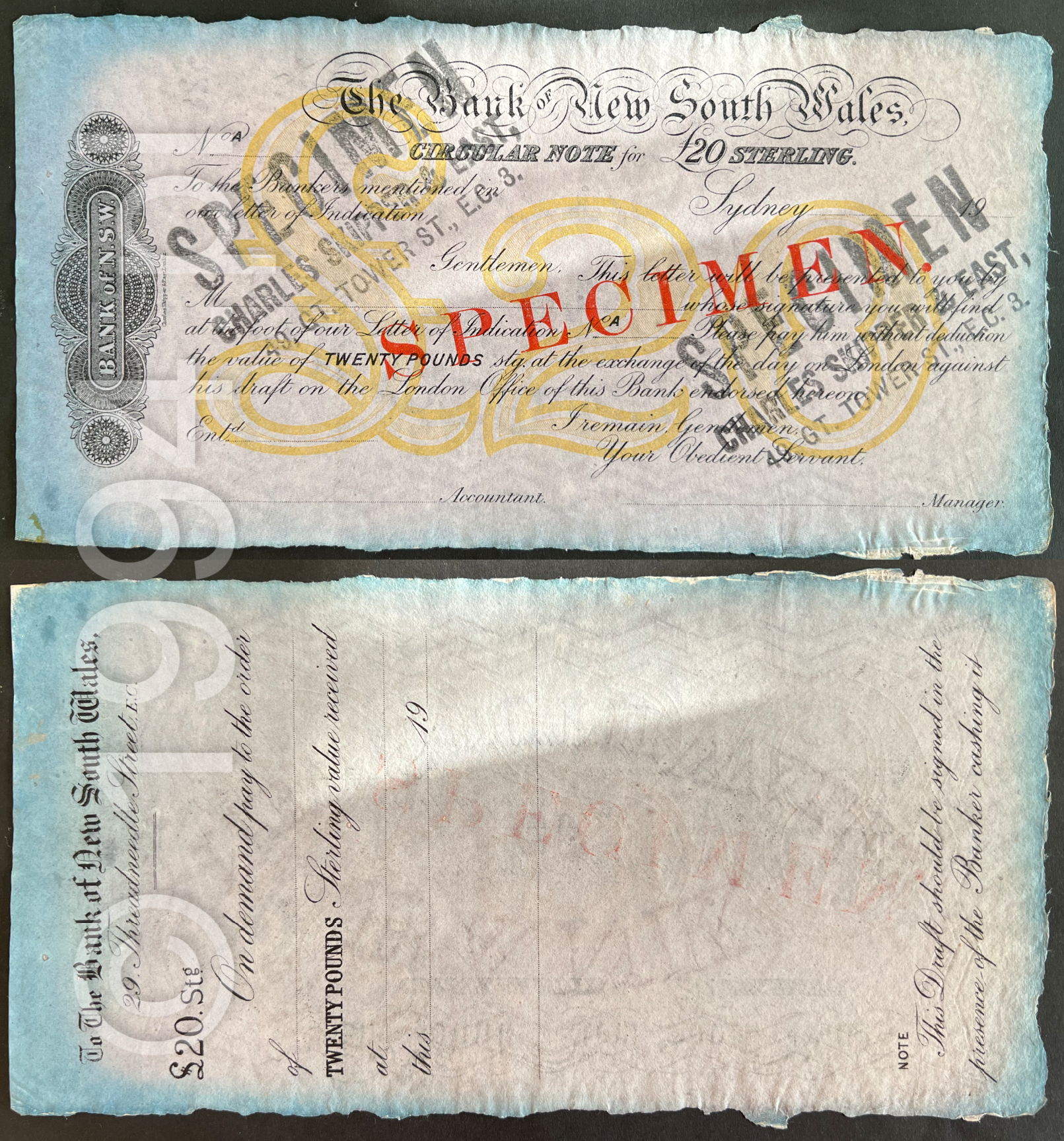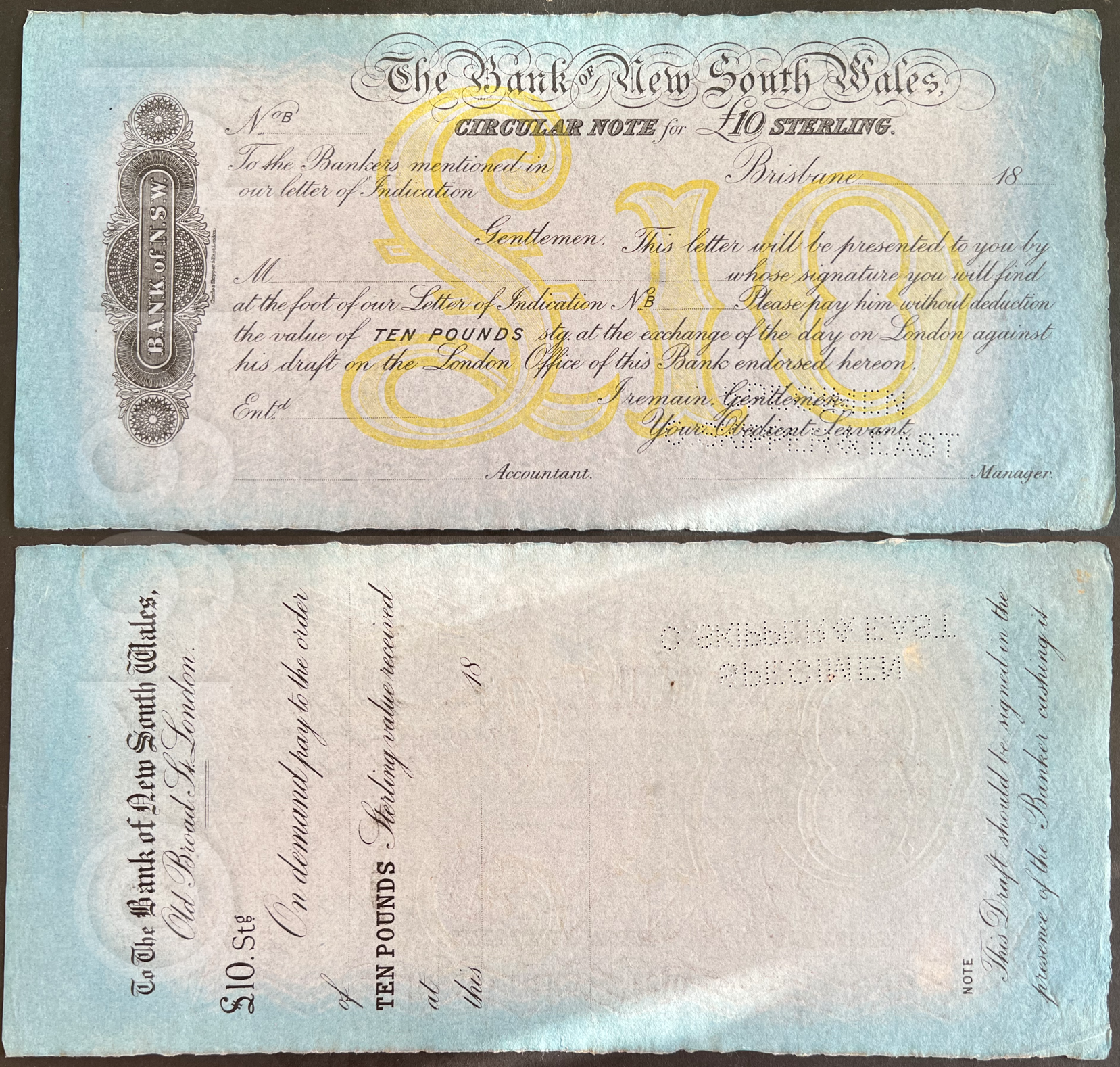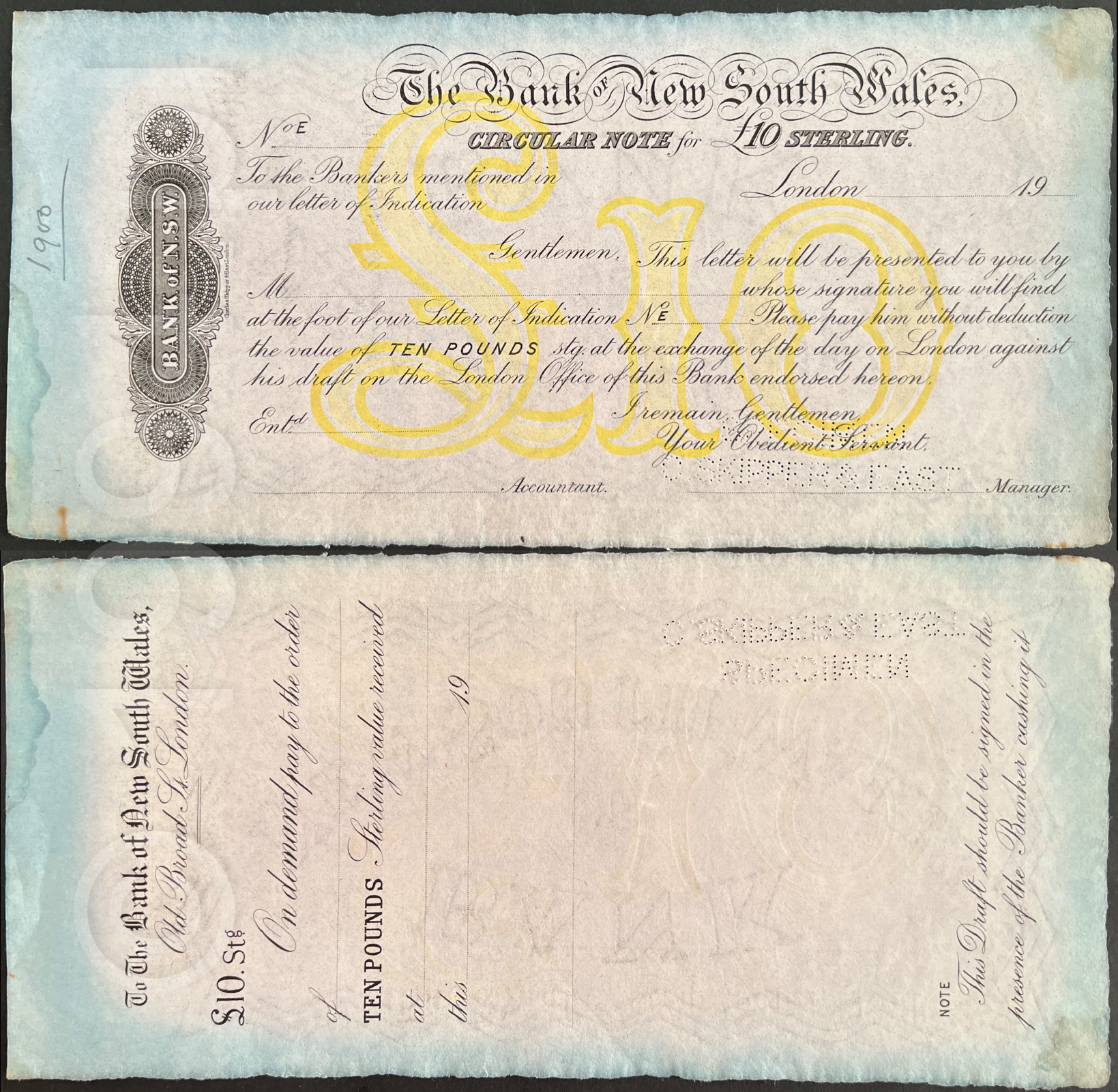
Description and research notes
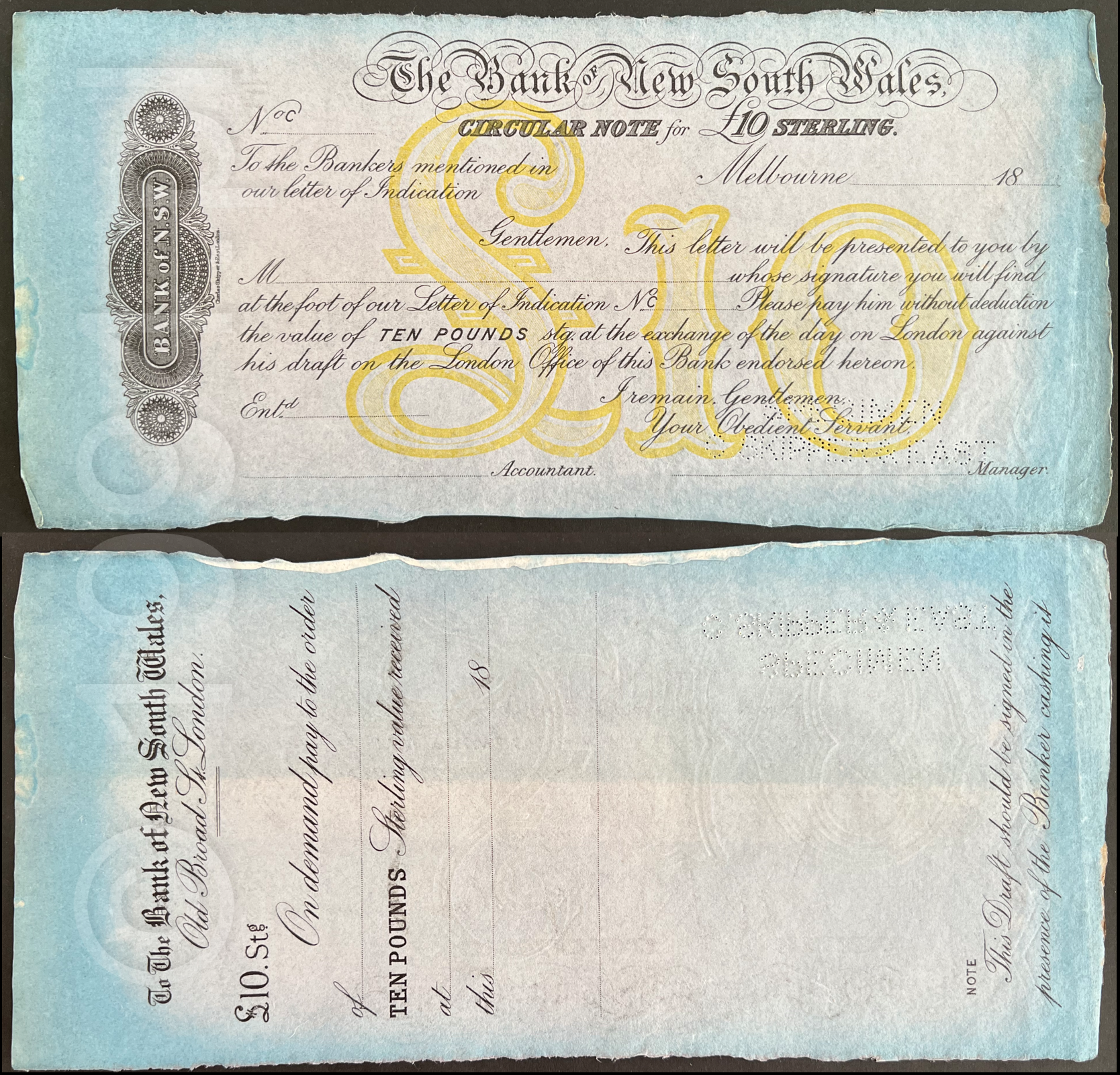
This £10 Sterling Circular Note specimen was prepared for The Bank of New South Wales at Melbourne for use within the bank's international traveler-payment system. The face carries the Melbourne office designation and the printed open date field "18__", placing the form within the bank's 19th-century circular-note series.
Across the upper face, the ornate title "The Bank of New South Wales" is followed by "CIRCULAR NOTE for £10 STERLING." Melbourne appears prominently below the denomination. At upper left is the control-number field, while the adjoining instruction directs the instrument to the bankers identified in the customer's Letter of Indication.
The central text records the operating terms of the circular note. The presenting traveler was to be identified through the signature entered on the accompanying Letter of Indication. Once verified, the correspondent banker was instructed to pay ten pounds sterling without deduction at the exchange of the day on London, with settlement made against the traveler's draft on the London office of The Bank of New South Wales. The Accountant and Manager signature lines remain blank, preserving the piece in its unused specimen state.
The face is dominated by a large yellow-gold denomination underprint extending through the central field, combined with fine script, denomination lettering, and an elaborate vertical security panel at left containing "BANK OF N.S.W." The surrounding pale blue paper border creates a strong visual frame around the otherwise lightly printed central field.
The paper carries a large BANK OF NEW SOUTH WALES watermark accompanied by broad ornamental watermark elements extending across the sheet. These watermark structures are especially visible through the less heavily printed areas of the reverse and form an integral part of the original security paper used for the circular-note issue.
Specimen status is recorded physically through a large perforated SPECIMEN cancellation passing through the lower right portion of the face. The perforation remains clearly visible from the reverse, preserving the specimen-control treatment as part of the paper itself.
The reverse contains the blank sterling draft used when the circular note was cashed. It is addressed to The Bank of New South Wales at Old Broad St., London and carries the value £10 Stg. together with the wording "On demand pay to the order" and "TEN POUNDS Sterling value received." Blank ruled fields provide space for the place, date, and other transaction details, with the printed date line again retaining the "18__" format.
At the lower portion of the reverse, the printed instruction states that the draft should be signed in the presence of the banker cashing it. This requirement connected the reverse draft directly with the identity-verification procedure described on the face and completed the control system used when the traveler presented the circular note for payment.
The Melbourne specimen therefore preserves both sides of the complete financial instrument: the face authorization addressed to correspondent bankers and the reverse demand draft drawn on the bank's London office. Its branch designation, 18__ date format, large institutional watermark, yellow-gold security underprint, blue-bordered paper, Letter of Indication procedure, and perforated specimen control document the working structure of a late 19th-century Bank of New South Wales circular note. Pick Unlisted, this exact Melbourne £10 specimen form is recorded as R9 Extremely Rare and Unique.