Description and research notes
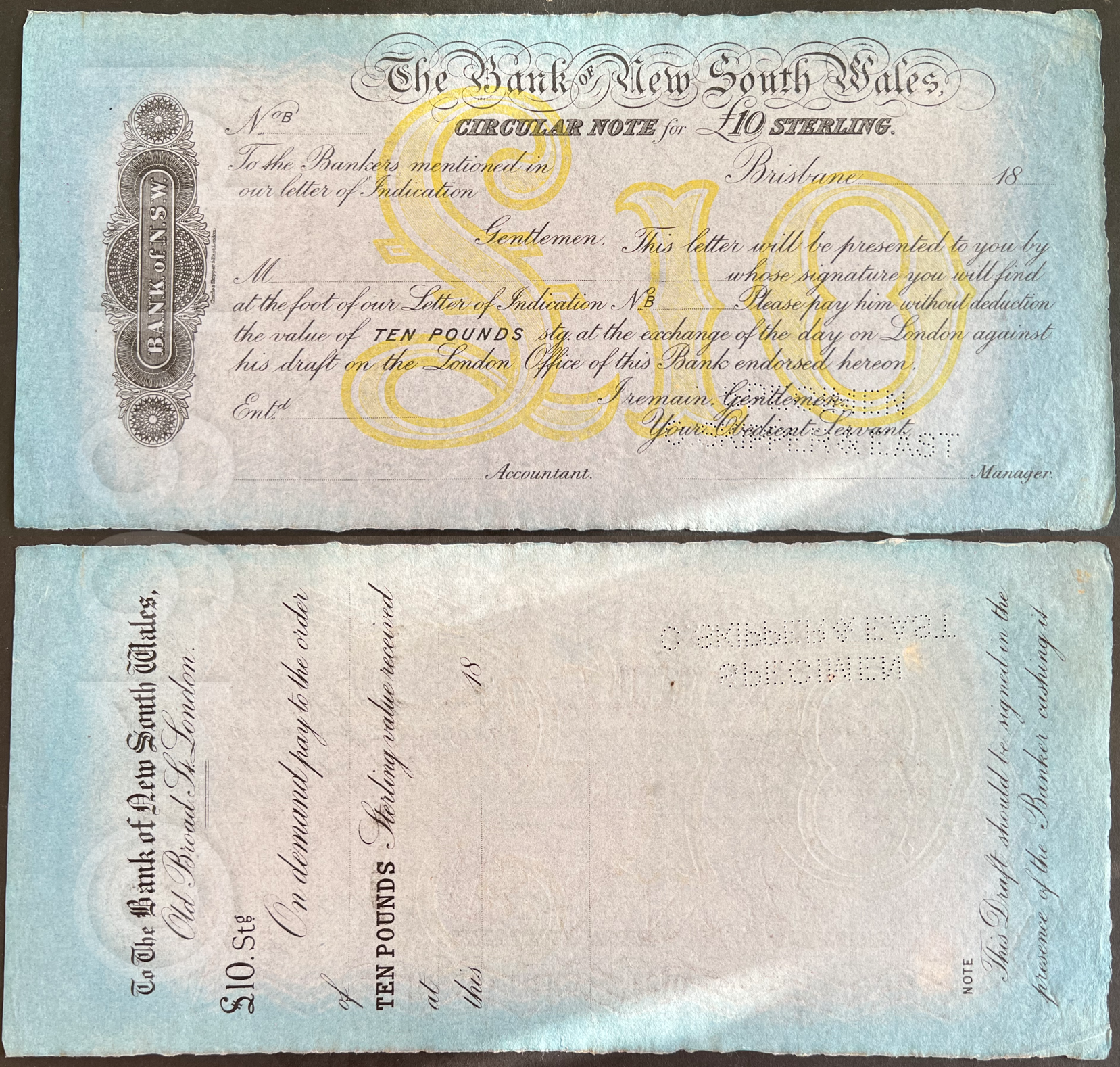
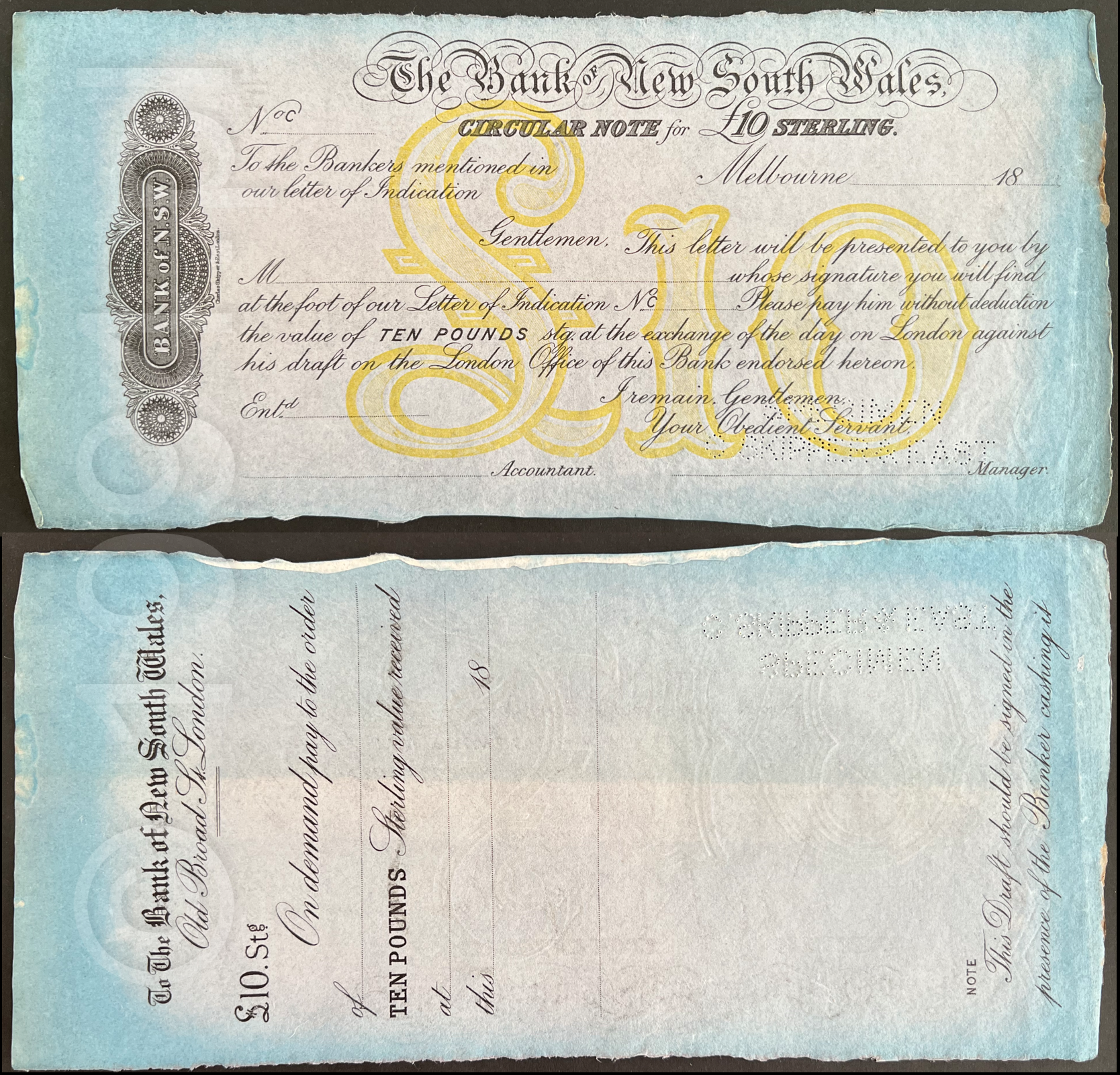
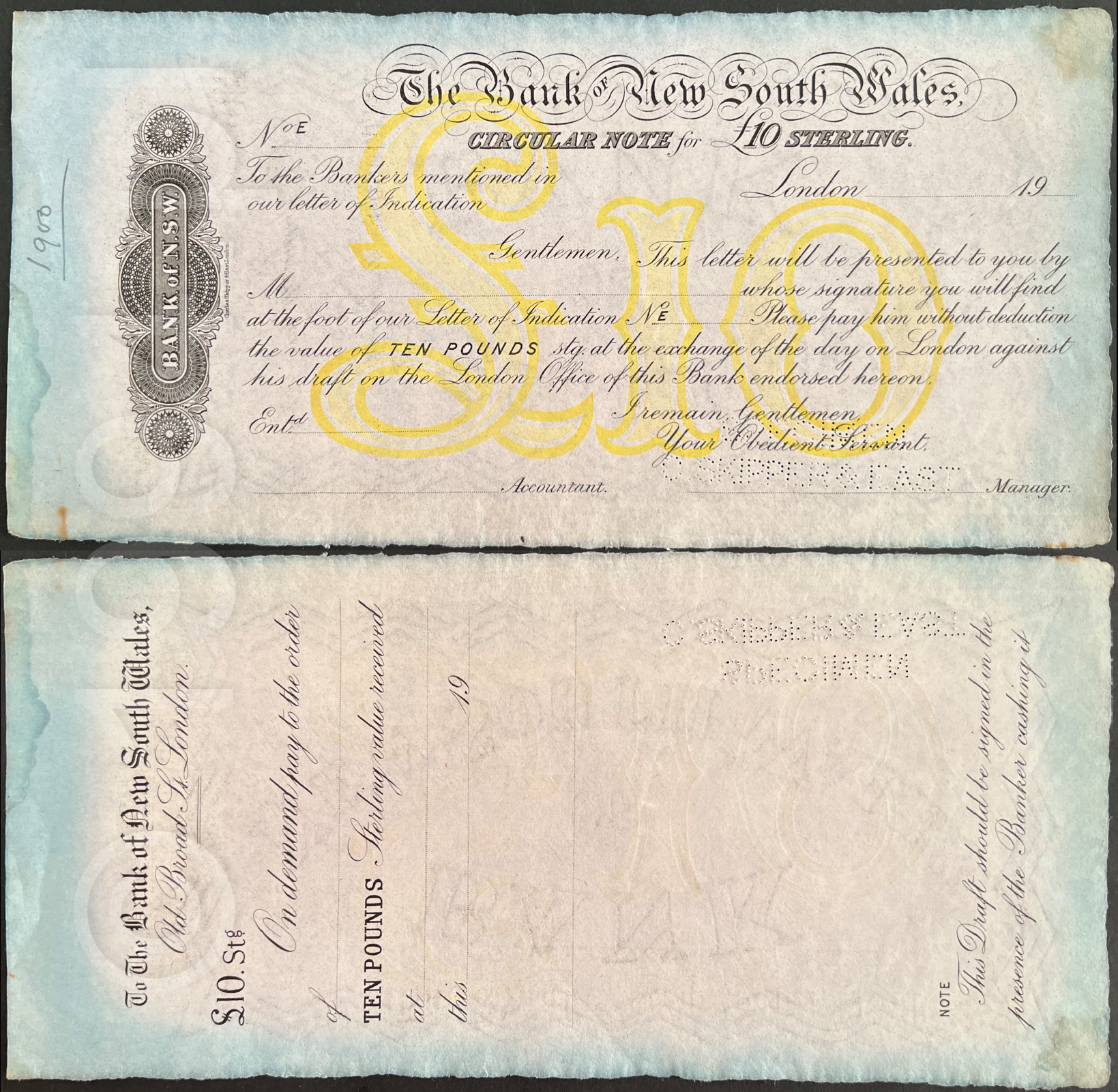
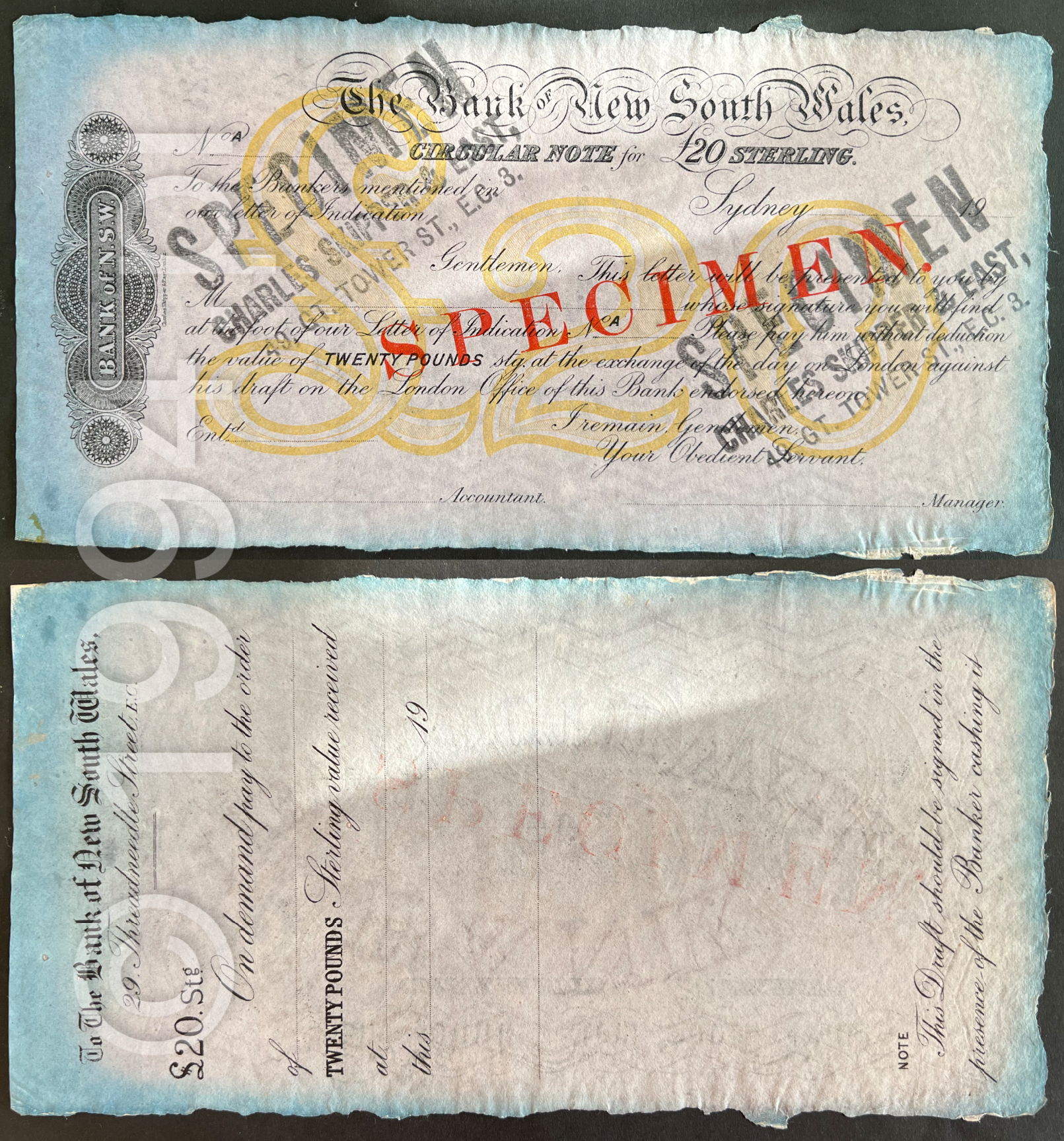
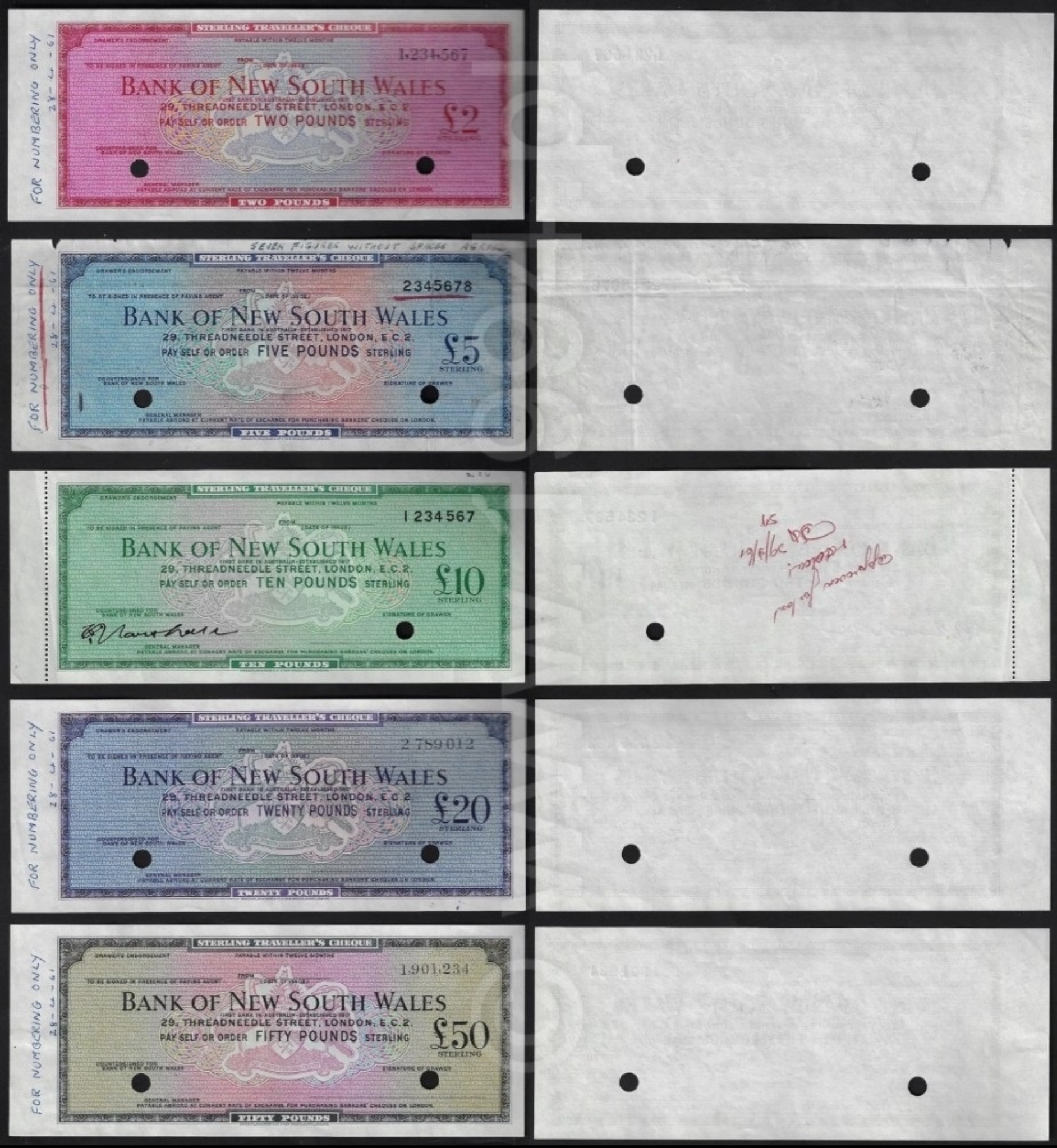
A complete archival printer’s proof set of five Sterling Traveller’s Cheques produced by Bradbury Wilkinson & Company in London for the Bank of New South Wales in April 1961. The set comprises the full denomination range - 2 Pounds, 5 Pounds, 10 Pounds, 20 Pounds, and 50 Pounds - preserved together from a single, documented submission event within the printer’s internal approval and numbering workflow.
Each sheet displays the finished engraved face design adopted by the Bank of New South Wales for its early-1960s traveller’s cheque issue. The layouts feature multitone intaglio guilloche backgrounds, denomination tablets at the corners, a central payable text panel, and the London address of the issuing bank at 29 Threadneedle Street. All five sheets are printed on high rag-content proof paper, showing clear plate bite and fibre structure under angled light.
Across the set, uniform front-margin manuscript annotations read “For numbering only” and are dated 28 April 1961, confirming that these sheets were prepared specifically to test serial layout, spacing, and alignment prior to production. Each denomination carries a single round control punch in the lower left quadrant, identifying the sheets as internal reference material rather than instruments intended for circulation or sale.
The 5 Pounds sheet carries an additional instruction, “Seven figures without space again,” documenting a live test of seven-digit serial format and spacing. Serial placeholders and trial numbers vary by denomination to demonstrate correct registration and position. Colour palettes are denomination-specific - ranging from violet-carmine through blue-green and green-yellow to mauve-violet and brown-olive - reflecting Bradbury Wilkinson’s mid-century colour-separation system for rapid denomination recognition.
The 10 Pounds sheet functions as the supervisory master proof for the group. It retains a perforated binding stub at the left edge, includes printed facsimile signature placement on the face, and carries a small alphanumeric control mark at the upper right. On the reverse, a red handwritten approval line and date record final sign-off on 29 April 1961, one day after the initial numbering submission. These features identify the 10 Pounds as the controlling approval sheet that finalized layout, signature position, and numbering logic for the entire series.
The remaining 2 Pounds, 5 Pounds, 20 Pounds, and 50 Pounds sheets are companion numbering proofs from the same printer batch. Their identical paper stock, control-punch placement, handwriting, and synchronized margin notes confirm that the set represents a single production event rather than an accumulation of unrelated proofs. Minor pencil ticks and short filing codes appear on the margins, and the reverses show light archival handling consistent with Bradbury Wilkinson proof-room practice.
Preserved intact, this set documents the final pre-decimal Sterling traveller’s cheque series prepared for the Bank of New South Wales immediately prior to Australia’s 1966 currency changeover. While isolated traveller’s cheque proofs occasionally survive, complete denomination sets with unified dates, control notes, and a clearly identifiable master approval sheet are virtually unknown. As a coherent archival object recording one approval workflow, this set constitutes a unique survival and a museum-grade record of mid-twentieth-century Australian security printing.