Description and research notes
Photographic proof of the 5 Pounds Circular Note prepared for Thomas Cook and Son in 1919, representing an early post First World War production-stage record from the firm's international private payment system. Mounted on cardstock and dated 24 April 1919 in manuscript on the mount, this proof preserves the face design of a 5 Pounds circular note before finished specimen or issued-form production.
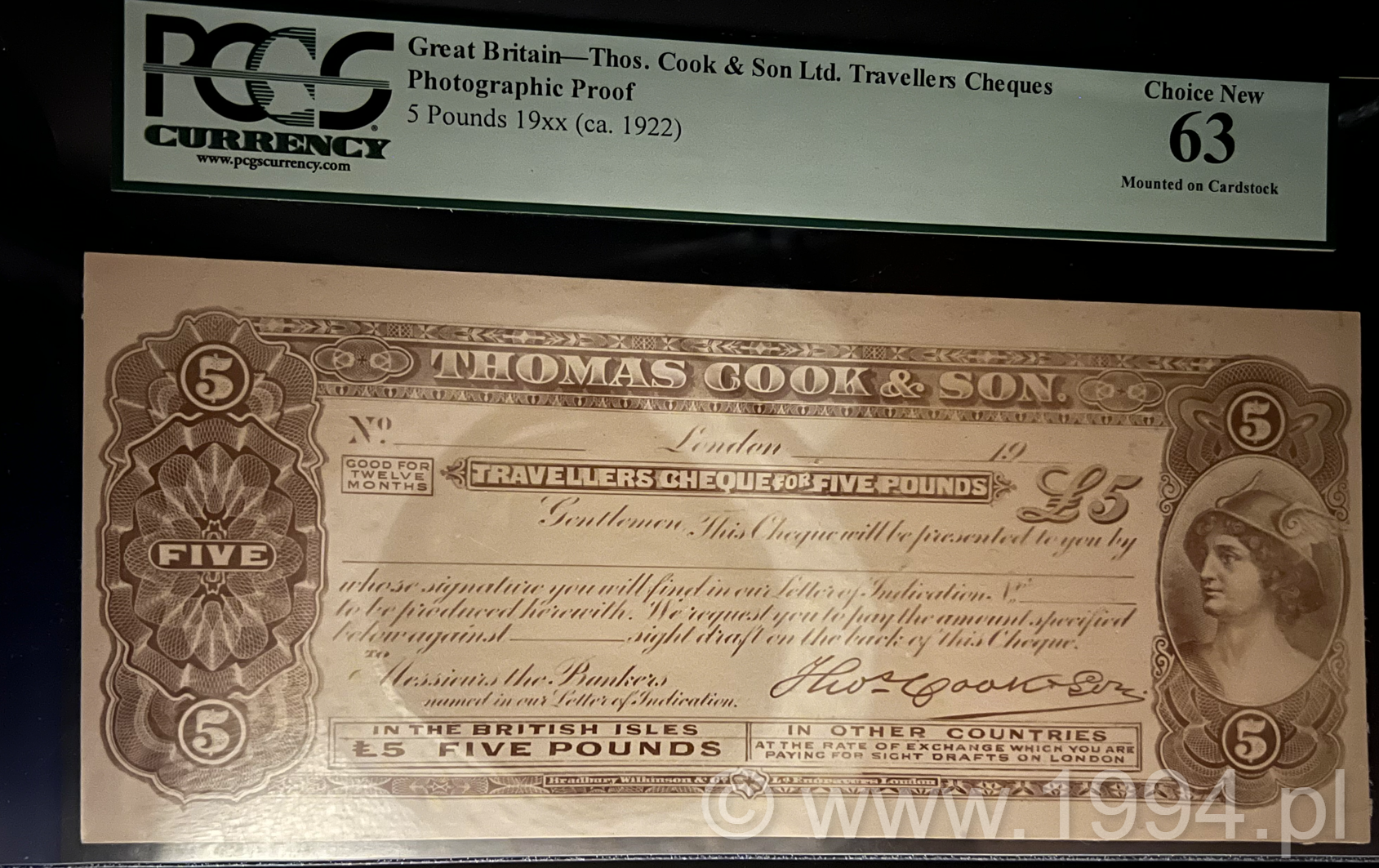
The design is printed in a warm brown photographic tone and shows a highly developed Thomas Cook and Son composition built around secure international payment rather than ordinary circulation. The face carries the large Thomas Cook and Son title, prominent 5 Pounds denomination devices, layered guilloche ornament, a central payment panel, engraved signature areas, and a right-side female portrait vignette. That portrait device is especially important because it continues into the later 5 Pounds traveller-payment design, appearing again on both the 1922 photographic proof and the matching specimen. The wording identifies the instrument as a circular note, a controlled payment document presented through banking and correspondent channels.
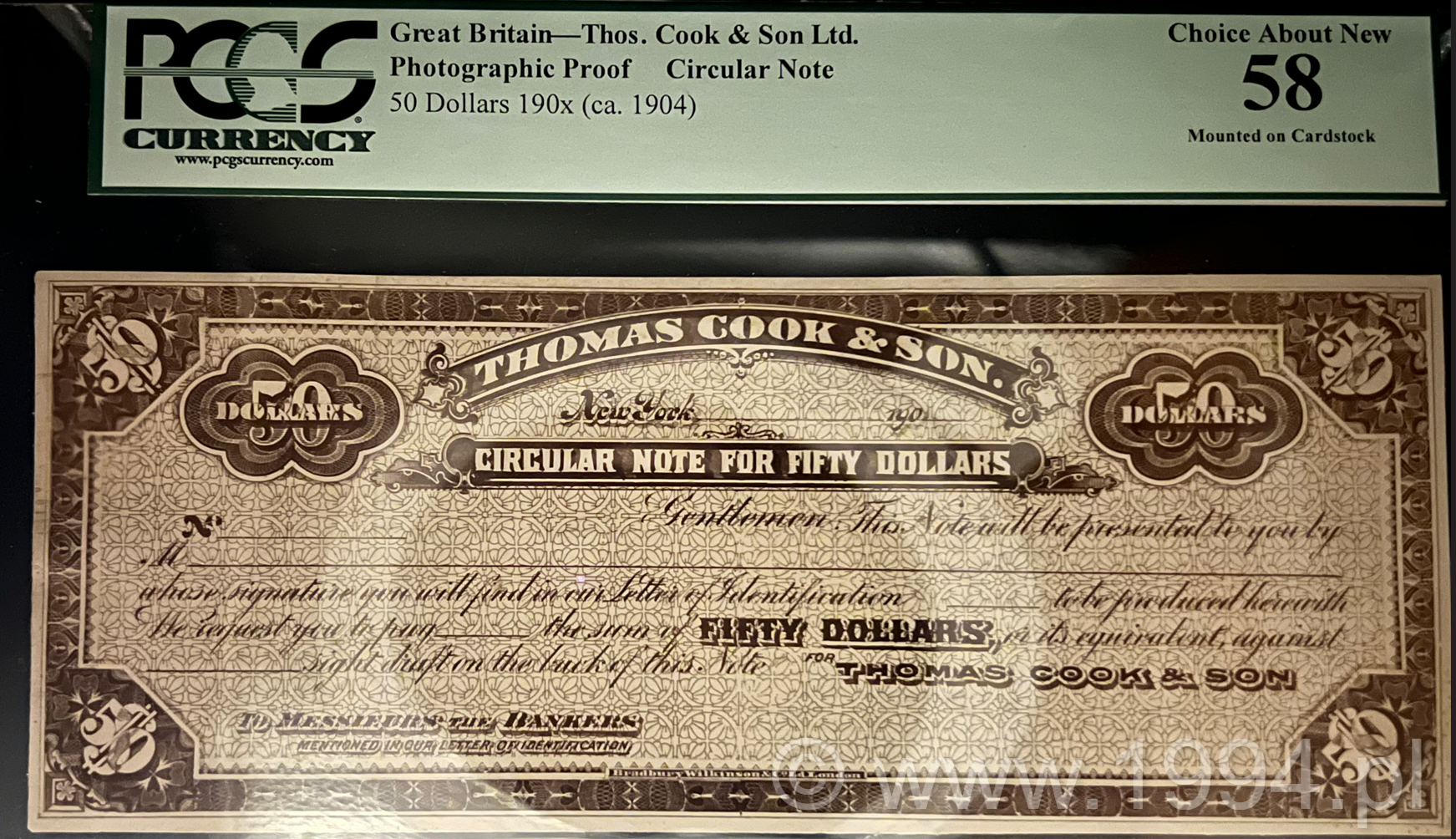
This 1919 proof occupies an important position between earlier Thomas Cook circular note designs and the more standardized traveller-payment instruments of the early 1920s. It connects backward to the earlier Thomas Cook and Son 50 Dollars Circular Note photographic proof and forward to the later Thomas Cook and Son 5 Pounds Travellers Cheque photographic proof. The comparison shows the continuity of Thomas Cook's identity-linked payment system while also documenting the movement from circular note design language toward the later traveller's cheque format.
The proof also relates directly to the alternate 1919 Thomas Cook and Son 5 Pounds Circular Note photographic proof, which preserves a different design approach for the same denomination and period. The contrast is important: the present proof uses the right-side female portrait vignette and denomination architecture that visually leads toward the later 1922 5 Pounds traveller-payment proof and specimen, while the alternate design follows a different ornamental structure. Together, the two 1919 photographic proofs document a rare parallel design stage in the firm's postwar 5 Pounds circular note development.
As a photographic proof, this piece records the design as a production-review image rather than as a circulating financial instrument. Its mounted format, dated proof-room handling, security-printing composition, portrait-based design continuity, and close relationship to the companion 1919 alternate design make it an unusually strong reference artifact. It preserves a stage where the engraver's image, banking language, denomination structure, and global payment function could be studied before the final printed form was selected or advanced.
This 5 Pounds Circular Note proof is a discovery-level survivor within the history of Thomas Cook and Son's private financial instruments. Its importance lies not only in its individual rarity, but in its place within a wider linked sequence of circular note and later traveller-payment material. When viewed beside the 1904 50 Dollars circular note proof, the alternate 1919 5 Pounds proof, and the later 1922 5 Pounds traveller-payment proof and specimen, it helps document the evolution of secure portable money for international travel from Edwardian circular notes into the mature twentieth-century travel-payment system.