Description and research notes
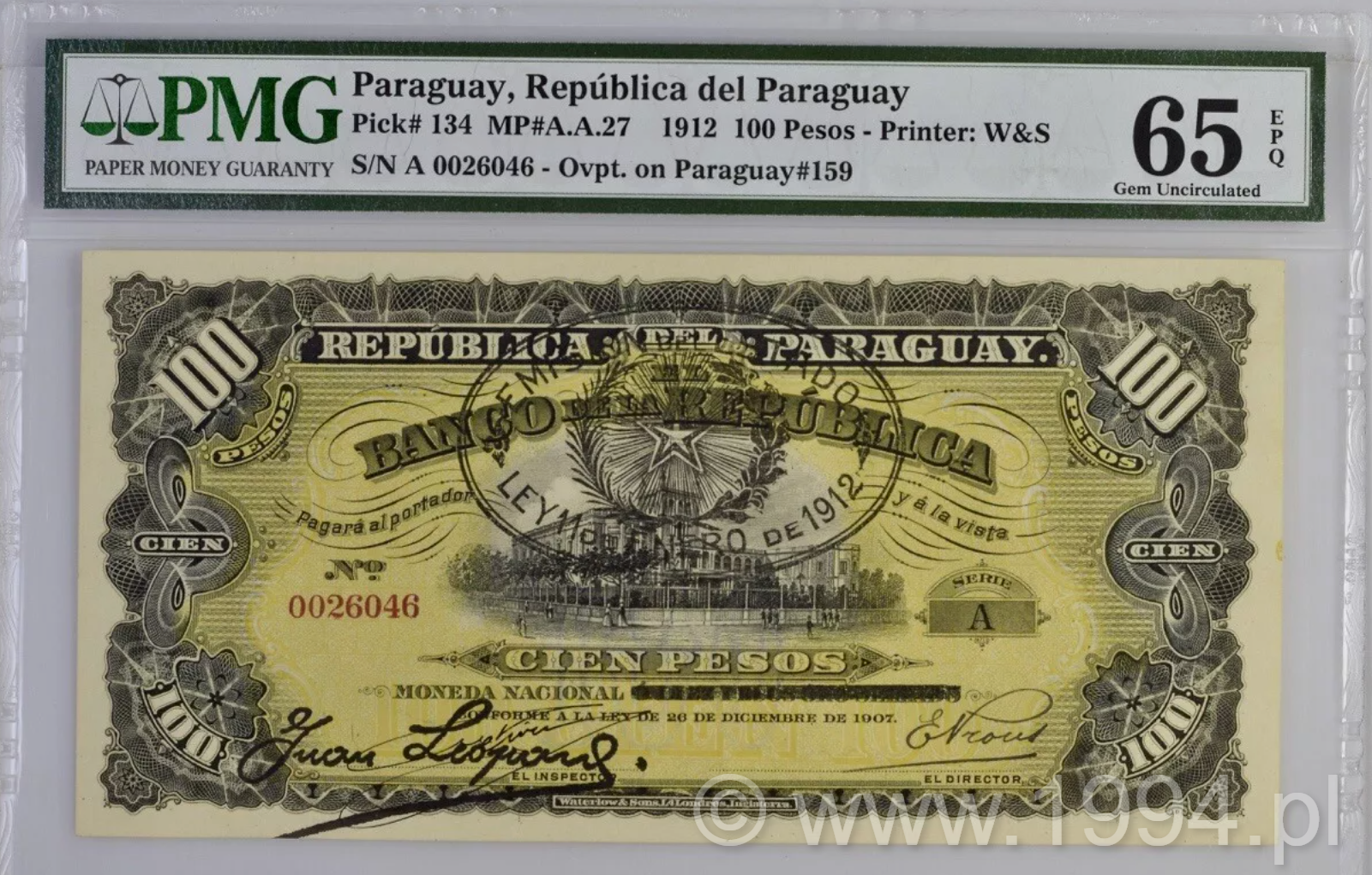
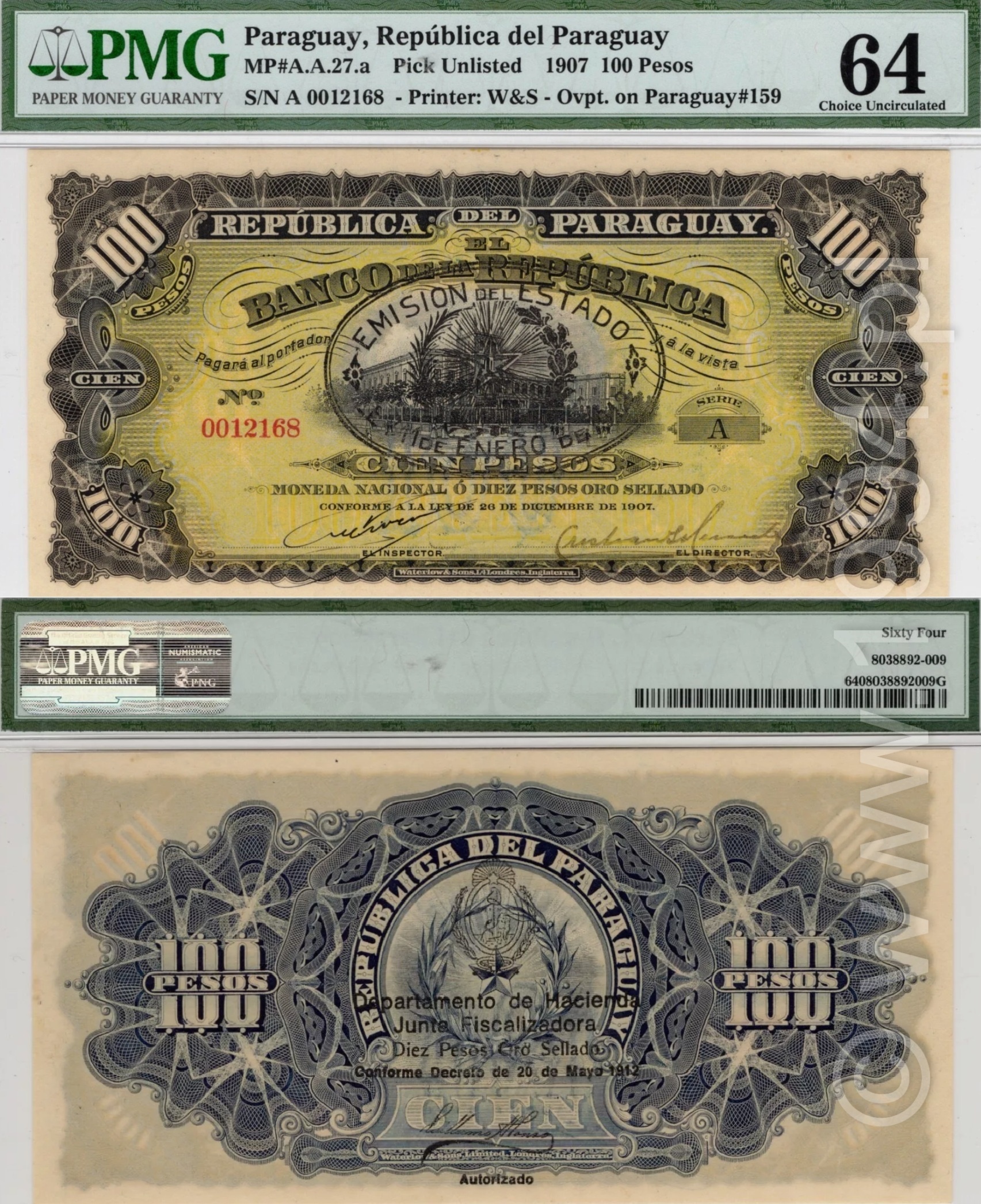
Archival specimen of the 1907 Banco de la República 100 Pesos, base Pick 159, printed by Waterlow & Sons, London, and later transformed by one of the most historically revealing emergency overprint configurations in Paraguayan paper money. The note bears the large face overprint “Emisión del Estado – 11 de Enero de 1912,” together with the reverse fiscal validation “Departamento de Hacienda – Junta Fiscalizadora – Diez Pesos Oro Sellado – Conforme Decreto de 20 de Mayo 1912.” This dual-side treatment places the note outside the ordinary single-face revalidation pattern and identifies it as a treasury-controlled specimen of exceptional documentary importance.
The significance of the reverse overprint is especially important. The original 1907 note already carried the monetary clause “Moneda Nacional ó Diez Pesos Oro Sellado,” meaning that the 100 Pesos paper denomination was legally associated with a value formula of ten sealed gold pesos. During the monetary and political emergency of 1912, this wording became more than decorative text. The state needed a way to distinguish selected, officially reviewed notes from the unstable mass of paper circulating in a damaged economy. The second, reverse overprint did exactly that: it reaffirmed the gold-denominated language of the base note and placed the note under the authority of the Treasury’s fiscal inspection board.
This does not mean the overprint magically protected the note from all market inflation in ordinary daily commerce. Rather, it shows a far more precise administrative purpose. The face overprint asserted state liability by converting the dormant Banco de la República obligation into an emergency state-recognized issue. The reverse overprint added treasury verification, confirming that this specific note had passed through the Departamento de Hacienda and the Junta Fiscalizadora under the decree of 20 May 1912. In practical terms, the dual-side overprint created a stronger and more official instrument than the ordinary single-overprint examples: a note whose validity, origin, and fiscal authorization were visibly confirmed on both sides.
This distinction is central to understanding the rarity and historical value of the piece. A single-face overprint could identify a note as part of the emergency state emission, but the additional reverse validation created a second layer of control. It linked the note directly to the fiscal board responsible for supervising the state’s monetary obligations and for separating verified notes from unverified or less formally processed material. The reverse wording “Diez Pesos Oro Sellado” is not incidental. It deliberately echoes the gold-value clause printed on the original 1907 design, reinforcing that this selected note remained connected to the higher official monetary standard even while ordinary paper pesos were under severe pressure.
The timing explains why such a process mattered. Paraguay in 1912 was facing political disorder, fiscal weakness, and the disruptive effects of civil conflict. The government did not have the luxury of designing and printing a completely new currency system from scratch. Instead, it relied on existing Banco de la República stocks and converted them through emergency overprints, decrees, departmental controls, and fiscal counterstamps. These improvised issues were not merely accounting conveniences. They were visible acts of state authority, used to restore confidence, impose control over available paper money, and identify which notes were formally accepted into the public accounts.
Within that emergency system, this specimen represents the highest visible level of revalidation: first, the national state emission overprint on the face; second, the Treasury and Junta Fiscalizadora validation on the reverse; and third, the explicit reaffirmation of the ten sealed gold pesos formula. The note therefore records a complete chain of authority. It begins as a 1907 Banco de la República Waterlow & Sons banknote, becomes a January 1912 state-recognized obligation, and is then further confirmed by the Treasury under the May 1912 decree. Few Paraguayan notes of the period show this administrative transition so clearly.
The design itself remains one of the finest Waterlow & Sons productions for Paraguay. The face combines a yellow-green tint field with dark intaglio borders, large corner denomination tablets, and the architectural vignette of the Banco de la República building. The engraved security work is dense and elegant, with layered guilloché patterns, scrollwork, and ornamental side panels framing the central promise-to-pay text. The reverse, with its large mirrored denomination panels and circular national emblem, becomes even more important on this variety because the Treasury overprint was placed directly across the center, turning the back from a purely decorative security design into an official fiscal record.
Certified PMG 64 Choice Uncirculated, this specimen preserves the emergency overprints with remarkable clarity. The face overprint remains bold across the central vignette and upper field, while the reverse Junta Fiscalizadora validation is fully legible and visually dominant. The paper, margins, and printed detail make the note an unusually strong reference example for studying the relationship between the 1907 Banco de la República issue, the 1912 state emission, and the later fiscal control process. For a note type born from crisis, administrative improvisation, and limited surviving documentation, this level of preservation is extraordinary.
Among recorded Paraguayan emergency issues, the dual-side state and treasury revalidation format is virtually in a class of its own. It is not simply another overprint variety. It is a surviving document of how Paraguay attempted to defend official monetary credibility at a moment when ordinary paper value, legal value, and gold-referenced value were no longer the same thing in practice. The second overprint is therefore the key historical feature: it confirms that this note was not only reissued, but reviewed, fiscalized, and tied back to the higher official “Diez Pesos Oro Sellado” standard. As a Pick-unlisted specimen, base Pick 159, and R9 Extremely Rare survivor, it stands as a museum-grade crown piece of Paraguayan emergency paper money.