Description and research notes
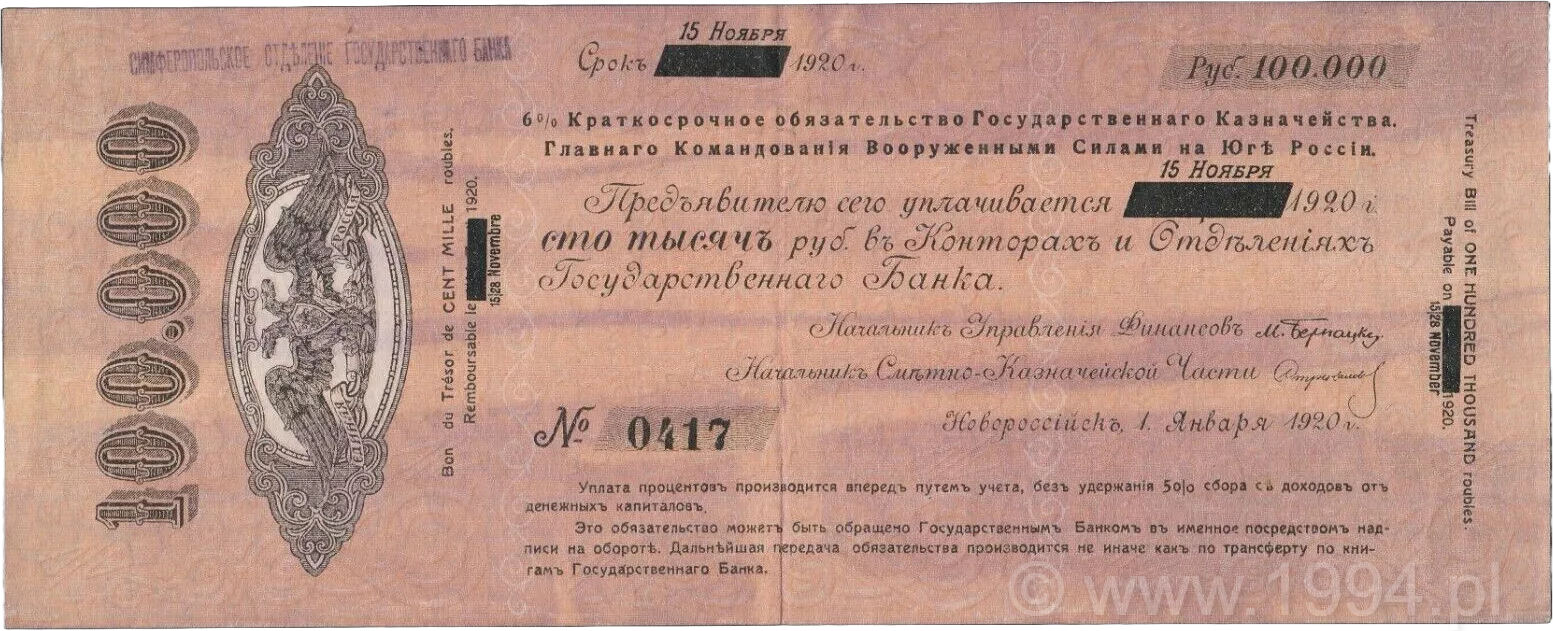
Six-percent short-term Treasury bill for 100,000 rubles issued by the Government Treasury of the Armed Forces of South Russia during the final phase of the Russian Civil War. This is the November 15, 1920 payable issue (Pick S431c), printed after General Pyotr Wrangel transferred the White administration to Crimea. The note follows the classical Imperial layout: bilingual Russian–French legends, the double-headed eagle in an ornate oval cartouche at left, and a formal typographic bond structure intended to signal continuity with pre-1917 state finance.
The bill promises payment to the bearer at official State Bank offices and carries detailed interest, transfer, and endorsement instructions. Its bilingual inscriptions were deliberately retained by the collapsing White administration to reassure foreign creditors and align the fiscal paper with pre-revolutionary international financial norms.
The Wrangel government in Crimea (1920) operated as the last centralized White authority, maintaining its own treasury, banking apparatus, postal service, and fiscal printing despite territorial collapse. These bonds were issued during the final months before the evacuation of Crimea in November 1920, making all surviving examples relics of the last functioning White state. Most were destroyed, lost during evacuation, or later repudiated and discarded after the USSR consolidated control.
Rarity context (Pick S431a–c): the August 1920 issue (S431b) is the rarest, the November 1920 bill (S431c) is scarce and significantly harder to locate than the January 1920 issue (S431a), which is the most frequently encountered but often in poor condition. Survival across all three months is limited, with only a small number of intact, untampered examples known. This 100,000-ruble bill stands as a high-tier artifact of the financial administration of the White movement in the final days of the Civil War.