Collection PL

About
20 results · Page 1 of 2
China 1920 Xinjiang textile emergency currency printed on red cloth by woodblock, showing framed inscription panel and ornamental borders

China 1920 - Xinjiang Textile Emergency Currency Printed on Red Cloth, Local Authority Issue (Pick Unlisted)

On the basis of observable evidence, this specific textile issue has no documented catalog entry, institutional reference, or known parallel example. Under the collection’s evidence-based classification system, it is treated as a single known example at present and classified as R9. Read more →

ChinaTextile Emergency Currency1920UnspecifiedIssued (Textile Emergency Currency) Textile BanknoteTextile Emergency CurrencyCloth BanknoteIssued Emergency MoneyWoodblock PrintingFrontier CurrencyXinjiangSinkiangLocal Authority IssueEarly Republican PeriodRegional Monetary SystemChina1920Museum GradeR9 Extremely RareUniquePick Unlisted
Held
New Zealand 1916–1920 Bank of New Zealand £5 Red-Rose wartime specimen from the BNZ orange lineage, Pick S227s, serial prefix 7/180001–7/220000, PMG 65 EPQ Top Pop

New Zealand 1916–1920 - Bank of New Zealand £5 Red-Rose (Orange Lineage) Specimen with Serial Number Prefix (Pick S227s)

A wartime £5 specimen of the Bank of New Zealand, printed in London by Bradbury, Wilkinson & Co. during the 1916–1920 production cycle. The note carries live serial numbering and survives as an internal audit and approval piece from a numbered print run, distinct from zero-serial display specimens. Read more →

New ZealandSpecimen with Serial Number Prefix19165 PoundsPMG 65 EPQ Gem Uncirculated (Top Pop) Specimen5 PoundsRed-RoseBNZ Color LineageOrange LineageWith Serial PrefixPrinter AnnotationCANCELLED PerforationHigh DenominationBradbury WilkinsonBWCPick S227sBank of New ZealandPrivate Banknote EraPre-Reserve BankWartime IssueNew Zealand Banking HistoryMāori Portrait SeriesMaritime Economy NotesSecurity Printing HistoryNew Zealand191619201916–1920Top PopPMG 65 EPQMuseum GradeR8 Extremely RareAnnotationsHandwritten Annotations
Held
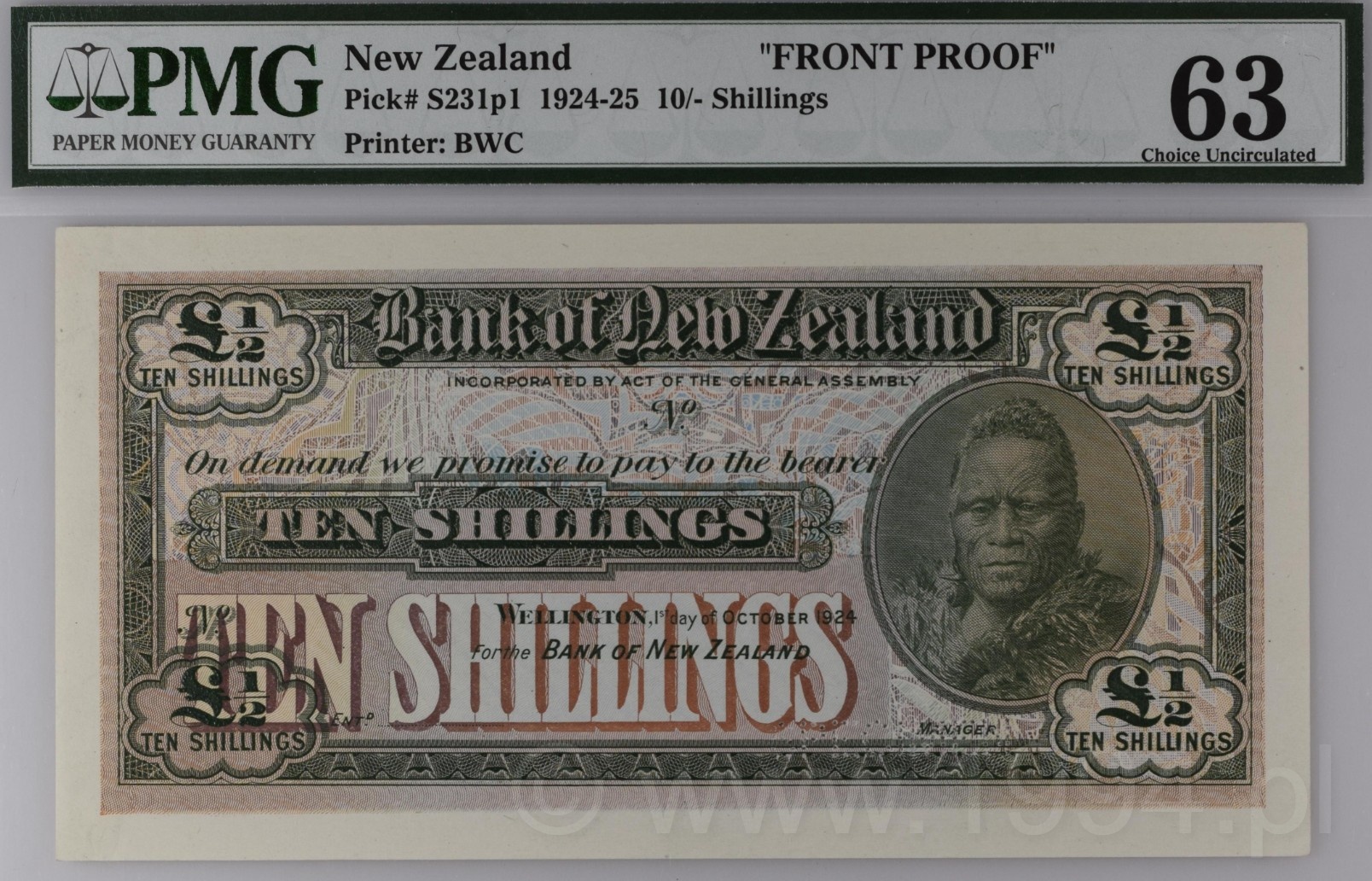
New Zealand 1924–1925 Bank of New Zealand 10 Shillings Front Proof Pick S231p1 with SPECIMEN perforation, Bradbury Wilkinson & Co.

New Zealand 1924–1925 - Bank of New Zealand 10 Shillings Front Proof with SPECIMEN Perforation (Pick S231p1)

The 10 Shillings denomination was the workhorse of the New Zealand economy-circulating in stores, docks, farms, ferry routes, and railway stations. By the 1920s, heavy usage of earlier BNZ half-pound notes forced the bank to strengthen the layout: thicker borders, more assertive denomination framing, and sharper tint layers. This proof reveals the exact engraved state of that redesign before any production wear, serialing, or signature shifts touched the plate. Read more →

New ZealandFront Proof192410 ShillingsPMG 63 Choice Uncirculated (Top Pop, Front Proof with SPECIMEN Perforation) Front Proof10 ShillingsSpecimen PerforationIntaglioBradbury WilkinsonBWCTamati Waka NeneBank of New ZealandNew Zealand Banking HistoryPre-Reserve BankPrivate Banknote EraInterwar Currency DesignEngraved Security PrintingLate Edwardian PlateworkTint-Stone UnderprintMāori Portrait SeriesNew Zealand192419251924–1925PMG 63Top PopMuseum GradeR8 Extremely Rare
Held
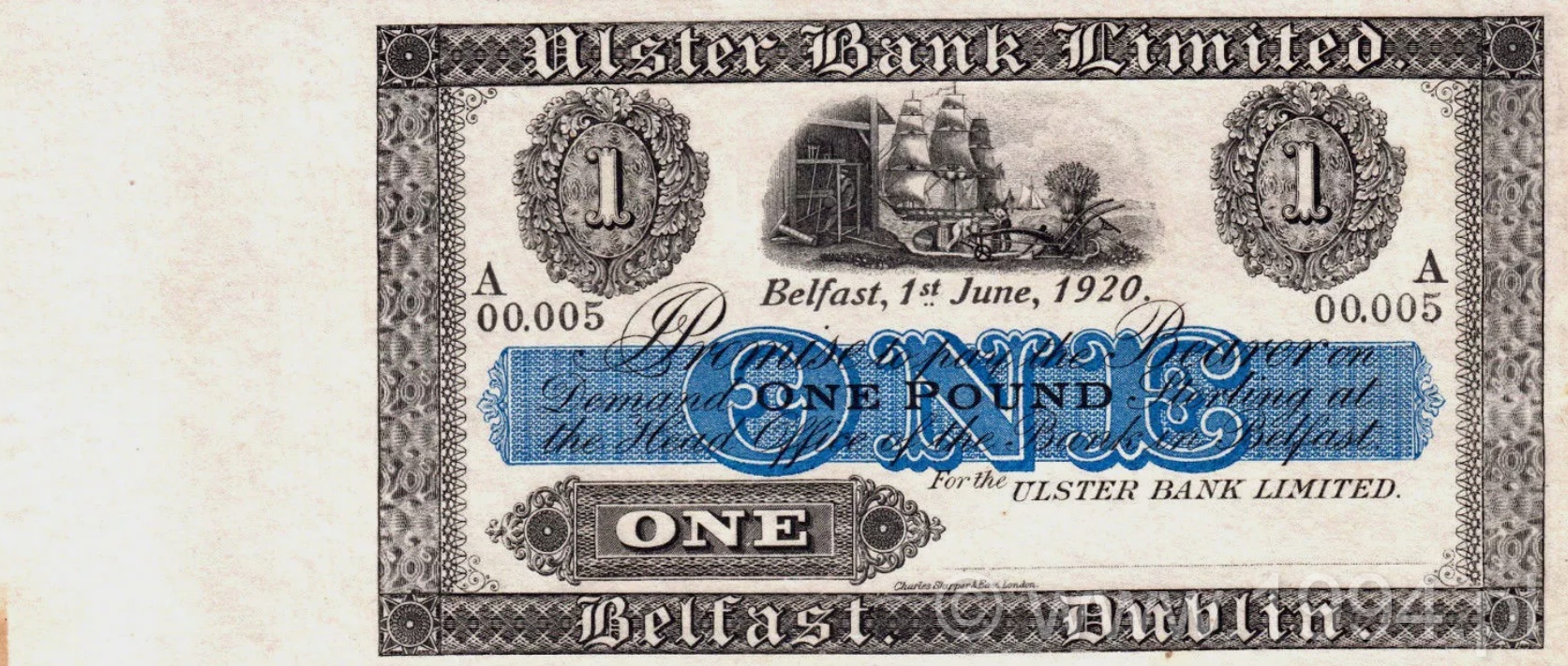
Ireland 1920 Ulster Bank Limited 1 Pound proof, Pick 388p and UB39, serial A 00,005, graded PMG 64 Choice Uncirculated, with blue central denomination panel, maritime vignette, Belfast and Dublin border, and Charles Skipper and East Limited London printer imprint

Ireland 1920 - Ulster Bank Limited 1 Pound Proof (Pick 388p / UB39)

This 1920 Ulster Bank Limited 1 Pound proof is a completed proof-stage example of one of the most visually distinctive private-bank issues from Ireland before partition. Dated Belfast, 1st June 1920, and bearing serial number A 00,005, the note belongs to the Ireland category rather than the later Northern Ireland issue structure. Its PMG classification as Proof, together with the Pick 388p and UB39 references, places it among the specialized archival forms of Ulster Bank Limited's early twentieth-century note production. Read more →

IrelandProof19201 PoundPMG 64 Choice Uncirculated ProofCompleted ProofPrivate Banknote IssueAuthorized Banknote IssueIrish Private BankSerial A 00,0051 PoundUlster BankUlster Bank LimitedBelfastDublinBlue Central Denomination PanelMaritime VignetteSailing ShipDockside SceneCharles Skipper and East LimitedCharles Skipper and East Limited LondonLondon Security PrinterBanknote PrintingSecurity PrintingEngraved ProofPrivate Banknote ProductionProof-stage MaterialPick 388pUB39Irish Banking HistoryPre-partition IrelandPrivate Banknote TraditionCommercial Banknote IssueIrish Financial HistoryEarly Twentieth Century Paper MoneyHistoryIreland1920PMG 64PMG 64 Choice UncirculatedTop PopPopulation 1R9 Extremely RareMuseum Grade
Held
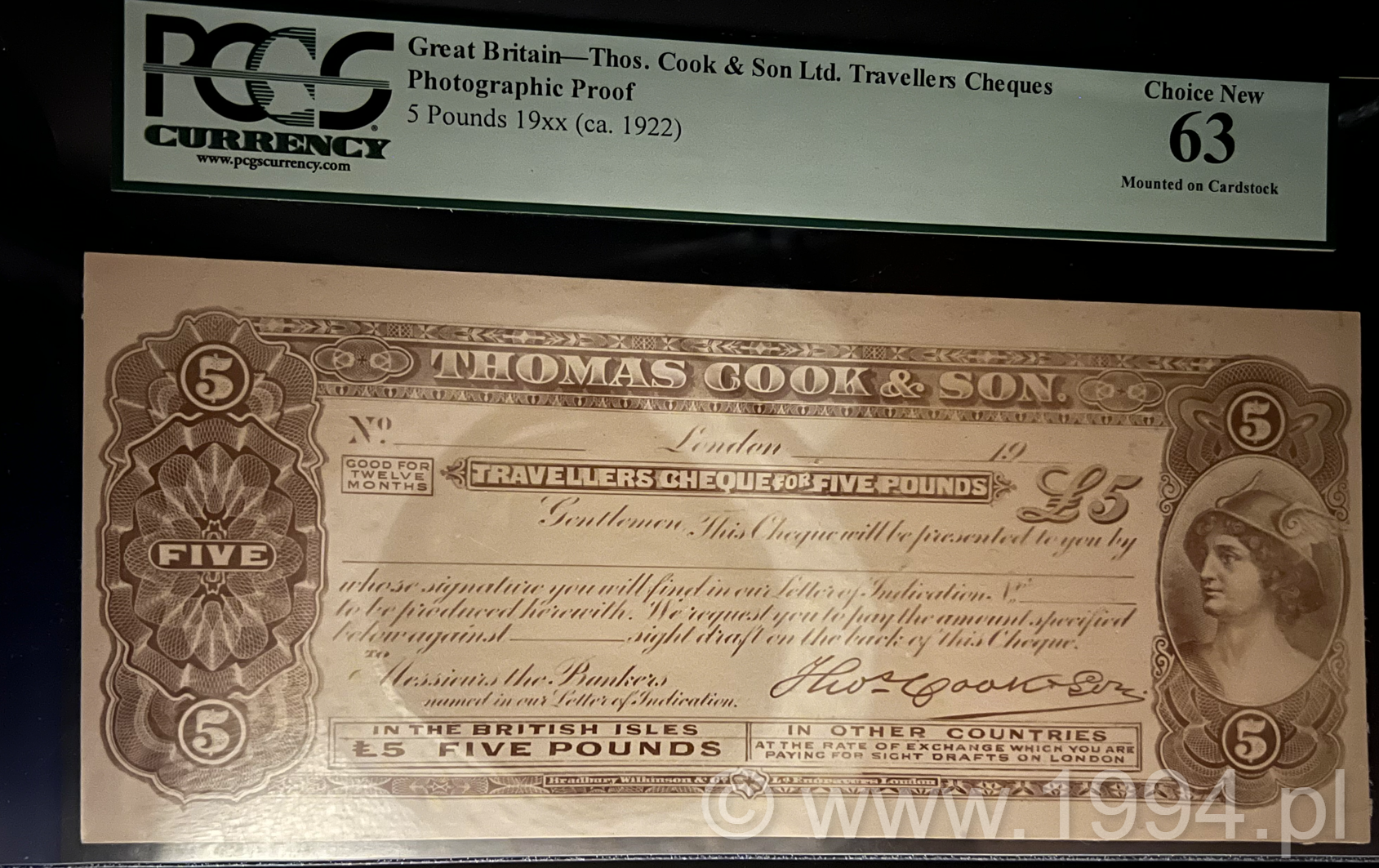
Great Britain ca. 1922 Thomas Cook & Son £5 Travellers Cheque photographic proof mounted on card stock, PCGS 63 Choice New

Great Britain 1922 - Thomas Cook and Son 5 Pounds Travellers Cheque Photographic Proof (Pick Unlisted)

Photographic proof of the 5 Pounds Travellers Cheque prepared for Thomas Cook and Son in the early 1920s, produced during the post First World War consolidation phase of the firm's international payment system. Mounted on cardstock and preserved as a production-stage reference image, this proof records the engraved face before the finalized specimen form was printed for presentation and control use. Read more →

Great BritainPhotographic Proof19225 PoundsPCGS 63 Choice New Photographic Proof5 PoundsTravellers ChequeTravelers CheckPrivate IssuePre Issue Production ProofMounted on Card StockThomas Cook and SonInternational Travel FinancePrivate Payment InstrumentsPost World War One FinanceSecurity PrintingDesign Verification ArtifactProofing ProcessGreat Britain1922Pick UnlistedMuseum GradeR9 Extremely RareUnique
Held
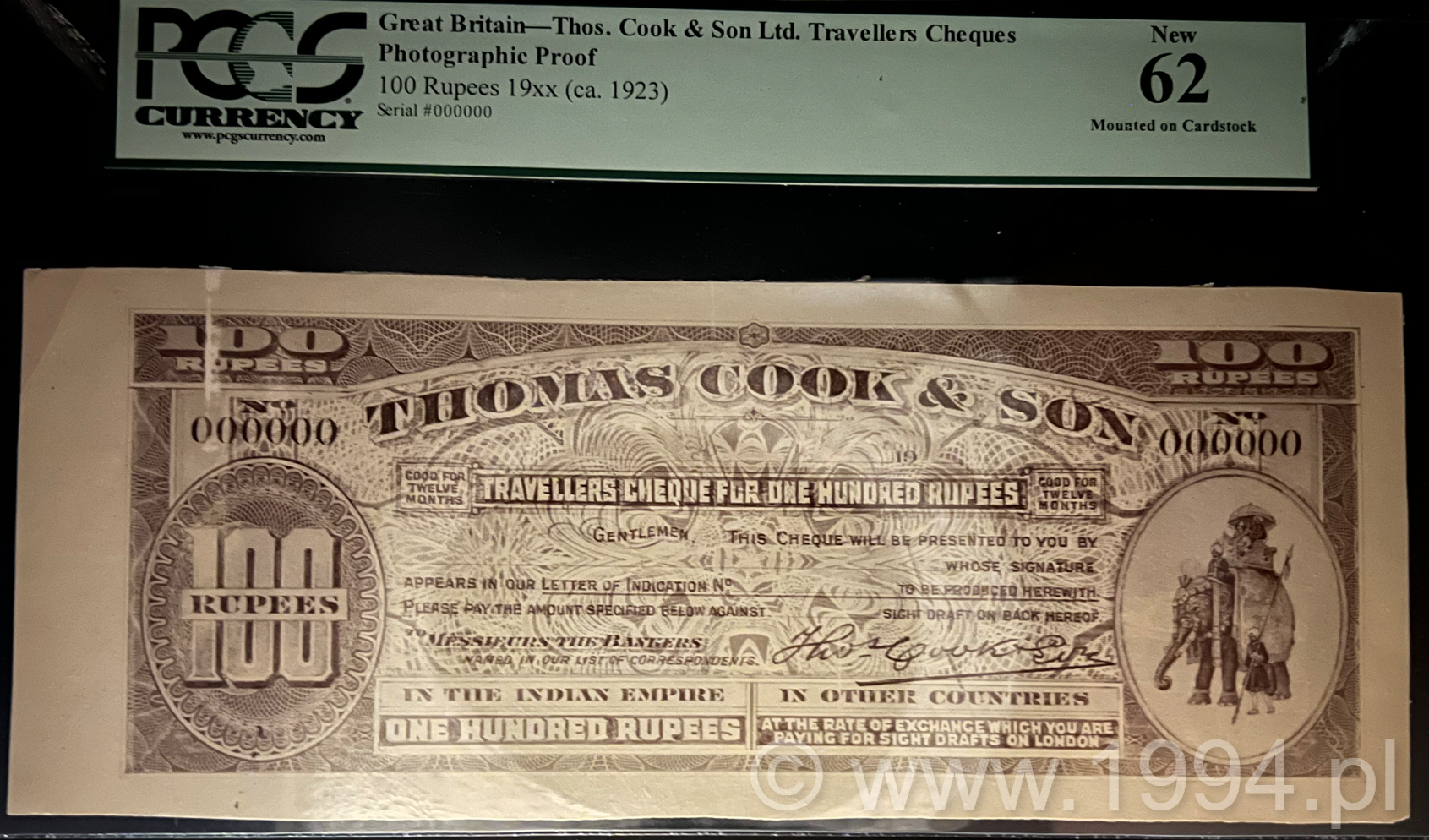
Great Britain ca. 1923 Thomas Cook & Son 100 Rupees Travellers Cheque photographic proof mounted on card stock, PCGS 62 New

Great Britain 1923 - Thomas Cook & Son Travellers Cheque 100 Rupees Photographic Proof (Pick Unlisted)

By the early 1920s, Thomas Cook & Son had fully transitioned from a travel agency into a global financial intermediary, operating one of the most extensive private payment networks in the world. Rupee-denominated travellers cheques were a key component of this system, allowing British and colonial travelers to draw local currency securely without transporting coin or bullion. The 100 Rupees denomination functioned as a high-value instrument within the Indian Empire, suited to extended travel and commercial expenditure. Read more →

Great BritainPhotographic Proof1923100 RupeesPCGS 62 New Photographic ProofTravellers ChequeTravelers CheckPrivate IssuePre Issue Production ProofMounted on Card StockThomas Cook and SonImperial Travel FinanceBritish India Monetary SystemPrivate Payment InstrumentsSecurity PrintingDesign Verification ArtifactProofing ProcessGreat BritainBritish India1923Pick UnlistedMuseum GradeR9 Extremely RareUnique
Held
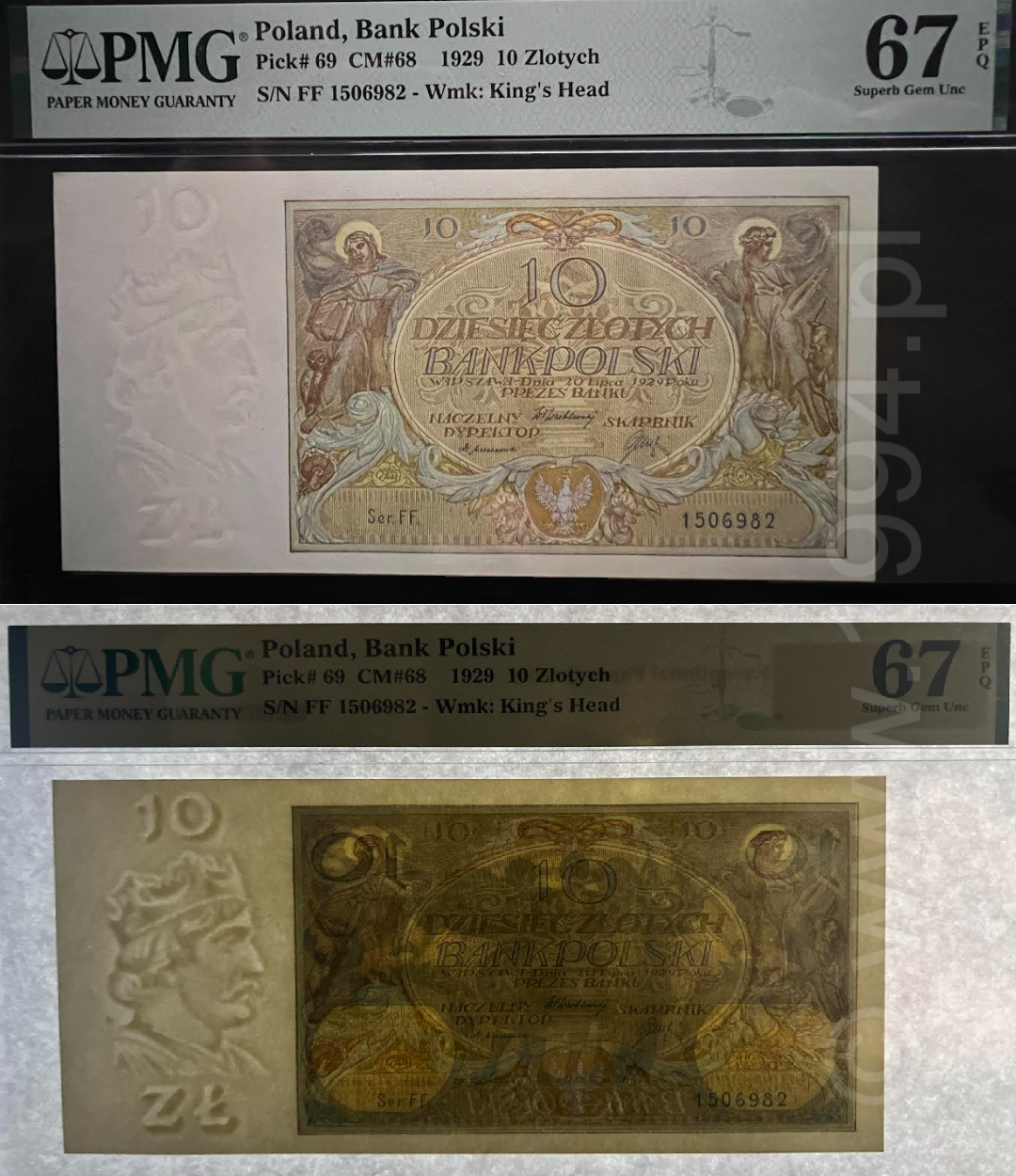
Poland 1929 10 Złotych Bank Polski issue with Bolesław Chrobry multitonal 10 ZŁ watermark, Pick 69, PMG 67 EPQ Superb Gem Uncirculated

Poland 1929 - 10 Zlotych Issued Note Miłczak 68 (Pick 69)

The 10 Złotych dated 20 June 1929 completed Bank Polski’s first modern post-stabilization currency series. Designed in Warsaw and printed by PWPW (Państwowa Wytwórnia Papierów Wartościowych), it brought a balanced Art-Deco neoclassical aesthetic that symbolized the Second Polish Republic’s recovery after early-1920s hyperinflation. Read more →

PolandIssued Note192910 ZłotychPMG 67 EPQ Superb Gem Uncirculated PolandChrobry10 ZŁ watermarkPMG 67 EPQIssued NoteBank PolskiMilczak1929II RPPick 69złotychPMGSuperb Gem10 złotych10 zlotych
Held
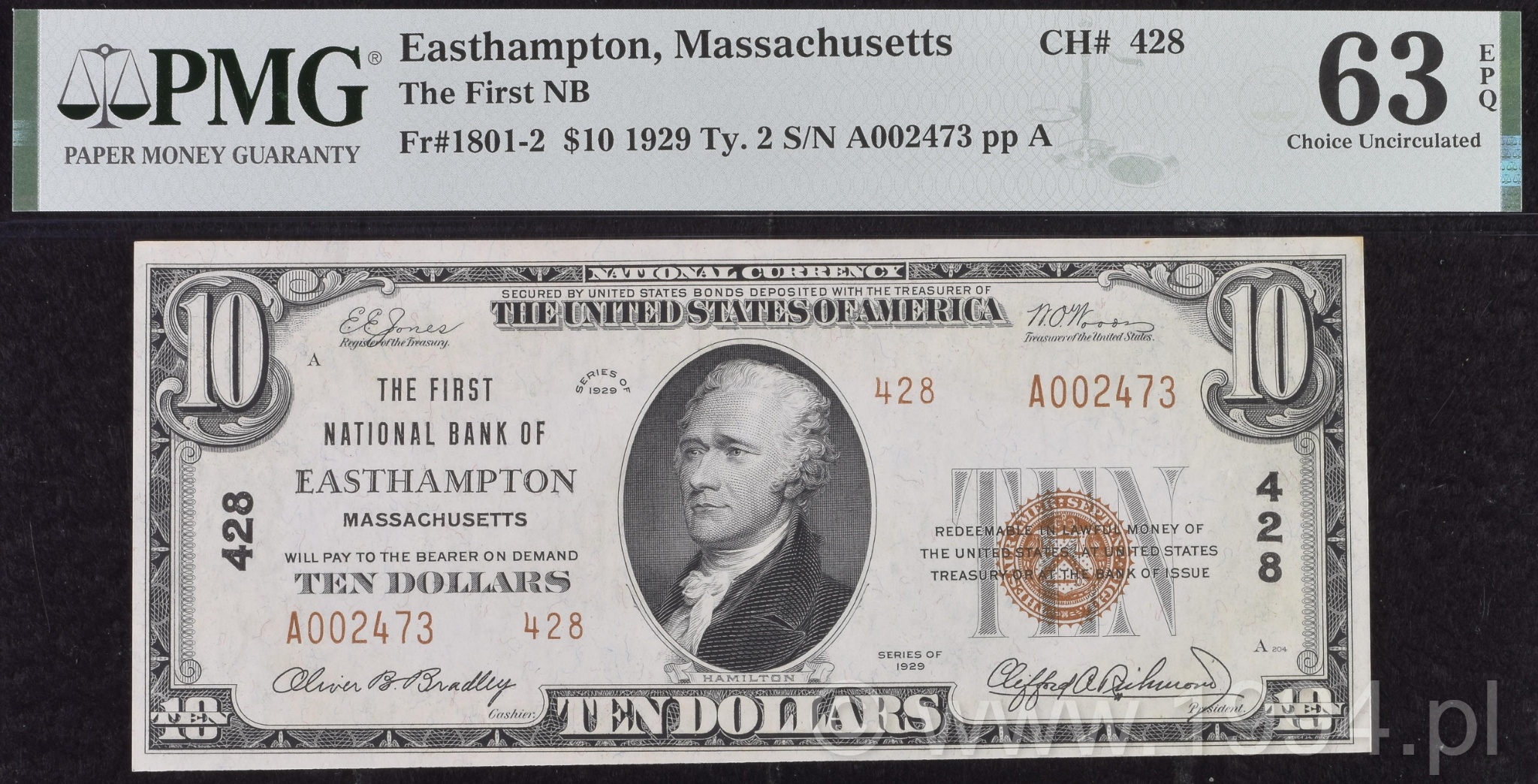
United States 1929 Type 2 - 10 Dollars National Bank Note The First National Bank of Easthampton Massachusetts Fr 1801-2 Chapter 428 PMG 63 EPQ

United States 1929 Type 2 - 10 Dollars National Bank Note - The First National Bank of Easthampton, Massachusetts Charter 428 (Fr. 1801-2)

Through seven decades of operation, the bank was led by a succession of presidents and cashiers who mirrored the town’s development from mill village to regional center: Williston and Horatio G. Knight in the 19th century, then Horace L. Clark and C. A. Richmond into the 1920s. Its resources peaked above 1.5 million dollars by 1929, a remarkable figure for a community of fewer than 10 000 people. The bank continued under its national charter until the mid-1930s, later transitioning into the federally insured system. Read more →

United StatesNational Bank Note192910 DollarsPMG 63 EPQ Choice Uncirculated 10 DollarsNational Bank NoteIssued NoteType 2EasthamptonMassachusettsCharter 428Hamilton1929PMG 63 EPQLocal Banking History
Held
Bradbury, Wilkinson and Company engraved portrait die proof of José Gervasio Artigas, reference 192A, printed on India paper and mounted on card with cancellation notation

Uruguay 1920 - Bradbury, Wilkinson & Company José Gervasio Artigas Engraved Portrait Die Proof (Reference 192A, Cancelled)

Engraved die proofs of this type were pulled directly from the master steel die prior to hardening and were produced in extremely limited numbers. Their purpose was restricted to engraver reference, institutional review, and internal archival recordkeeping. They were never intended for circulation, specimen distribution, or public release. Read more →

UruguayEngraved Portrait Die Proof1920NoneUncertified (archival engraved die proof) Engraved Portrait Die ProofIndia Paper ProofMounted on CardPrinter Archive MaterialJosé Gervasio ArtigasBradbury, Wilkinson and CompanyEarly Twentieth Century Currency DesignBritish Banknote EngravingUruguayan Monetary HistoryState IconographyEngraving Reference MaterialUruguay1920Pick UnlistedR9 Extremely RareMuseum Grade
Held
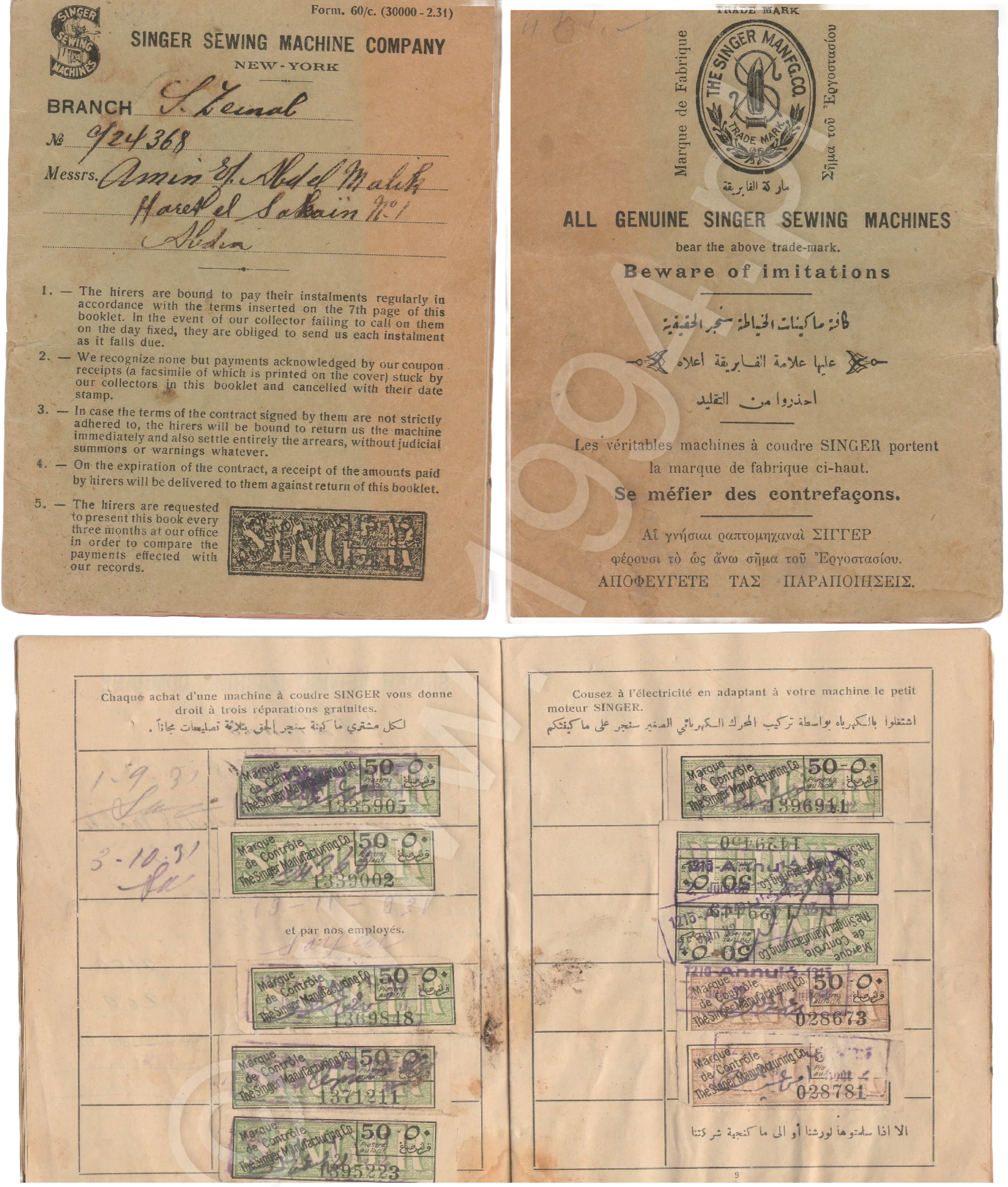
1931 Singer Sewing Machine Company Cairo booklet with tied Singer revenue stamps

Egypt 1931 - Singer Sewing Machine Co. Booklet with Tied Singer Revenues

The booklet also includes Singer’s multilingual advertising and authenticity pages. One page shows the iconic Singer oval trade mark with needle and shuttle, surrounded by text in English, French, Arabic and Greek warning customers to beware of counterfeit machines. Typography varies between serif, sans-serif and compressed styles characteristic of Singer’s international printing division in the 1920s–1930s. The paper tone transitions from light cream on the interior to a slightly darker, more textured card on the covers. Read more →

EgyptCommercial Document1931N/A (Service Booklet with Revenues)Uncertified (VF, Complete Booklet) Commercial DocumentTechnical BookletInstalment Payment SystemSinger Fiscal StampsSinger RevenuesProprietary Revenue StampsCorporate AccountingSewing MachineBusiness History EgyptFiscal HistoryInterwar Consumer GoodsGlobal Trade HistoryMultilingual PrintingCorporate HistoryCommercial Invoice HistorySinger EgyptEgyptCairo1931Museum GradeR6 Extremely RareAnnotationsHandwritten Annotations
Held
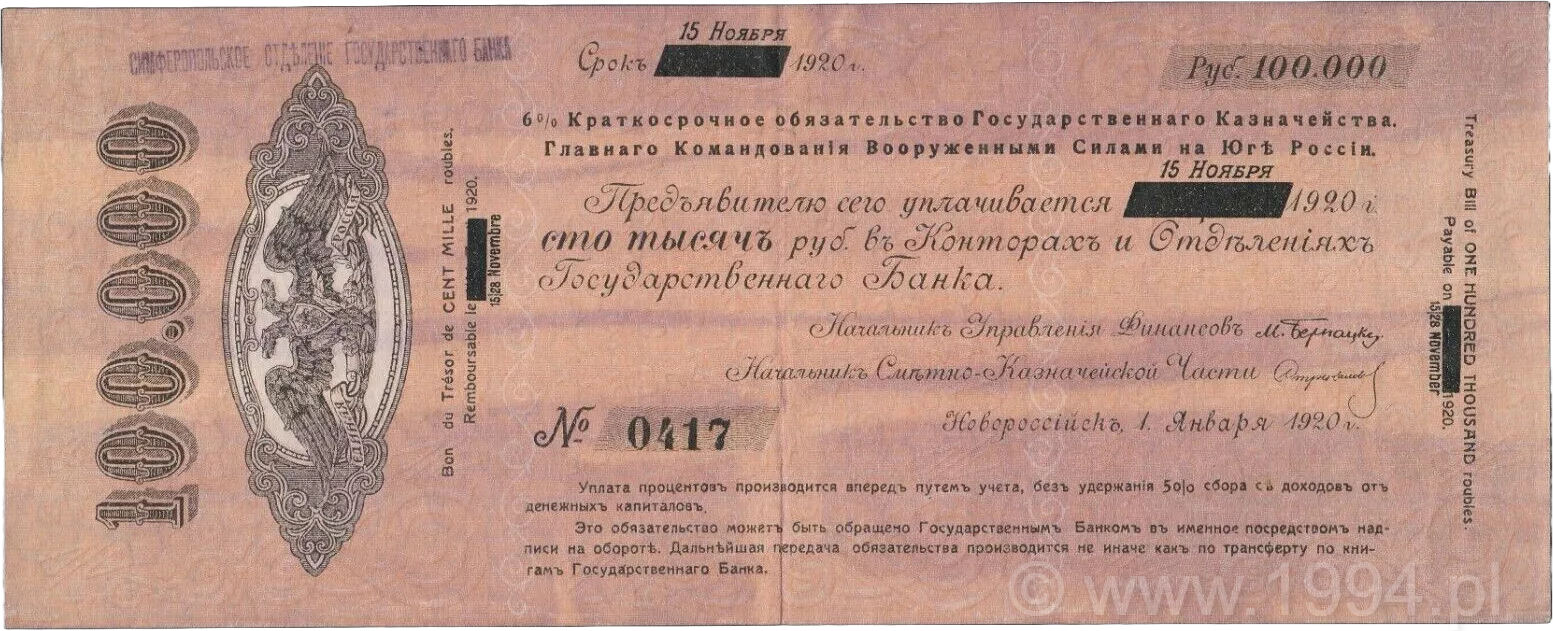
Armed Forces of South Russia 100,000 Rubles Treasury Bill, November 1920 (Pick S431c), Imperial eagle at left

Russia 1920 - Armed Forces of South Russia 100,000 Rubles Treasury Bill (November Issue, Pick S431c)

Six-percent short-term Treasury bill for 100,000 rubles issued by the Government Treasury of the Armed Forces of South Russia during the final phase of the Russian Civil War. This is the November 15, 1920 payable issue (Pick S431c), printed after General Pyotr Wrangel transferred the White administration to Crimea. The note follows the classical Imperial layout: bilingual Russian–French legends, the double-headed eagle in an ornate oval cartouche at left, and a formal typographic bond structure intended to signal continuity with pre-1917 state finance. Read more →

RussiaTreasury Bond Note1920100,000 Rubles- Treasury Bill100000 RublesFiscal DocumentHigh-Value DenominationGovernment ObligationBond IssueImperial EaglePick S431cRussian Civil WarWhite MovementArmed Forces of South RussiaWrangel GovernmentCrimea AdministrationCollapse of White RussiaEmergency FinanceExile Government HistoryTransitional Fiscal SystemsAnti-Bolshevik AdministrationRussiaCrimeaSimferopol1920Museum GradeR6 Extremely Rare
Held
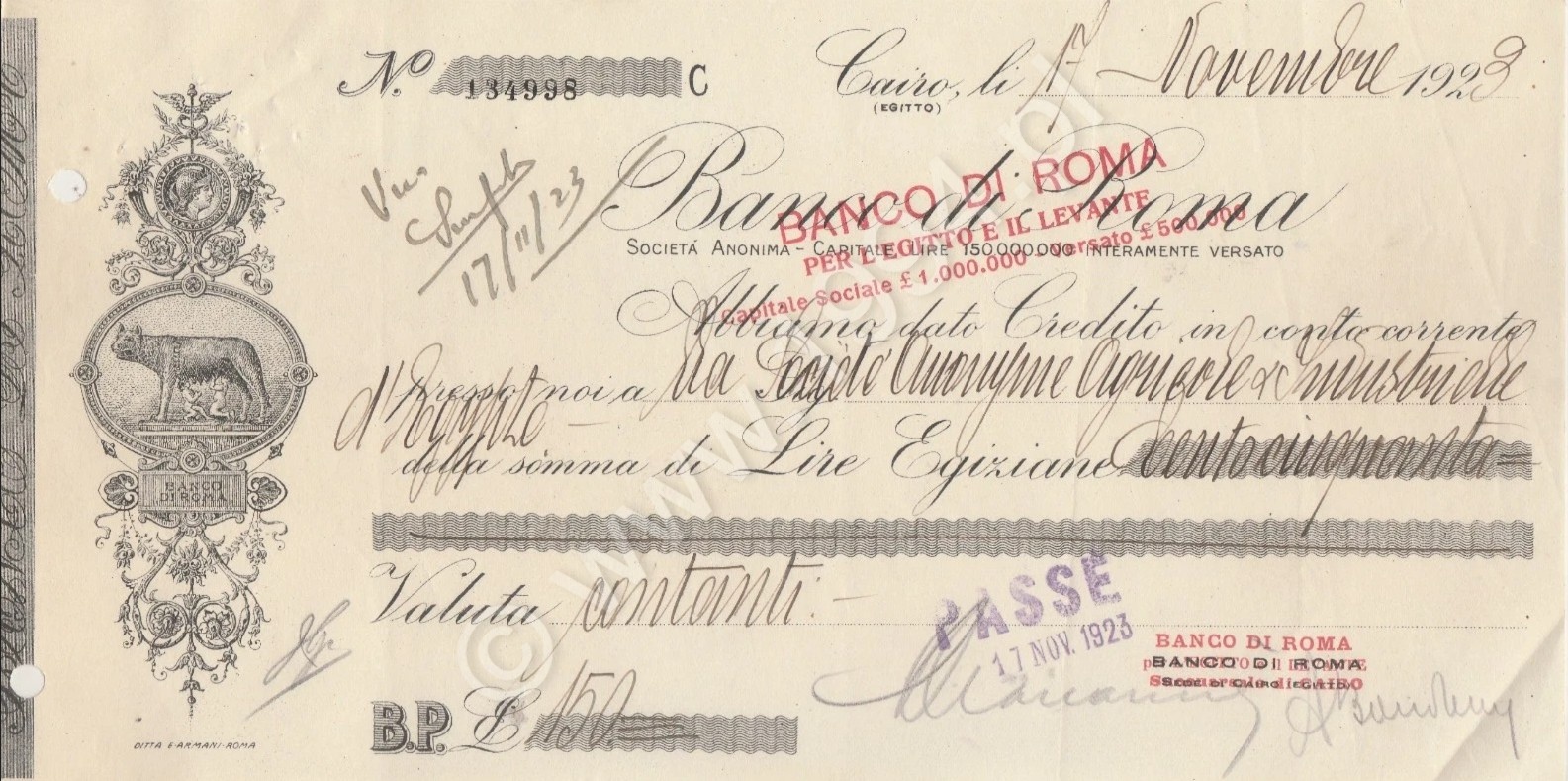
1923 Banco di Roma Cairo issued cheque with Capitoline Wolf emblem and engraved Roman header

Egypt 1923 - Banco di Roma, Cairo Branch Issued Cheque

Banco di Roma played a significant role in the financial and commercial world of interwar Egypt. By the 1910s and 1920s, Italy maintained a broad expatriate community in Alexandria and Cairo, with active merchant houses, construction firms, shipping agents, agricultural exporters, contractors, and artisans. To serve this community and strengthen Italy’s economic footprint in the region, Banco di Roma established branches across the eastern Mediterranean-Alexandria, Cairo, Beirut, Smyrna-acting as both a retail bank and a conduit between Italian capital markets and Near Eastern commerce. Its Cairo branch offered current accounts, trade financing, documentary clearing, foreign exchange services, remittances to Italy, and the management of contractors' payrolls engaged in infrastructure and building projects. Read more →

EgyptFinancial Document1923Cheque (Egyptian Pounds)Uncertified (VF, Strong Impressions) Financial DocumentBanking DocumentIssued ChequeCheque HistorySecurity PrintingEngraved LetterheadItalian BankingBanco di RomaItalian Overseas ExpansionMediterranean FinanceEgyptian Banking HistoryInterwar FinanceForeign Exchange HistoryColonial Era BankingCorrespondent BankingCommercial History EgyptEgyptCairo1923Museum GradeR6 Extremely Rare
Held
↑ Top